Why there are so many positive and negative ions in N and P types?

Click For Summary

Homework Help Overview

The discussion revolves around the characteristics of N-type and P-type semiconductors, specifically focusing on the presence of positive and negative ions in these materials and their behavior in the context of a PN junction under equilibrium.

Discussion Character

  • Conceptual clarification, Assumption checking

Approaches and Questions Raised

  • Participants explore the nature of ions in N-type and P-type semiconductors, questioning why these ions are present outside the depletion region. There is also a discussion about the relationship between electrons and positive ions in N-type semiconductors.

Discussion Status

The conversation includes various perspectives on the neutrality of P-type and N-type regions and the movement of charge carriers. Some participants provide insights into the behavior of impurities and their role in creating charge carriers, while others seek clarification on terminology and concepts.

Contextual Notes

Participants note the concentration of doping atoms relative to silicon atoms and discuss the implications of this in the context of charge carrier movement and the formation of the depletion region.

anhnha
Messages
179
Reaction score
1
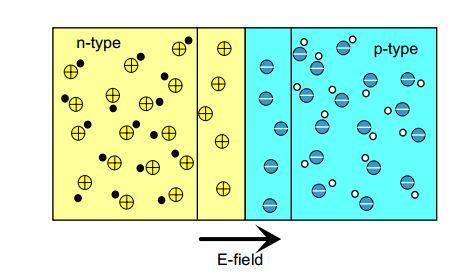
The image bellow is the PN junction under equilibrium.
I wonder why there are so many positive and negative ions in N and P types respectively.
For me, I think that these ions should only exist in the depeletion region not outside the region.
attachment.php?attachmentid=59368&stc=1&d=1370674622.jpg

Thanks for help.
 

Attachments

  • PN junction in equilibrium.JPG
    PN junction in equilibrium.JPG
    17.4 KB · Views: 614
Physics news on Phys.org
Do you know what we call n type and p type semiconductor?

ehild
 
ehild said:
Do you know what we call n type and p type semiconductor?

ehild

Yes, I do.
I have just watched it carefully now I see. For example in N type right next to each positive ion is an electron.
I know that the electron and positive ion are separated but I usually consider that they is an unit beacuse its net charge still zero.
 
The p and n type regions are neutral, but the electrons and holes are free to move in the whole crystal, like the conduction electrons in a metal. The pure (intrinsic) semiconductor has only few free charge carriers, as the forbidden band, the gap between valence and conduction band is broader than the thermal energy. But adding impurity atoms which have one electron more than the host atoms (for example phosphorus in silicon) these extra electrons are very loosely connected to their atoms and the thermal energy (kT) is enough to remove them from the atom. We say that the impurities make a donor level just under the conduction band. Similarly, atoms less than one electron than silicon capture an electron from an other atom, so the "hole", the place of the missing electron moves as free positive charge carrier in the crystal. The number of doping atoms can be about 1015-1020 atoms/cm3, so they are not so many with respect to the silicon atoms.

In the depletion region, the free carriers move to the other side of the junction by diffusion, electrons to the p part and holes to the n part, leaving the ions alone. The depletion region is free from free carriers, but the concentration of the ions is the same as in the bulk of the semiconductor.

ehild
 
  • Like
Likes   Reactions: 1 person

Similar threads

Replies
13
Views
6K
  • · Replies 18 ·
Replies
18
Views
3K
  • · Replies 1 ·
Replies
1
Views
2K
  • · Replies 22 ·
Replies
22
Views
4K
  • · Replies 30 ·
2
Replies
30
Views
8K
  • · Replies 6 ·
Replies
6
Views
2K
  • · Replies 5 ·
Replies
5
Views
3K
  • · Replies 4 ·
Replies
4
Views
4K
  • · Replies 2 ·
Replies
2
Views
2K
  • · Replies 3 ·
Replies
3
Views
9K