Why Use Constant Volume for This Adiabatic Equation?

  • Context: Undergrad 
  • Thread starter Thread starter abdossamad2003
  • Start date Start date
  • Tags Tags
    Adiabatic equation
Join the discussion
Registration is free. Ask a follow-up in this thread, or start your own.
7 replies · 3K views
abdossamad2003
Messages
68
Reaction score
4
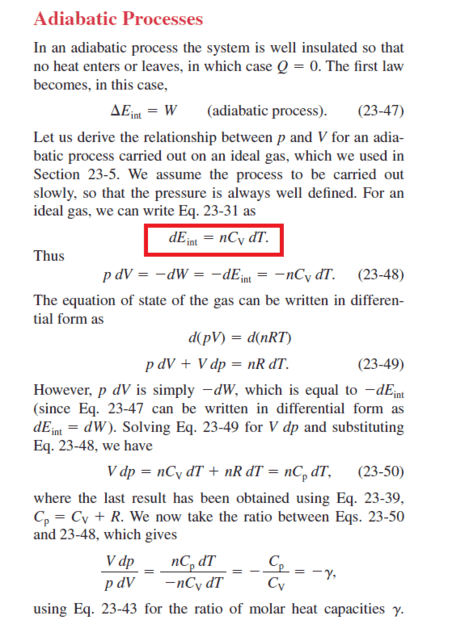
Why is this equation (red sign) written in constant volume and not in constant pressure?
Screenshot 2023-11-07 20.46.13.png
 
Physics news on Phys.org
Because this is what counts for the internal energy of the gas.
 
I was not convinced why internal energy should be written for heat capacity in constant volume. This process does not take place in constant volume, and if it is in constant volume, the change in internal energy must be zero.
 
The work is done on the adiabatic system, that is, it is not in constant volume, in my opinion, constant pressure seems more reasonable
 
The effect of volume on the internal energy is meaningful only in diabatic processes, for example, when heat is added to the system at a constant volume and the internal energy increases, but in adiabatic processes, when the volume is constant, the work done on the system is zero and the incoming heat is zero, as a result of the change in energy Internal is zero.
 
abdossamad2003 said:
The effect of volume on the internal energy is meaningful only in diabatic processes, for example, when heat is added to the system at a constant volume and the internal energy increases, but in adiabatic processes, when the volume is constant, the work done on the system is zero and the incoming heat is zero, as a result of the change in energy Internal is zero.
This is totally incorrect. Irrespective of the process, the internal energy of an ideal gas depends only on temperature, and not volume.
 
Last edited:
abdossamad2003 said:
I was not convinced why internal energy should be written for heat capacity in constant volume. This process does not take place in constant volume, and if it is in constant volume, the change in internal energy must be zero.
See, e.g., here: https://en.wikipedia.org/wiki/Internal_energy#Internal_energy_of_the_ideal_gas. ##C_V## is the coefficient of proportionality between internal energy on one hand and number of moles and temperature of the gas on the other hand.