tomtomtom1
- 160
- 8
- TL;DR
- Why Use The Parallel Axis Theorem For With Second Moment of AREA???
Hi all
I was wondering if someone could help clear up some confusion about the Parallel Axis Theorem.
I am trying to understand the purpose/benefit of applying the Parallel Axis Theorem with respect too the Second Moment Of Area.
For example I have a beam that is under load.
I have found its centroid axis from which i can calculate the second moment of area about the x-axis (using the equation bh^3/12) which would tell me the resistance to bending in about the X axis.
Now if i use the Parallel Axis Theorem to calculate the second moment of area from the base of my shape which is a distance d below the neutral axis then what does that tell me? how does this help me?
Below is a sketch of my thinking?
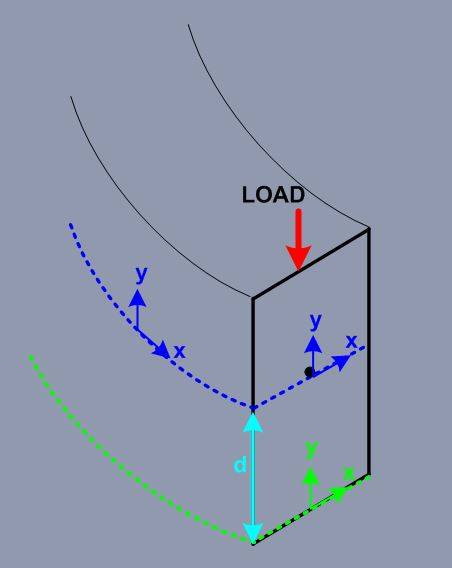 I am struggling to understand why taking the second moment of area from somewhere other than the neutral axis helps in anyway.
I know it helps with Second Moment Of Mass but i just want to get my head around applying the Parallel Axis Theorem to Second Moment of Area for now.
Does this make sense?
I was wondering if someone could help clear up some confusion about the Parallel Axis Theorem.
I am trying to understand the purpose/benefit of applying the Parallel Axis Theorem with respect too the Second Moment Of Area.
For example I have a beam that is under load.
I have found its centroid axis from which i can calculate the second moment of area about the x-axis (using the equation bh^3/12) which would tell me the resistance to bending in about the X axis.
Now if i use the Parallel Axis Theorem to calculate the second moment of area from the base of my shape which is a distance d below the neutral axis then what does that tell me? how does this help me?
Below is a sketch of my thinking?
I know it helps with Second Moment Of Mass but i just want to get my head around applying the Parallel Axis Theorem to Second Moment of Area for now.
Does this make sense?