Why would sailboat racers prefer a full keel over a fin keel?

  • Context: High School 
  • Thread starter Thread starter DaveC426913
  • Start date Start date
DaveC426913
Gold Member
2025 Award
Messages
24,544
Reaction score
8,848
TL;DR
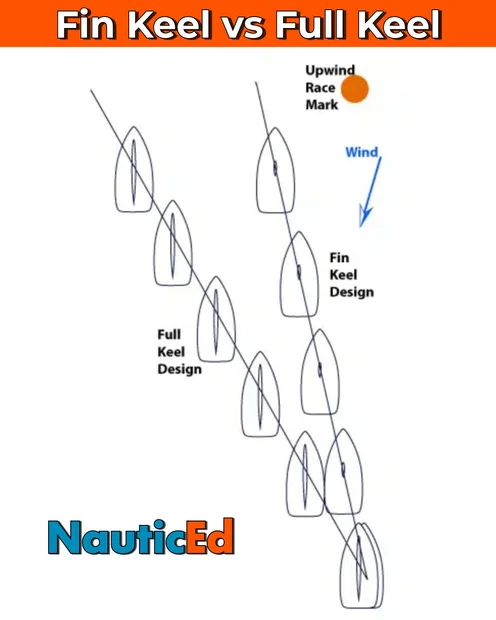
Fin keels are apparently *less* prone to leeway. Why?
I keep going back and forth on this. Apparently, fin keels are better (and preferred) than full keels for racing because they
1] are faster (less drag), and
2] can point higher, and finally
3] are apparently less prone to leeway?

1779731278257.webp


I first thought well sure that huge full keel would more easily be pushed off to leeward by the water, but duh - why would there be any pressure from the water pushing the keel to leeward? The boat is being pushed to leeward by the sails; the job of the keel is to prevent that and keep it on track. Ergo, a full keel would track better toward a mark because of its lesser leeway.
 
Physics news on Phys.org
Could you post some pictures or links or something about those 2 kinds of keels? Thanks.
 
Think of a fin keel more like an airplane wing. It generates lift in exactly the same way. So to some extent it isn't just resisting drift to leeward but pulling the boat to windward. Fins make more efficient lifting devices. So, "why do airplanes have long wings?" is a similar question. Lift vs. drag and weight favors long wings.

Of course there are other practical matters to consider, like draft, ruggedness, cost etc.

PS: There's also an advantage of having the weight lower to allow more force on the sails with deep keels, hence the keel bulbs that you see on modern racing boats. Also sometimes wings at the bottom to generate this righting force as well as improve efficiency (just like the winglets at the tip of modern airplane wings).
 
Last edited:
berkeman said:
Could you post some pictures or links or something about those 2 kinds of keels? Thanks.
Full/reef is long, fin is short (longitudinally - i.e. front-to-back).

The fin keel is not necessarily deeper than the full/reef keel:
1779747934467.webp


Both have zero camber (i.e. symmetrical), of course, since they need to work on both tacks.

They generate lift that opposes the force of wind. That's what keeps the boat on-track.
 
The full keel prevents quick changes in direction when the rudder is moved, and forces the boat to travel closer to the line of the hull. In effect the full keel is a single vertical axis foil, with the camber adjusted by the rudder position. The headsail-mainsail imbalance is important when changing direction.

A fin keel, with the rudder, makes for more dynamic control of the hull direction through the water, so some deliberate sideways motion in the water can be generated, that keeps the boat and sails more upright. In effect the fin keel, with the rudder gives two separated vertical-axis foils, giving more turning torque. The fin keel allows for rapid turns, with little loss of hull speed through the water.

The full keel is like a delta wing aircraft, while the fin keel is more like the typical aircraft configuration, with more control of the attitude, and the angle of attack of the wings.
 
  • Informative
Likes   Reactions: berkeman
Thats an excellent analysis, Bal, especially the delta wing concept. But does it answer the primary question? Why would a full keel be prone to leeway?
 
DaveC426913 said:
Apparently, fin keels ...
3] are apparently less prone to leeway?
Do you have a reliable reference for this? Most importantly: What parameters are held constant in this comparison?
 
Maybe first consider the function of a fin (or centreboard on a small craft). The sail is a aerofoil in the wind and a fin is an aerofoil in the water. The wind force on the sail may be resolved into two components: one in the forward direction, causing propulsion, and the other at right angles, causing leeway or sideways movement. To counter leeway we use the fin or keel to provide lift. This is a force acting at right angles to the forward motion and opposing leeway. To produce lift the fin must have an angle of attack. Although the boat is steering along its desired heading, where it points, it actually travels on a path that is a few degrees to leeward. This is so that the fin has an angle of attack sufficient to counter the sideways force developed by the sails. We can say that the leeway angle is equal to the angle of attack of the fin. Also notice that the fin, like the wing of an aeroplane, works in conjunction with the rudder to maintain the desired heading (the pitch angle for an aercraft).
The long keel is less efficient as an aerofoil, but has large area and also provides large directional (steering) stability, particularly in heavy weather, and it is less vulnerable to damage. It also provides somewhere to locate heavy weight to provide stability. In heavy weather the long keel provides stability to allow the boat to either lie a'hull, with sails dropped, or to heave-to, the sails being set to oppose each other. Both these manoeuvres allow the boat almost to stop and to ride big waves and strong winds without intervention by the crew.
As a fin is a better aerofoil than a long keel, I think we will find it provides the least leeway, so would be suitable for inshore racing, but may not be the choice for heavy weather.
 
  • Agree
Likes   Reactions: DaveE
tech99 said:
The sail is a aerofoil in the wind and a fin is an aerofoil in the water.
The correct term for a submerged wing is a hydrofoil.
 
  • #10
A.T. said:
Do you have a reliable reference for this? Most importantly: What parameters are held constant in this comparison?
Yeah, I mean, I guess that's part of the problem. Sailors are notorious for relying on unwritten lore and "sea smarts", so it's particularly difficult to find much in the way of fact-based information. If you ask, you'll be told "centuries of experts say so".
 
  • #11
DaveC426913 said:
Yeah, I mean, I guess that's part of the problem. Sailors are notorious for relying on unwritten lore and "sea smarts", so it's particularly difficult to find much in the way of fact-based information. If you ask, you'll be told "centuries of experts say so".
Yes, but the information is out there. It's not that hard to find, but it is hard to understand. Fluid dynamics is a complex subject. Sailors want easy answers, but it's just not an easy subject.

You can start with this:
1779825478027.webp
 
  • Informative
Likes   Reactions: berkeman
  • #12
DaveC426913 said:
it's particularly difficult to find much in the way of fact-based information
You could have at least provided the link to the article you got that image from:
https://sailing-blog.nauticed.org/fin-keel-versus-a-full-keel-efficiency/

The key part of the argument seems to be:
https://sailing-blog.nauticed.org/fin-keel-versus-a-full-keel-efficiency said:
A fin keel is simply more efficient at pushing back against the wind. More efficient means it needs less of a leeway angle to push back against the wind.
My interpretation of this: For thinner foils (fin keel) the maximal lift/drag ratio occurs at a smaller angle of attack (leeway angle). See also:
https://www.researchgate.net/figure...-various-relative-thickness-RT_fig4_270079717

DaveC426913 said:
Fin keels are apparently *less* prone to leeway. Why?
It's not so much "it is less prone to leeway", but more like "it has its best efficiency at a smaller leeway angle".

In general terms, what matters for the boat performance are the maximal lift/drag ratios (at the water and at the air), regardless at what angles of attack they occur:
https://www.onemetre.net//design/CourseTheorem/CourseTheorem.htm
 
Last edited:
  • Like
Likes   Reactions: Nik_2213
  • #13
IIRC, a long keel is inherently robust, and provides excellent lateral stability, making it easier to hold a course, so preferred for 'passage' and cruising. Twin keels / skegs let you 'take the ground' without steep heeling or stilts. And a smaller routine or 'emergency' rudder may suffice.

A Fin keel is more nimble, suits zig-zag races. The longer lever-arm provides mechanical advantage. But, it takes a *lot* of strain at fin/hull join. If craft is 'knocked down' during squall or storm, it risks breakage. Being dis-masted is bad, but rather more survivable than losing fin / bulb keel. Also, craft depth is considerable, so must shun shoaling waters. Course control may require rather larger rudder than long keel...

Compare hull-form of life-boats and their working-boat ancestors: What endures 'In Extremis' ??
 
  • #14
A.T. said:
You could have at least provided the link to the article you got that image from:
(I didn't get the image from an article , but OK.)
 
  • #15
Nik_2213 said:
IIRC, a long keel is inherently robust, and provides excellent lateral stability, making it easier to hold a course, so preferred for 'passage' and cruising. Twin keels / skegs let you 'take the ground' without steep heeling or stilts. And a smaller routine or 'emergency' rudder may suffice.

A Fin keel is more nimble, suits zig-zag races. The longer lever-arm provides mechanical advantage. But, it takes a *lot* of strain at fin/hull join. If craft is 'knocked down' during squall or storm, it risks breakage. Being dis-masted is bad, but rather more survivable than losing fin / bulb keel. Also, craft depth is considerable, so must shun shoaling waters. Course control may require rather larger rudder than long keel...

Compare hull-form of life-boats and their working-boat ancestors: What endures 'In Extremis' ??
No argument fin feels being nore nimble overall. This question is specifically about why full keels would suffer greater leeway.
 
  • #16
DaveC426913 said:
Yeah, I mean, I guess that's part of the problem. Sailors are notorious for relying on unwritten lore and "sea smarts", so it's particularly difficult to find much in the way of fact-based information. If you ask, you'll be told "centuries of experts say so".
This reminds me of a similar story about the old 12 meter America's Cup yachts. A classic yacht designer designed a hull with a fine bow and rounded stern for the race. The yacht club hired a Caltech physicist*, who did aerodynamic work among other things, to help. He said it looked like a raindrop falling up (sort of) and showed that it was faster in tank testing when going backwards than forwards.

* Francis H. Clauser, "The Boat That Almost Was"

Current generations of America's Cup yachts don't have this "eminence based design" problem anymore. Part of the reason they are so expensive is that they hire teams of designers with physical science and computer simulation backgrounds instead of the guys that make pretty boats for rich people.
 
Last edited:
  • #17
DaveE said:
This reminds me of a similar story about the old 12 meter America's Cup yachts. A classic yacht designer designed a hull with a fine bow and rounded stern for the race. The yacht club hired a Caltech physicist* who did aerodynamic work among other things to help. He said it looked like a raindrop falling up (sort of) and showed that it was faster in tank testing when going backwards than forwards.

* Francis H. Clauser, "The Boat That Almost Was"

Current generations of America's Cup yachts don't have this "eminence based design" problem anymore. Part of the reason they are so expensive is that they teams of designers with physical science and computer simulation backgrounds instead of the guys that makes pretty boats for rich people.
Sure, so which keel do they choose? To my eye, their millon dollar keels are shaped like hyper surfaces or Klein bottles, amirite?
 
  • #18
DaveC426913 said:
I didn't get the image from an article
Then you can do a reverse image search to read the full context.

DaveC426913 said:
... full keels would suffer greater leeway.
I don't think this is a good way to phrase it. See post #12.

DaveC426913 said:
Sure, so which keel do they choose?
See the last part of post #12
 
  • #19
May I mention again that the leeway angle is equal to the angle of attack of the keel. It is important that the area of the foil is great enough so that the angle of attack at which it operates is small, such as 5 degrees. At small angles the cross section of the foil is not so important because even a flat plate will not stall at such small angles and may have less drag than a thick cross section.
 
  • #20
While it does depend on the race and the conditions, there are two hull shapes that consistently do well in the annual Sydney to Hobart race. Neither is a traditional hull with a long keel, both now employ a fin that can be canted sideways to move the underwater ballasted fin to the upwind side.

The first is a wide but shallow boat with the width extending to the wide square stern, sometimes described as an aircraft carrier. The wind causes the upwind side of the hull to lift, which reduces the wetted area. Since the side that drops is downwind, and further from the centreline, that increases the length and the torque that counters the force of the wind on the sails.

The second form is a cigar shape, long and thin. Under normal conditions, that reduces wave drag, while in light conditions it reduces wetted area, compared to the aircraft carrier.

The hull style that wins the race, aircraft carrier or cigar, will depend on the wind and sea conditions that year. The traditional long keel hulls will arrive later, after having taken part in a relatively comfortable race.
 
  • #21
DaveC426913 said:
No argument fin feels being nore nimble overall. This question is specifically about why full keels would suffer greater leeway.

Different posts here have provided parts of the answer, I'll attempt a summary for this specific question:

In order to offset the heeling moment generated by the wind on the sails, the keel must generate a given amount of lift. At sailing boat speeds, high aspect foils (like a glider's wings) generate more lift at lower angles of attack than low aspect foils (like a delta wing designed for supersonic flight). In a sailing boat, the angle of attack is the same as leeway.

Yacht design (and engineering generally) is always about compromise, choosing the right balance of compromise to suit the intended use. One boat builder's explanation of the compromises related to keel design is at https://www.rustleryachts.com/keel-design-explained/
 
  • Like
Likes   Reactions: DaveE and DaveC426913
  • #22
@DaveC426913 is hardcore with anything that involves water and (marine) animals. How does "flying boats" fit in? I've always thought they were a technical wonder.
 
  • Haha
Likes   Reactions: DaveC426913
  • #23
sbrothy said:
@DaveC426913 is hardcore with anything that involves water and (marine) animals. How does "flying boats" fit in? I've always thought they were a technical wonder.
They have a "meat" keel. :oldbiggrin:

1779908605514.webp
 
  • #24
sbrothy said:
How does "flying boats" fit in?
Which ones?

960px-Boeing_314_Clipper-cropped.webp
Screen-Shot-2017-05-09-at-13.20.05.webp
 
  • Like
Likes   Reactions: DaveC426913

Similar threads

  • · Replies 3 ·
Replies
3
Views
2K
  • · Replies 27 ·
Replies
27
Views
11K