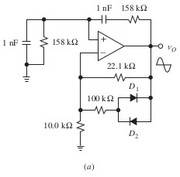
I have the same trouble with Wein bridges. They need something to keep amplitude stable , usually a voltage dependent component like an incandescent lamp.
IMHO the approach is to realize they're a feedback system and it's operating right on the cusp of (in)stability.
To your question about ciphering amplitude,
i'd bite the bullet and admit the math will run away from me
then take a low-tech look at the circuit.
How does feedback work ?
A fraction of output gets applied to both of the opamp's inputs,
and that fraction
must be same for both inputs . There's the key...
A quick glance at the upper voltage divider circuit for +input suggests to me that fraction is 1/3 at 1 hzEDIT oops, 1khz... (I didn't calculate , so correct me if I'm wrong i just want to demonstrate an approach here.)
Now take a look at lower feedback voltage divider:
If 1/3Vo is to appear across that 10K resistor,
then in order to drop 2/3Vo , the two resistor & two diode part of that divider must appear to be 20K.
So, what resistance in parallel with 22.1K would make 20K ? Answer = 210K .
Therefore, the combination of those diodes and the 100K must look like 210 K.
How does that 2/3 Vo divide across the 210K of resistor and diodes ?
100/210 = 48% across the resistor, leaving 52% across the diodes. Again it's nonlinear but we're estimating here so just call it a 50/50 split.
That means ~1/3 Vo appears across the resistor and ~1/3Vo appears across the diodes.
1/3 Vo across the diodes?
That tells me Vo at peak (when negative feedback turns the output around) should be in the neighborhood of 3X a diode drop ,
if i guess a diode drop is in the range of 0.5 to 0.7 volts around its knee
i get 1.5 to 2.1 volts for Vo at peak.
Does that 'poor man's' approach skin the cat ?
Was your 2 volt number measured or from a simulation ?
old jimEDIT OOPS!
I just noticed your capacitor is 1 nf not 1uf so my frequency is off by three decades. 1khz not 1hz.
Sorry about that. I had been working from the smaller schematic . My bad.
Approach doesn't change though.
.