Discussion Overview
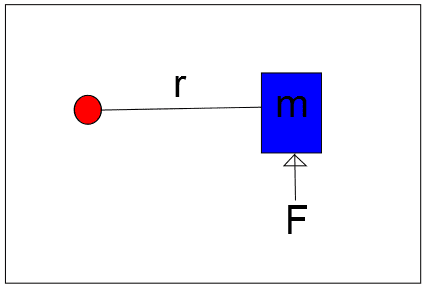
The discussion centers on whether a jet-powered rigid link system, with a mass at the end, will reach a steady state characterized by constant angular velocity or if angular acceleration will continue to increase indefinitely. The scope includes theoretical considerations and potential real-world implications, such as the effects of air resistance.
Discussion Character
- Exploratory, Technical explanation, Debate/contested
Main Points Raised
- One participant questions if the system will reach a steady state with constant angular velocity or if angular acceleration will keep increasing.
- Another participant draws an analogy to a falling rock, noting that gravitational force is constant, but air resistance leads to terminal velocity, suggesting a similar outcome may occur in the jet-powered system.
- A third participant clarifies that if air resistance and friction are ignored, angular acceleration will remain constant, leading to an unbounded increase in angular velocity until failure occurs.
- This participant also suggests that with air resistance considered, the system might reach a steady state where the forces balance, similar to terminal velocity.
- The original poster mentions running a simulation that showed the system reaching a steady state after an initial increase in velocity, which raises questions about the assumptions made in the theoretical discussion.
Areas of Agreement / Disagreement
Participants express differing views on whether the system will reach a steady state, with some suggesting it will under certain conditions (like air resistance), while others maintain that without those factors, acceleration will continue indefinitely. The discussion remains unresolved regarding the implications of the simulation results.
Contextual Notes
The discussion highlights the dependence on assumptions such as the neglect of air resistance and friction, as well as the potential for different outcomes based on varying conditions. The simulation results introduce additional complexity that is not fully reconciled with the theoretical arguments.