Will the bleed resistors enable a shorter path to ground or not?
- Thread starter checkmatescott
- Start date
Join the discussion
Registration is free. Start your own thread to ask a follow-up.
80 replies · 7K views
Engineering news on Phys.org
checkmatescott
- 80
- 2
ok I have spice, does it have IC's integrated in/with the software?
checkmatescott
- 80
- 2
why skeptical?checkmatescott said:to be honest I kind of need spoon feeding a little bit to get me through this next part of my project
checkmatescott
- 80
- 2
the mechanical flywheel in my case is equivalent to a low-pass-filter in electrical terms dunno if you've ever come accross maybe you might find the different analogys of some interest https://lpsa.swarthmore.edu/Analogs/ElectricalMechanicalAnalogs.html
checkmatescott
- 80
- 2
anyway that software is EPIC, I can't thank you enough
Science Advisor
Gold Member
2025 Award
- 4,604
- 4,325
Read the online instructions. Less typing, more study. In our service/support department the favorite acronym was RTFM; which BTW, you would never say to a customer.checkmatescott said:ok I have spice, does it have IC's integrated in/with the software?
But, yes some. IC manufacturers will often give you spice models. But that only works for people that can search the web and find answers themselves.
Science Advisor
Gold Member
2025 Award
- 4,604
- 4,325
TonyStewart
- 306
- 132
Do not trust a simple schematic unless you know the credentials of who did it. When there are specs like max 60V ask why and get component specs and examine the interface. Trustworthy designs come from TI, Analog Deices, Microchip, Hitachi, Toshiba, etc. This is just a rookie undergraduate example. Using DO NOT EXCEED (DNE) levels is not a good design practice. Use the values in the tables where it is guaranteed. U1 is DNE 22V This also would exceed Vgs(max).

If this is your 1st attempt , it is impossible to design anything and have it work without failure and it will cost much more than buying one. But you may learn tools in the process. I recommend fast learners buy one then analyze it for load impedance ratio error and noise. Then learn how that works. It's simple resistor divider Ohms Law. The voltage drop load regulation error is the same % ratio of impedances for small values. Obviously 50% drop they are equal 1:1
If this is your 1st attempt , it is impossible to design anything and have it work without failure and it will cost much more than buying one. But you may learn tools in the process. I recommend fast learners buy one then analyze it for load impedance ratio error and noise. Then learn how that works. It's simple resistor divider Ohms Law. The voltage drop load regulation error is the same % ratio of impedances for small values. Obviously 50% drop they are equal 1:1
checkmatescott
- 80
- 2
Ok I think I understand that, so which should I choose ir2103 or lt1160 in your opinion? are there any books that you recommend for learning?
checkmatescott
- 80
- 2
so the vgs of the P-channel mosfets cannot go above -20v and and the chips are rated for 18v so must not exceed that.
checkmatescott
- 80
- 2
I need to choose the N-channel mosfets, how do I do this correctly?
checkmatescott
- 80
- 2
so these are the N chan fets that i have settled on
IRFP4668
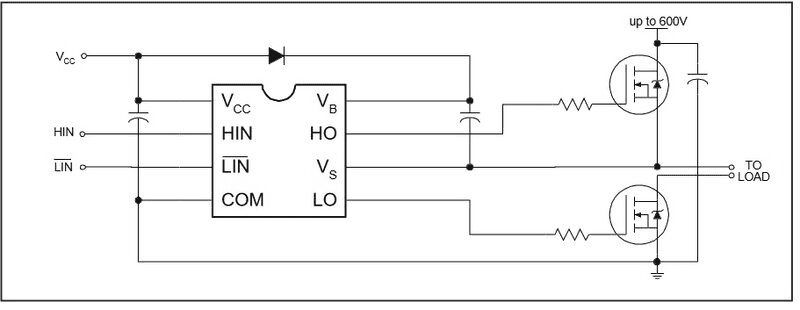
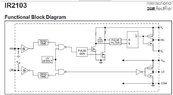
I am still unclear how to make "The two halves a whole" or how to wire it up. As far as I can work out, the N chan fets are used as high side switches. The drain is connected to the supply voltage in my case it will be 55v and source to load. The gate needs the correct vgs to turn it on then I was looking at direct drive, level shifted drive, or bootstrap gate drive. In the picture you provided its a bootstrap driver and I suppose the logic in pins are important can I please have some guidance. Thanks again!
checkmatescott
- 80
- 2
can you teach me how to use google effciently for example when you search that initial image and cross checked with the internet?
checkmatescott
- 80
- 2
what is personal speculation
checkmatescott
- 80
- 2
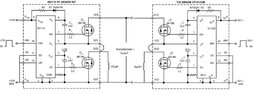
can you draw me a diagram of where and how to place components to at least give me a clue, in the form of a very rough schematic plase
checkmatescott
- 80
- 2
checkmatescott
- 80
- 2
checkmatescott
- 80
- 2
logging off for the night, my eyes are gone cyas
Admin
- 69,789
- 25,639
Whelp, it turns out that this newbie is an accomplished hacker of a number of things, and proud of it. He is now gone, and this thread will remain closed. Sorry that you spent so much time trying to help this "Help Vampire", but his intentions were not good. Thanks folks.berkeman said:Thread is on "pause" for a bit...