High power switching circuit problem.

Click For Summary

Discussion Overview

The discussion revolves around troubleshooting a high power switching circuit using a MOSFET controlled by an Arduino Nano. Participants explore issues related to the operation of a solenoid valve and an LED, focusing on power supply limitations and circuit configurations.

Discussion Character

  • Exploratory
  • Technical explanation
  • Debate/contested

Main Points Raised

  • One participant describes the circuit setup and the unexpected behavior of the solenoid valve and LED when controlled by the Arduino.
  • Another participant suggests that the solenoid valve may draw more current than the power supply can provide.
  • Concerns are raised about potential failures in the diode or the valve, including the possibility of incorrect wiring.
  • A participant notes that increasing the current limit on the power supply resolved the issue, indicating that the power supply was initially current limiting.
  • There is speculation about the orientation of the diode and the implications of the FET's input capacitance on switching behavior.
  • Participants express surprise at the LED not burning out despite being subjected to 12V, attributing it to luck.

Areas of Agreement / Disagreement

Participants generally agree that the power supply's current limitation was a key issue, but there are multiple viewpoints regarding the potential causes of the initial problems, including wiring errors and component failures.

Contextual Notes

Some assumptions about the circuit configuration and component specifications remain unverified, and the discussion does not resolve all uncertainties regarding the behavior of the components involved.

perplexabot
Gold Member
Messages
328
Reaction score
5
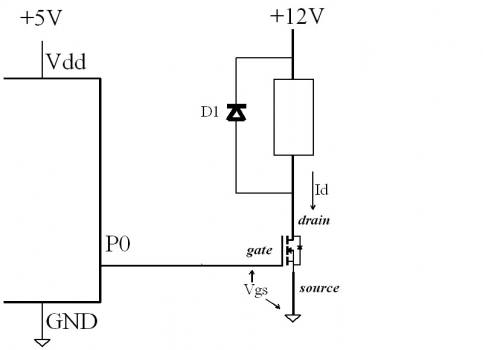
Hello all. I am trying to use a mosfet as a high power switch. I have an arduino nano pin controlling the gate of the fet. I am using an NTE2374 mosfet. I am using a typical circuit:
img_1224968365_15332_1271040628_mod_483_350.jpg


I also have the gate connected to the source (ground) so that when the gate is not HIGH, it isn't floating.

I have been testing this circuit on two separate components; main component (the valve) and also on an LED (not sure if this is a good idea). I have found the following things to happen:
  • When the arduino pin output is LOW and the component is either a valve of LED, the
    component was off (as it should)
  • When the arduino pin output is HIGH the LED turns on.
  • When the arduino pin output is HIGH the valve does NOT turn on and the voltage reading on
    my dc power supply goes from 15V down to zero in a moment.
I have been at this for a couple of days and I can't seem to figure out what the problem is. Can anyone help me out or direct me towards the correct path? Thank you.
 
Last edited:
Engineering news on Phys.org
It sounds to me like the 'valve' as you call it which I assume is a solenoid valve draws more current than your power supply is able to source.
 
Last edited:
  • Like
Likes   Reactions: 1 person
D1 could have failed by going short circuit.
The valve could have failed by going short circuit.
The wires to the valve and D1 may have been swapped, which forward biasses D1.
 
  • Like
Likes   Reactions: 1 person
Averagesupernova said:
It sounds to me like the 'valve' as you call it which I assume is a solenoid valve draws more current than your power supply is able to source.
Yes, it is a solenoid valve. So, I tried increasing the current knob on my power supply and... it worked, LOL. Thank you. I hooked it up to my battery and it worked directly. I learned something new today: A dc power supply, by default, doesn't source current.

Thank you Averagesupernova and Baluncore for the quick replies.
 
You maybe have the diode in backwards?
It's wired incorrectly?
The power supply is current limiting at too low a threshold?

What happens if you short across the FET to turn on the thingy.

The FET input capacitance is 1300pf so the turn on will be slow. During that switching time the FET dissipates a lot of power. But even if the FET blew, I don't see how that causes what you describe.

EDIT: Problem solved while I was typing
 
  • Like
Likes   Reactions: 1 person
meBigGuy said:
...
:biggrin:
meBigGuy said:
The power supply is current limiting at too low a threshold?
You got it. Thanks anyway!
 
perplexabot said:
So, I tried increasing the current knob on my power supply and... it worked, LOL.

I was wondering why the LED that you tested first didn't burn out with 12V applied to it. That would explain it :smile:

(But I didn't want to spoil everybody's fun guessing the answer by looking at ALL the evidence, so I didn't post this earlier!)
 
  • Like
Likes   Reactions: 1 person
AlephZero said:
I was wondering why the LED that you tested first didn't burn out with 12V applied to it. That would explain it :smile:

Aahahaha, didn't even cross my mind. Lucky led.
 

Similar threads

  • · Replies 14 ·
Replies
14
Views
2K
Replies
10
Views
2K
Replies
39
Views
6K
  • · Replies 1 ·
Replies
1
Views
2K
  • · Replies 4 ·
Replies
4
Views
2K
Replies
7
Views
3K
  • · Replies 3 ·
Replies
3
Views
2K
  • · Replies 12 ·
Replies
12
Views
2K
  • · Replies 14 ·
Replies
14
Views
4K
  • · Replies 10 ·
Replies
10
Views
3K