Wireless Power Transfer (is this correct)

Click For Summary
The discussion centers on the workings of a wireless power transfer circuit involving a transistor and coils. Participants express confusion about the circuit's operation, particularly regarding the relationship between base, collector, and emitter currents. One explanation suggests that the transistor generates high-frequency AC current, creating a magnetic field, but this is met with skepticism due to unclear terminology like "discharging an inductor." The need for negative feedback and amplification to achieve oscillation is highlighted as crucial for the circuit's functionality. Overall, there is a consensus that the circuit's explanation requires clarification and more accurate representation of its mechanics.
jaus tail
Messages
613
Reaction score
48
TL;DR
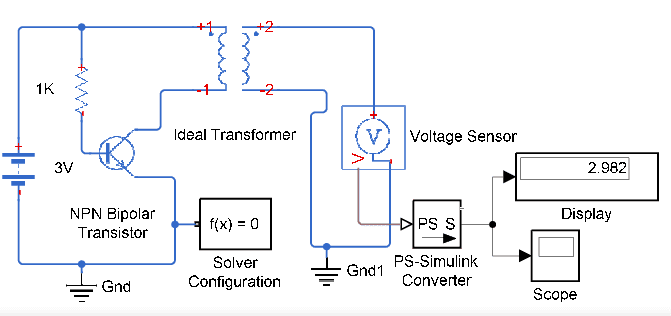
Circuit Operation:
Ref: https://www.semanticscholar.org/paper/Design-and-Simulation-of-Different-Wireless-Power-Baroi-Isla m/dc19ecfde904964704777ab5adef96d5d6846f1f
1572628388867.png


I couldn't find the working of this circuit so I guess it would be like:
Initially transistor is OFF, so the current flows through Base, and then when transistor is ON, the current flows through transistor Collector to Emitter, so now it flows down the transformer. Base current is reducing and then transistor turns off, so then flux falls. And then again current flows through Base, so cycle continues?

Is this correct? But if current flows through base initially, and if Emitter current is zero, so where does the base current come out from? Emitter current is Beta times collector current. Collector current is zero, so emitter current would also be zero, right?

 
Engineering news on Phys.org
Which figure is that from at the link? It looks wrong, and is missing some way to make the left hand side oscillate, IMO. Is it from Figure 5?

1572633818698.png
 
  • Like
Likes jaus tail
Oh, maybe you posted Figure 6. Still looks wrong to me, though...
 
  • Like
Likes jaus tail
But I drew the original circuit that I have posted in MATLAB simulink and was able to get oscillations. I had kept source voltage around 0.4V
 
How
berkeman said:
Which figure is that from at the link? It looks wrong, and is missing some way to make the left hand side oscillate, IMO. Is it from Figure 5?

View attachment 252164
Could you explain the working of this circuit?
I found a slightly difference circuit:
1572842917182.png

It says:
In transmitter section, the Transistor is generating high-frequency AC current across the coil and the coil is generating a magnetic field around it. As the coil is center tapped, the two sides of the coil start to charge up. One side of the coil is connected to the resistor and another side is connected to the collector terminal of NPN transistor. During the charging condition, the base resistor starts to conduct which eventually turns on the transistor. The transistor then discharges the inductor as the emitter is connected with the ground. This charging and discharging of the inductor produces a very high frequency oscillation signal which is further transmitted as a magnetic field.

Ref: https://circuitdigest.com/electronic-circuits/simple-wireless-power-transmission-circuit-diagram
 
In transmitter section, the Transistor is generating high-frequency AC current across the coil and the coil is generating a magnetic field around it. As the coil is center tapped, the two sides of the coil start to charge up. One side of the coil is connected to the resistor and another side is connected to the collector terminal of NPN transistor. During the charging condition, the base resistor starts to conduct which eventually turns on the transistor. The transistor then discharges the inductor as the emitter is connected with the ground. This charging and discharging of the inductor produces a very high frequency oscillation signal which is further transmitted as a magnetic field.

That explanation really makes no sense. "discharging an inductor" ?
What happens both of the 17-turns inductors are wound into a transformer. Once the transistor starts to conduct, the much large collector current will turn off the base current. Negative feedback + time delay + enough amplification will produce oscillation.
 
Last edited by a moderator:
  • Like
Likes jaus tail
I am trying to understand how transferring electric from the powerplant to my house is more effective using high voltage. The suggested explanation that the current is equal to the power supply divided by the voltage, and hence higher voltage leads to lower current and as a result to a lower power loss on the conductives is very confusing me. I know that the current is determined by the voltage and the resistance, and not by a power capability - which defines a limit to the allowable...

Similar threads

  • · Replies 5 ·
Replies
5
Views
4K
  • · Replies 19 ·
Replies
19
Views
2K
  • · Replies 10 ·
Replies
10
Views
2K
  • · Replies 2 ·
Replies
2
Views
2K
  • · Replies 5 ·
Replies
5
Views
3K
  • · Replies 8 ·
Replies
8
Views
3K
Replies
19
Views
7K
  • · Replies 15 ·
Replies
15
Views
8K
  • · Replies 8 ·
Replies
8
Views
3K
Replies
2
Views
2K