Work done by gravity - what is wrong?

Click For Summary
The discussion focuses on calculating the work done by gravity on a mass attached to a weightless, rigid rod. The initial approach involved integrating the gravitational force over a path, leading to confusion about the sign of the work. It was clarified that the work done by gravity is independent of the path and is equal to the negative change in potential energy. The correct interpretation shows that the gravitational force and displacement are in the same direction, resulting in positive work. The importance of considering the potential function and the correct path of integration was emphasized.
Zoli
Messages
19
Reaction score
0
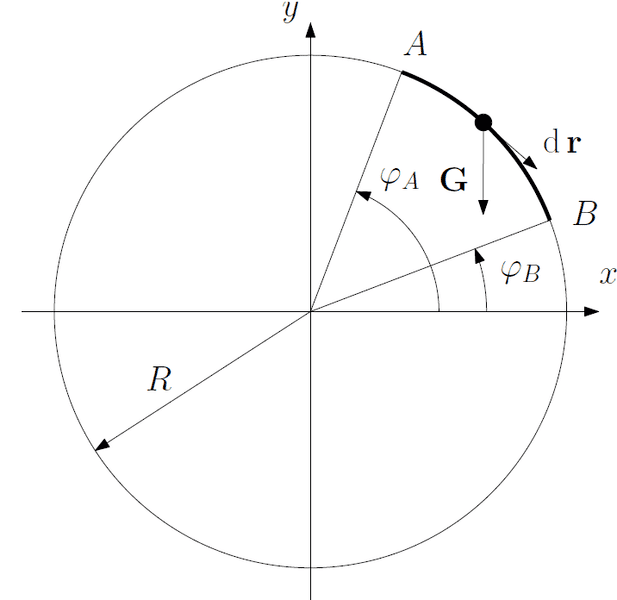
I would like the determine the work done by gravity on a mass attached to a rod (see the attached image). The rod is assumed to be weightless and rigid.
I start from the definition of work:
W_{AB} = \int_{\mathbf{r}_A}^{\mathbf{r}_B} \mathbf{G}\cdot \mathrm{d}\,\mathbf{r}.
In the x-y coordinate system we can write
\mathbf{G} = G(0,-1), \quad \mathrm{d}\,\mathbf{r} = R(\sin\varphi,-\cos\varphi)\mathrm{d}\,\varphi,
k4xmpv.png

therefore the value of the integral becomes W_{AB} = GR(\sin\varphi_B - \sin\varphi_A), which is negative since we are in the first quadrant. However, if we look at the attached draft, we may notice that the angle between W_{AB} = \mathbf{G} and \mathrm{d}\,\mathbf{r} is an acute angle, so the work should be positive.
What have I done wrong?

Thank you, Zoli
 
Physics news on Phys.org
You tried it the hard way and in so doing, looks like you integrated backwards. The easier way is to note that the work done by gravity is independent of the path taken, and equal to the negative of the potential energy change. You can calculate the potential energy from basic trig to determine the vertical height change. Since the gravity force and it's vertical displacement are in same direction, work must be positive.
 
  • Like
Likes Zoli
I see it. It should be noticed that dr=-R(sinφ,−cosφ)dφ,becasue from A to B dφ is negative.
 
  • Like
Likes Zoli and Nugatory
PhanthomJay said:
You tried it the hard way and in so doing, looks like you integrated backwards. The easier way is to note that the work done by gravity is independent of the path taken, and equal to the negative of the potential energy change. You can calculate the potential energy from basic trig to determine the vertical height change. Since the gravity force and it's vertical displacement are in same direction, work must be positive.
Yes, I surmised that I changed the path of integration, since \mathrm{d}\,\varphi is negative. I forgot the idea of the potential function. Thank you.
 
For simple comparison, I think the same thought process can be followed as a block slides down a hill, - for block down hill, simple starting PE of mgh to final max KE 0.5mv^2 - comparing PE1 to max KE2 would result in finding the work friction did through the process. efficiency is just 100*KE2/PE1. If a mousetrap car travels along a flat surface, a starting PE of 0.5 k th^2 can be measured and maximum velocity of the car can also be measured. If energy efficiency is defined by...

Similar threads

Replies
1
Views
1K
  • · Replies 1 ·
Replies
1
Views
18K
  • · Replies 8 ·
Replies
8
Views
3K
  • · Replies 2 ·
Replies
2
Views
1K
  • · Replies 9 ·
Replies
9
Views
4K
  • · Replies 1 ·
Replies
1
Views
2K
  • · Replies 28 ·
Replies
28
Views
2K
  • · Replies 4 ·
Replies
4
Views
4K
  • · Replies 8 ·
Replies
8
Views
2K
  • · Replies 1 ·
Replies
1
Views
3K