Work greater than heat given to colder reservoir -- impossible?

Click For Summary
SUMMARY

The discussion centers on the feasibility of a heat engine extracting more work from a hot reservoir than the heat transferred to a cold reservoir, challenging the first law of thermodynamics. Participants clarify that while it is impossible for work (W) to exceed the heat rejected to the cold reservoir (Q2), it is feasible for the heat extracted from the hot reservoir (Q1) to be greater than Q2. The GE HA gas turbine, which operates at over 64% efficiency, exemplifies this principle, demonstrating that high efficiency is achievable under specific conditions. The theoretical maximum efficiency of a heat engine is defined by the equation n_max = 1 - (T_c/T_h), indicating that efficiency can exceed 50% if the temperature difference is sufficient.

PREREQUISITES
  • Understanding of the first law of thermodynamics
  • Familiarity with heat engine efficiency concepts
  • Knowledge of the Carnot cycle and its implications
  • Basic grasp of thermodynamic temperature scales
NEXT STEPS
  • Research the Carnot heat engine and its efficiency limits
  • Study the Kelvin-Plank statement of the second law of thermodynamics
  • Explore advanced thermodynamic cycles and their efficiencies
  • Investigate real-world applications of high-efficiency gas turbines
USEFUL FOR

Students of thermodynamics, engineers designing heat engines, and professionals in energy production seeking to understand the principles governing heat transfer and efficiency in thermodynamic systems.

Callmelucky
Messages
144
Reaction score
30
Homework Statement
Is it possible to make machine that would take more heat from hot reservoir to do work than what would hot reservoir give to cold reservoir(heat)?
Relevant Equations
1st law of thermodynamics
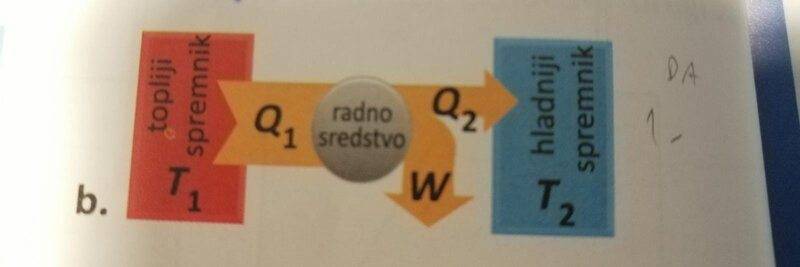
photo below... Is it possible to make a machine that would take more heat from the hot reservoir to do work than what would hot reservoir give to the cold reservoir(heat)? Apparently, it's impossible because it violates 1st law of thermodynamics.

the thickness of the arrows symbolizes the amount of heat or work. The red rectangle is hot res. the blue rectangle is cold res. The grey circle is a working tool(mean).
WhatsApp Image 2022-11-23 at 05.47.48.jpeg
 
Physics news on Phys.org
I'm unsure of what you're asking. Are you asking about the total amount of heat (or energy) moved, the rate of heat transfer, or something else?
 
Drakkith said:
I'm unsure of what you're asking. Are you asking about the total amount of heat (or energy) moved, the rate of heat transfer, or something else?
Apparently, heat that goes from a hot reservoir to be used to do work can not be greater than the heat that goes to a cold reservoir, is that true?
 
Callmelucky said:
Apparently, heat that goes from a hot reservoir to be used to do work can not be greater than the heat that goes to a cold reservoir, is that true?
Seems you have it backwards. As the diagram illustrates, it is certainly possible that ##Q_1>Q_2##. It is the reverse that is not possible.
 
haruspex said:
Seems you have it backwards. As the diagram illustrates, it is certainly possible that ##Q_1>Q_2##. It is the reverse that is not possible.
I understand that, I don't understand why(according to answers at the end of the book) work can not be greater that Q2
 
Callmelucky said:
I understand that, I don't understand why(according to answers at the end of the book) work can not be greater that Q2
As far as I know it can. GE has a gas turbine that runs at upwards of 64% efficiency, meaning that W > Q2.
SCHENECTADY, NEW YORK - December 4, 2017 - GE Power (NYSE:GE) announced today that its largest and most efficient gas turbine, the HA, is now available at more than 64 percent efficiency in combined cycle power plants, higher than any other competing technology today. This milestone is achieved largely due to GE’s advances in additive manufacturing and combustion breakthroughs through constant innovation, coming just 18 months after GE set a world record with the HA for powering the world’s most efficient combined-cycle power plant at 62.22 percent.

Link here.
 
Also, the theoretical maximum efficiency of a heat engine is given by: ##n_{max}=1-\frac{T_c}{T_h}##
So there's nothing theoretically stopping a heat engine from being more than 50% efficient as long as the temperature difference is high enough.
 
  • Like
Likes   Reactions: 256bits
Drakkith said:
Also, the theoretical maximum efficiency of a heat engine is given by: ##n_{max}=1-\frac{T_c}{T_h}##
So there's nothing theoretically stopping a heat engine from being more than 50% efficient as long as the temperature difference is high enough.
OP said according to the 1st law, of which he has not explained how it bears upon the scenario he has described.
@Callmelucky Could you explain your reasoning with regards to the 1st law?
drakkith has proposed the 2nd law.
 
Callmelucky said:
I understand that, I don't understand why(according to answers at the end of the book) work can not be greater that Q2
I may have misunderstood. Is it saying W cannot exceed Q2? Seems to me it can, provided ##T_1>2T_2##.
 
  • #10
the question goes: is this heat engine possible? if not, what law of thermodynamics is he violating? And in solutions, the answer is: not possible, violates 1st law of thermodynamics. Which is weird because in that same textbook, in the chapter on 1st law of thermodynamics it's stated that some ship engines have efficiency of 52%. I guess it's a mistake then in solutions.
 
  • #11
The work cannot equal ##Q_1## by the Kelvin-Plank statement of the Second Law, but that's not what is portrayed.

I think your book is incorrect. What's shown seems quite plausible for any real process.
 
  • #12
erobz said:
The work cannot equal ##Q_1## by the Kelvin-Plank statement of the Second Law, but that's not what is portrayed.

I think your book is incorrect. What's shown seems quite plausible for any real process.
Yes, something happened in solutions, I think that the order of answers is wrong and some are missing.
My bad for not checking them all first, I'm sorry for that.
 
  • #13
Callmelucky said:
Yes, something happened in solutions, I think that the order of answers is wrong and some are missing.
My bad for not checking them all first, I'm sorry for that.
I'm no expert. Don't be sorry, these things can be subtle ( that's why perpetual motion devices are "a thing"). You shouldn't have to check the book. However, It's better that you first questioned your understanding and then confirmed your suspicions IMHO.
 
  • Like
Likes   Reactions: Lnewqban
  • #14
We are told that "the thickness of the arrows symbolizes the amount of heat or work." I used a plastic ruler to measure the width of each arrow on my laptop's screen. I got
Q1 = 1.9 ± 0.05 cm (total heat entering the radno sredstvo from the red, hi T, reservoir)
Q2 = 0.6 ± 0.05 cm (total heat dumped by the radno sredstvo into the blue, lo T, reservoir)
W = 1.2 ± 0.05 cm (work done by the radno sredstvo)

The first law says Q1 - Q2 = W over one cycle.
Here Q1 - Q2 = 1.3 ± 0.1 cm.
My conclusion is that, to within the uncertainty of my measurement, the diagram is consistent with the first law of thermodynamics. The efficiency of the cycle can also be estimated, $$e=\frac{W}{Q_1}=\frac{1.2}{1.9}=0.63\pm 0.03.$$
 
  • Like
Likes   Reactions: Callmelucky
  • #15
kuruman said:
We are told that "the thickness of the arrows symbolizes the amount of heat or work." I used a plastic ruler to measure the width of each arrow on my laptop's screen. I got
Q1 = 1.9 ± 0.05 cm (total heat entering the radno sredstvo from the red, hi T, reservoir)
Q2 = 0.6 ± 0.05 cm (total heat dumped by the radno sredstvo into the blue, lo T, reservoir)
W = 1.2 ± 0.05 cm (work done by the radno sredstvo)

The first law says Q1 - Q2 = W over one cycle.
Here Q1 - Q2 = 1.3 ± 0.1 cm.
My conclusion is that, to within the uncertainty of my measurement, the diagram is consistent with the first law of thermodynamics. The efficiency of the cycle can also be estimated, $$e=\frac{W}{Q_1}=\frac{1.2}{1.9}=0.63\pm 0.03.$$
Well, that should settle it!
 
  • Like
Likes   Reactions: kuruman
  • #16
erobz said:
Well, that should settle it!
When in doubt, measure it out. :oldsmile:
 
  • Haha
Likes   Reactions: erobz
  • #17
kuruman said:
We are told that "the thickness of the arrows symbolizes the amount of heat or work." I used a plastic ruler to measure the width of each arrow on my laptop's screen. I got
Q1 = 1.9 ± 0.05 cm (total heat entering the radno sredstvo from the red, hi T, reservoir)
Q2 = 0.6 ± 0.05 cm (total heat dumped by the radno sredstvo into the blue, lo T, reservoir)
W = 1.2 ± 0.05 cm (work done by the radno sredstvo)

The first law says Q1 - Q2 = W over one cycle.
Here Q1 - Q2 = 1.3 ± 0.1 cm.
My conclusion is that, to within the uncertainty of my measurement, the diagram is consistent with the first law of thermodynamics. The efficiency of the cycle can also be estimated, $$e=\frac{W}{Q_1}=\frac{1.2}{1.9}=0.63\pm 0.03.$$
yeah, it's some kind of mistake in textbook. That was a clever thing to do, it didn't come to me because I am pretty sure that it was not supposed to be done that way but yeah, still good idea. Thank you.
 
  • Like
Likes   Reactions: kuruman
  • #18
Callmelucky said:
yeah, it's some kind of mistake in textbook. That was a clever thing to do, it didn't come to me because I am pretty sure that it was not supposed to be done that way but yeah, still good idea. Thank you.
The only way that physics problems are supposed to be done is correctly.
 

Similar threads

  • · Replies 5 ·
Replies
5
Views
2K
  • · Replies 3 ·
Replies
3
Views
7K
  • · Replies 1 ·
Replies
1
Views
2K
  • · Replies 20 ·
Replies
20
Views
2K
  • · Replies 19 ·
Replies
19
Views
3K
Replies
1
Views
2K
  • · Replies 7 ·
Replies
7
Views
16K
Replies
7
Views
25K
Replies
5
Views
3K
  • · Replies 2 ·
Replies
2
Views
2K