How do I accurately calculate work done against friction?

  • Thread starter Thread starter Elara04
  • Start date Start date
  • Tags Tags
    Friction Work
Join the discussion
Ask a follow-up here, or get your own question answered by working scientists, mathematicians and engineers — people, not an autocomplete.
Real named experts · corrections over time · the nuance an AI answer skips
11 replies · 3K views
Elara04
Messages
5
Reaction score
0
Homework Statement
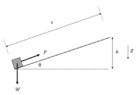
An object on an inclined plane of weight W=20kN is acted on by a force of 10.1 kN parallel to an inclined plane. The object travels up the slope at a constant speed and travels over a distance s = 37 m, also gaining h = 9 m in height.
How much work is done against friction (i.e. energy dissipated as heat)? Give your
answer in kilo-joules (kJ)
Relevant Equations
𝑊 = 𝐹 ∙ ∆ 𝑠 = 𝐹 ∥ ∆ 𝑠
I'm unsure on where to begin with this question, i've tried many different formulas that aren't giving me the right answer. I believe to start I need to convert the kilo newtons to newtons.
I tried w = fs + mgh
w = 10500 x 8.9/sin(13.9)+(1845.69 x 9.8 x8.9) = 549986.46 J
and then convert to kilo joules = 549.99 kJ

But this isn't correct
any help would be appreciated
 
Physics news on Phys.org
Elara04 said:
w = 10500 x 8.9/sin(13.9)+(1845.69 x 9.8 x8.9) = 549986.46 J
Please explain all the parts of that.
Where do 10500, 1845.69 and 8.9 come from?
Why are you dividing by sin(13.9°)?

Your work would be much easier to follow if you were to refrain from plugging in numbers straight away. There are many benefits in working symbolically as far as possible.
 
Reply
  • Like
Likes   Reactions: MatinSAR
haruspex said:
Please explain all the parts of that.
Where do 10500, 1845.69 and 8.9 come from?
Why are you dividing by sin(13.9°)?

Your work would be much easier to follow if you were to refrain from plugging in numbers straight away. There are many benefits in working symbolically as far as possible.
Sorry, 10500 is force in newtons instead of kilonewtons, 8.9m is the height, 13.9 is theta. I was using w = F x H / sin theta + mgh, although i'm not entirely certain whether that equation is correct
 

Attachments

  • Screen Shot 2023-01-23 at 10.32.40 PM.png
    Screen Shot 2023-01-23 at 10.32.40 PM.png
    7.7 KB · Views: 149
Elara04 said:
10500 is force in newtons instead of kilonewtons
It says 10.1kN
Elara04 said:
8.9m
It says 9m
Elara04 said:
w = F x H / sin theta
Why H / sin theta when you are given s?
But your big problem there is being clear about what force F is.
What forces act on the object?
 
Reply
  • Like
Likes   Reactions: MatinSAR
The work dissipated by friction has nothing to do with the weight of the body or any other forces. You just need the force, the displacement and the angle between them.
 
Elara04 said:
Hey, so the formula would be w=fd cos theta, but after using that formula I need to find the work done against friction and im not entirely sure how to do that
Please try to answer my questions in post #4.
What forces act on the object?
Which of them is f in your w = fs + mgh in post #1?
 
Reply
  • Like
Likes   Reactions: nasu
kuruman said:
The work done against friction sometimes goes by the name "the work done by friction". So find the force of kinetic friction, find the cosine of the angle between it and the displacement and multiply the three quantities.
Only true for constant velocity?
 
haruspex said:
No, it doesn’t depend on time in any way.
Sorry, why?