Working Principle of Sewing Machine ( Paddle Part )

Click For Summary
SUMMARY

The discussion focuses on the mechanical mechanism of traditional sewing machines, specifically the foot paddle, known as the "treadle." The treadle allows the operator to convert foot pressure into rotary motion via a crank, enabling the sewing machine to function. The user seeks to understand how to calculate the force applied from the paddle to the sheave, indicating a need for deeper insights into the mechanics involved in this process.

PREREQUISITES
  • Understanding of mechanical systems and force calculations
  • Familiarity with sewing machine components, particularly the treadle and sheave
  • Basic knowledge of rotary motion and its conversion from reciprocating motion
  • Experience with mechanical advantage principles in simple machines
NEXT STEPS
  • Research the mechanics of treadle systems in sewing machines
  • Learn about calculating force and torque in mechanical systems
  • Explore the historical evolution of sewing machines and their mechanical components
  • Investigate the relationship between pedal pressure and sewing machine speed
USEFUL FOR

Mechanical engineers, sewing machine enthusiasts, and anyone interested in the historical mechanics of sewing technology will benefit from this discussion.

shinnsohai
Messages
41
Reaction score
0
Hi guys,
I wanted to ask something that I am interested on
Which is on the traditional sewing machine mechanical mechanism (On the foot paddle part)
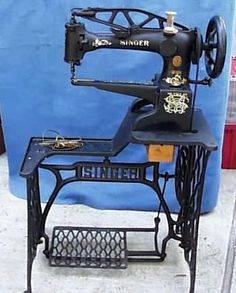
eccee90e9bacf36b622af9e31321be65.jpg

Image taken from Google.

From the image above, a typical sewing machine
For such application, what is the "Name" for it?
Im more likely wanted to know more about how do i calculate the force from paddle to the sheave

P.S: I've been searching around the internet, all i got on the principle of the sewing machine is on its lock stitch
 
Engineering news on Phys.org
The mechanism is called a "treadle":

http://en.wikipedia.org/wiki/Treadle

In the days before electric motors became common, the sewing machine operator would use a foot pressing on the treadle to turn a crank, located up above. Turning the crank converted the reciprocating motion of the treadle into a rotary motion used by the sewing machine on top.
 
Thanks mate!
I'll look into it
 

Similar threads

  • · Replies 7 ·
Replies
7
Views
2K
Replies
2
Views
1K
  • · Replies 10 ·
Replies
10
Views
3K
  • · Replies 4 ·
Replies
4
Views
2K
  • · Replies 4 ·
Replies
4
Views
6K
Replies
29
Views
5K
  • · Replies 6 ·
Replies
6
Views
3K
  • · Replies 8 ·
Replies
8
Views
922
Replies
4
Views
3K
Replies
2
Views
3K