Worst load cases lattice structure

Click For Summary
The discussion centers on modeling load cases for a ship-to-shore crane's lattice structure in a FEM design course. The user seeks to identify the worst load cases for the trolley's weight applied at four corners on the boom, emphasizing the challenge posed by the lattice configuration. Suggestions include plotting critical points along the boom, modeling the structure as a simple beam for easier calculations, and considering the effects of horizontal wind loads alongside vertical forces. Additionally, the importance of accounting for the crane's weight and environmental factors, such as swinging loads, is highlighted. Overall, the conversation emphasizes the need for strategic load application to accurately assess stress in the lattice structure.
DaanD
Messages
1
Reaction score
0
Introduction
Dear all,
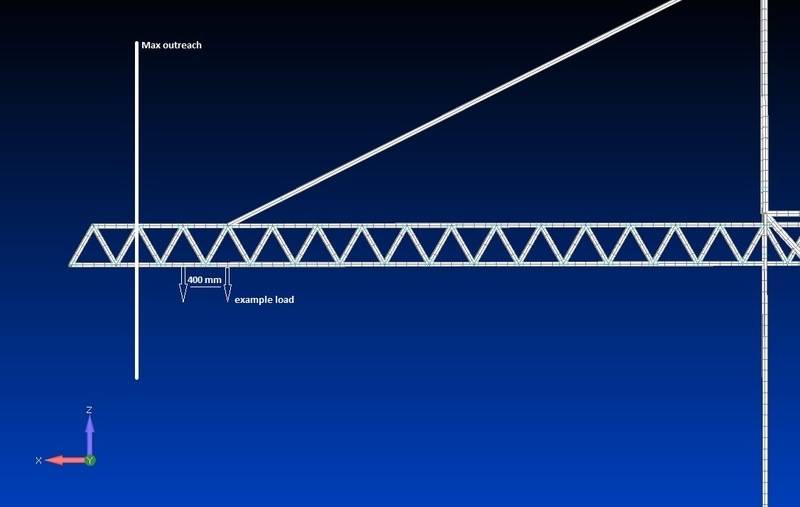
I'm working on an assignment to model a ship-to-shore crane for a FEM design course. Having modeled the crane, I now need to apply the load of the trolley (which is hoisting the container) on the boom (which in my case is a lattice structure made up of beam elements).

The total load of the trolley will be applied on the boom in 4 points (1 for each corner of the trolley) the load on an arbitrary position is shown in the image.
331zsrt.jpg


The question
Instead of applying the load at every possible position (which are a lot), I want to find the worst load cases along the lattice structure and only calculate the stresses when the loads are in those positions. I however have a hard time determining where that might be. If the boom would be model as just a single beam, it would be a lot easier. However, thanks to the lattice structure I have a hard time imaging where to apply the loads. Perhaps someone can point me in the right direction?
 
Engineering news on Phys.org
I think you first need to model the load at each lattice point along the boom.
Plot a curve to show where the most critical points along the boom may be.
Then model say eight smaller step positions along the boom between two lattice points in that region.

Remember that the horizontal wind load on a lattice structure can often be more than the vertical gravitational forces.
 
DaanD said:
If the boom would be model as just a single beam, it would be a lot easier.

You can model it approximately as a simple beam. It acts like an I-beam with the top and bottom rails as the flanges, and other parts carrying the shear load between them like the web of an I-beam.

You could calculate the equivalent "I" value approximately, by ignoring the "web" and just including the top and bottom rails. Or, take your existing model, delete the irrelevant parts, load it like a cantilever, and find the equivalent "EI" value from the deflection you get. If you have time, it would be instructive to do both and compare them (and compare them with your detailed model).

I real life you would probably design the crane by doing this backwards: start by assuming the boom is a simple beam, then figure out the lightest/cheapest way to make that beam from a truss structure.

Actually, you can probably get some useful information from shear force and bending moment diagrams, without calculating the equivalent beam properties at all - just by realizing that the structure acts like a beam.
 
Last edited:
Your best bet for maximum stress is still putting the load as close to the end of the boom as you can.

It's not clear from the OP if you are also modeling the weight of the structure and if you are including any environmental loading. Since this crane is transferring suspended weights, have you considered what might happen if the suspended weight starts swinging, or otherwise be upset by wind or coming to an abrupt stop at the end of its travel along the boom?

As the others have said, the method of construction of the boom is unlikely to affect how it responds to being loaded. Lattice structures, while being more complicated to construct, are generally lighter than other methods of construction.
 
Had my central air system checked when it sortta wasn't working. I guess I hadn't replaced the filter. Guy suggested I might want to get a UV filter accessory. He said it would "kill bugs and particulates". I know UV can kill the former, not sure how he thinks it's gonna murder the latter. Now I'm finding out there's more than one type of UV filter: one for the air flow and one for the coil. He was suggesting we might get one for the air flow, but now we'll have to change the bulb...

Similar threads

Replies
3
Views
4K
  • · Replies 5 ·
Replies
5
Views
6K
  • · Replies 5 ·
Replies
5
Views
2K
  • · Replies 12 ·
Replies
12
Views
5K
  • · Replies 14 ·
Replies
14
Views
3K
Replies
10
Views
12K
Replies
4
Views
3K
  • · Replies 1 ·
Replies
1
Views
1K
  • · Replies 2 ·
Replies
2
Views
2K
Replies
3
Views
3K