Wrong answer key for this Induction Motor question?

Click For Summary

Discussion Overview

The discussion centers around a question from the GATE-2019 exam regarding the behavior of an induction motor when the supply voltage is reduced. Participants explore the implications of this change on magnetizing inductance and reactance, considering various models and assumptions related to the operation of induction motors.

Discussion Character

  • Debate/contested
  • Technical explanation
  • Mathematical reasoning

Main Points Raised

  • Some participants argue that reducing the rms value of voltage leads to a decrease in flux, which in turn affects magnetizing inductance, suggesting that the answer is c).
  • Others challenge the idea that magnetizing inductance is proportional to flux, stating that a non-energized coil maintains the same inductance regardless of voltage.
  • One participant mentions the Steinmetz model of induction motors, indicating that certain parameters do not depend on voltage, which could imply that the answer might not be c).
  • Another participant proposes that if saturation effects are considered, inductance and reactance could increase with lower voltage, complicating the reasoning for the correct answer.
  • There is a suggestion that both answers b) and c) could be valid depending on the assumptions made regarding saturation and slip in the motor.
  • One participant emphasizes that the magnetizing reactance is influenced by both flux and magnetizing current, leading to a conclusion that only c) can be correct.

Areas of Agreement / Disagreement

Participants express multiple competing views regarding the correct answer to the question, with no consensus reached. Some support answer c), while others propose that b) could also be valid under certain conditions.

Contextual Notes

The discussion highlights various assumptions, such as the impact of saturation on inductance and the behavior of the motor under different voltage conditions. The relevance of the Steinmetz model and the effects of slip are also noted, indicating that the context of the question may influence interpretations.

Who May Find This Useful

This discussion may be of interest to students preparing for engineering exams, particularly those focused on electrical engineering and induction motor theory, as well as professionals seeking to understand the nuances of motor behavior under varying electrical conditions.

cnh1995
Homework Helper
Gold Member
Messages
3,489
Reaction score
1,163
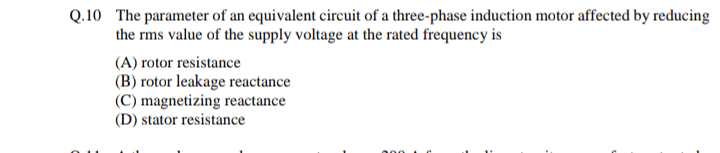
So this question was asked in GATE-2019 (EE). (GATE is the national Engineering post-graduate entrance exam in India and is conducted every year by one of the 7 top IITs (Indian Institute of Technology) and IISc Bangalore. This year, it was conducted by IIT Madras.)
20190520_123206.png

The answer I found in the official answer key released by IITM is c).
Most of the "coaching institutes" for this exam had also provided c) as the correct answer in their post-exam question paper analysis.
Their reasoning was as follows:
Since flux ∝ V/f and we are reducing rms value of voltage, flux is also reduced.
Also, magnetizing inductance Lm is proprtional to the flux. Hence, magnetizing inductance will also reduce. Therefore, c) is the correct option.

But how can magnetizing inductance change here as the magnetic coupling and self inductances of the coils remain unchanged throughout? If you reduce V 'x' times, the magnetizing current also reduces 'x' times and their ratio (Xmagnetizing) remains the same. Assuming absence of saturation and other nonidealities, isn't this simple Ohm's law in action? How can the answer be c)?

My reasoning tells me it should be b) instead. I'll post my reasoning later, but first, I need to know whether c) is right or wrong.

Thanks in advance!
 
Last edited:
Engineering news on Phys.org
What model does the question assume for the three-phase motor? The answer probably follows directly from that.

In the Steinmetz (IEEE) model of an induction motor none of those are a function of V.
https://en.wikipedia.org/wiki/Induction_motor#Steinmetz_equivalent_circuit
I am interested to see your reasoning. I am not sure what line of reasoning makes the answer B or C and not B and C. :)
 
  • Like
Likes   Reactions: cnh1995
cnh1995 said:
magnetizing inductance Lm is proprtional to the flux.
Not true. In fact, a non-energized coil of wire has the same inductance.
 
  • Like
Likes   Reactions: sophiecentaur, cnh1995 and essenmein
anorlunda said:
Not true. In fact, a non-energized coil of wire has the same inductance.
Yes, even I don't understand from where they got it.
eq1 said:
In the Steinmetz (IEEE) model of an induction motor none of those are a function of V.
Yes, the question assumes the IEEE model where the rotor reactance is made free of slip 's'. So I agree with your conclusion that none of them would change with voltage.

But practically, since we are not reducing the supply frequency, stator impedance and magnetizing reactance should be fixed (as they operate on the supply frequency).
Assuming constant load torque, T∝sV2 and if we change the voltage x times, the slip s should change 1/x2 times to maintain the necessary load torque. As slip is changing, rotor leakage reactance should also change by the same proportion. Hence, my answer was B).
 
The answer key seems a mess to me. Somebody didn't pay attention to his basics.If we allow for the non-linearity of B-H curve, ie include effects of saturation, then inductance and reactance both will increase when you lower the voltage.
Remember - inductance is flux linkages per amp, NΦ/I ,
and at lower flux it takes less current to magnetize the iron because you are farther away from the knee where saturation becomes an issue.
so since I is in the denominator not the numerator i'd say their reasoning is inverted.

But C is still the right answer.

cnh1995 said:
Since flux ∝ V/f and we are reducing rms value of voltage, flux is also reduced.
Also, magnetizing inductance Lm is an inverse function of flux.
Hence, magnetizing inductance and reactance will also reduce increase . Therefore, c) is the correct option.
anybody see a mistake in that ?

244057


old jim
 
  • Like
Likes   Reactions: cabraham and cnh1995
jim hardy said:
If we allow for the non-linearity of B-H curve, ie include effects of saturation, then inductance and reactance both will increase when you lower the voltage.

This assumes constant output power from the motor though right?

jim hardy said:
But C is still the right answer.

If we include saturation effects in the inductor model won't rotor leakage reactance also be affected? So the answer should be B and C? I'm actually rusty on this topic so I'm not confident that it would be but since the circuit is linear it's hard for me to see how they're not both "affected", which is all the question requires.
 
eq1 said:
This assumes constant output power from the motor though right?

i don't think so, at least i didnt assume that. It should be true for any stationary iron core inductor.

eq1 said:
If we include saturation effects in the inductor model won't rotor leakage reactance also be affected?

I don't disagree with your physics , because
as flux density approaches saturation the fraction of it that gets squeezed out into the air changes as well.
But i don't wholeheartedly agree with B because in the context of that test question i think the author didnt go that deep. It's a smaller effect that also depends on slip.

My two cents, and overpriced at that.

old jim
 
  • Like
Likes   Reactions: cnh1995 and cabraham
Answer is C. The magnetizing reactance is L*omega. But L = N*phi/I. Phi decreases with decreasing supply voltage, as does magnetizing current I. But as Jim said, when supply voltage decreases, L increases, moving away from saturation.
Only C can be correct. As far as leakage reactance goes, the path for leakage flux is air. Not affected by how close or far from saturation.
It can only be C. No other choice can be correct.

Claude Abraham
 
  • Like
Likes   Reactions: cnh1995 and jim hardy
  • Like
Likes   Reactions: cabraham

Similar threads

  • · Replies 4 ·
Replies
4
Views
3K
Replies
2
Views
5K
Replies
2
Views
9K
  • · Replies 5 ·
Replies
5
Views
2K
  • · Replies 6 ·
Replies
6
Views
4K
  • · Replies 2 ·
Replies
2
Views
5K
  • · Replies 55 ·
2
Replies
55
Views
9K
  • · Replies 7 ·
Replies
7
Views
7K
  • · Replies 9 ·
Replies
9
Views
3K
  • · Replies 25 ·
Replies
25
Views
5K