What is the equivalent capcitance of this circuit - Figured it out.

  • Context: Archived 
  • Thread starter Thread starter riseofphoenix
  • Start date Start date
  • Tags Tags
    Circuit Equivalent
Click For Summary

Homework Help Overview

The discussion revolves around calculating the equivalent capacitance of a circuit involving multiple capacitors (C1, C2, C3, and C4) with given values. The original poster expresses confusion regarding the expected answer and shares their thought process in attempting to solve the problem.

Discussion Character

  • Exploratory, Conceptual clarification, Mathematical reasoning

Approaches and Questions Raised

  • The original poster attempts to calculate the equivalent capacitance by first determining the parallel capacitance of C1 and C2, followed by the series capacitance of the entire circuit. They later revise their calculations and arrive at a different conclusion. Other participants provide insights into the reasoning behind adding capacitances in parallel and series, while questioning the original poster's initial confusion.

Discussion Status

The discussion includes various interpretations of the problem and attempts to clarify the concepts of combining capacitors in series and parallel. Some participants offer hints and guidance on how to approach the calculations, while others reflect on the original poster's reasoning.

Contextual Notes

Participants note the importance of understanding the differences in combining capacitors versus resistors, highlighting the unique mathematical treatment required for each. There is a suggestion to consider the implications of charge and voltage in the context of the circuit.

riseofphoenix
Messages
294
Reaction score
2
What is the equivalent capcitance of this circuit! -- Figured it out.

I have a Physics final exam in 2 hours and I'm re-reviewing things...

This problem DOESN'T make any sense!
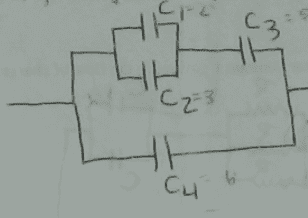
HELP_zps7fc6f1a6.png


17. If C1 = 2 F, C2 = 3 F, C3 = 5 F, C4 = 6 F, the equivalent capacitance of the circuit is:


A. 8.5 F is supposed to be the answer - that makes NO sense
B. 16 F
C. 5.5 F
D. 10 F

I didn't get ANY of those numbers...
This is what I did.

1) Determine PARALLEL capacitance of C1 and C2

Ceq = C1 + C2
Ceq = 2 +3
Ceq = 5

2) Determine the SERIES capacitance of the whole circuit now

1/Ceq = 1/5 + 1/C3 + 1/C4
1/Ceq = 1/5 + 1/5+ 1/6
1/Ceq = 0.567
Ceq = 1/0.567
Ceq = 1.763 :(:(:(:(!Edit:

Oh wait nvm.

I figured it out.

the upper arm (C net) is- 1/C net = 1/5 + 1/C3 = 1/5 + 1/5 =2/5
=>C net = 5/2 = 2.5
now 2.5 and 6 in parallel- 2.5+6 = 8.5
 
Last edited:
  • Like
Likes   Reactions: Electron Spin
Physics news on Phys.org
Claims he's figured it out. Looks good to me.
 
  • Like
Likes   Reactions: Electron Spin
Stream of consciousness thinking, charges in parallel add up so capacitances in parallel add up. So the capacitance of the combination C1 and C2 is 2 + 3 = 5. They've made it easy for you, you have two equal capacitances in series. So the voltage across one of them Is half the total voltage. So the charge on this one is 5/2 = 2.5. Add that to the 6 on C4 and you have got 8.5. Quite fast.

I haven't put in pedantries like units :oldbiggrin: because this is stream of consciousness thinking for a quiz.

Just remember - it makes sense I hope - that charges in parallel add up whereas the voltages in series and up. The charge on the leftmost plate in series equals that on the rightmost plate (though opposite sign) and that is the total charge on the equivalent capacitor. The internal plates not connected to conductor have total zero charge (though separated into a positive and negative one).

Because of this if you have say equal capacitances in series the total capacitance is less than that of anyone of them. Not realising that is why you thought the given answer didn't make any sense.
 
Last edited:
I know you exam is over but if you are interested...
BIG EASY HINT: to add L and C values..

You would total L's just like Resistors...

Totaling C's are opposite of resistors.. ( parallel C's you add like series R's, and series C's you combine (add) like parallel R's..1/1/C1+1/C2+1/C3...

IOW: You would total parallel C's as you would add series R's in a network. and when you total series C's in series, total them like you would total parallel R's.
Again,

- Treat the totaling of parallel capacitor values, opposite mathematically, as if they were like series resistor values, but only when 'totaling' their values, not their AC reactances!1.
- Treat the totaling of series or parallel Inductor values as if they were resistors.
img527.png
I always suggested to start with parallel capacitors because it's easy to see in your mind's eye...:oldwink:

Slide C2 up to the 'plates' of C1 note the combined total capacitance doubles in value, in plate area so to speak.What you are doing is actually, or electronically is combining the plate area twice, as to increase the capacitance twice..:oldwink:

Hence, L's are like R's and C's are opposite of R's, when totaling.

1 This is a completely different story for a different time.
 

Attachments

  • upload_2016-10-11_15-5-8.png
    upload_2016-10-11_15-5-8.png
    772 bytes · Views: 468
Last edited:

Similar threads

  • · Replies 27 ·
Replies
27
Views
5K
  • · Replies 7 ·
Replies
7
Views
2K
  • · Replies 11 ·
Replies
11
Views
3K
Replies
108
Views
12K
  • · Replies 19 ·
Replies
19
Views
2K
  • · Replies 5 ·
Replies
5
Views
3K
  • · Replies 12 ·
Replies
12
Views
8K
  • · Replies 3 ·
Replies
3
Views
4K
  • · Replies 8 ·
Replies
8
Views
2K
Replies
1
Views
3K