4DOF Spur Gear System - Eigenvalues not corresponding with the Eqns?

Click For Summary

Discussion Overview

The discussion revolves around the modeling of a four degree of freedom system involving two spur gears in mesh, focusing on the dynamics, equations of motion, and eigenvalue analysis. Participants explore issues related to achieving steady state in simulations and the implications of eigenvalues on system behavior.

Discussion Character

  • Technical explanation
  • Debate/contested
  • Mathematical reasoning
  • Homework-related

Main Points Raised

  • One participant describes their modeling process, including the equations of motion and the formation of mass and stiffness matrices, while noting difficulties in achieving steady state in simulations.
  • Another participant points out that the system should have exactly one zero-frequency mode and suggests that the presence of three zero-frequency modes indicates an issue with the model.
  • Concerns are raised about the stiffness matrix lacking terms for multiple stiffnesses, which may lead to incorrect eigenvalue results.
  • A participant proposes that the torque and force equations may be incomplete, suggesting the inclusion of bearing stiffness in the calculations.
  • After updating the stiffness matrix to include bearing stiffness, one participant reports achieving three positive eigenvalues and one zero, indicating improved model behavior.
  • Another participant provides MATLAB code to extract eigenvectors and eigenvalues directly from the mass and stiffness matrices.
  • A new participant raises questions about the number of variables versus equations in the model, the assumptions regarding torque values, and the initial values for the variables.

Areas of Agreement / Disagreement

Participants express differing views on the completeness of the equations and the implications of eigenvalues, with some agreeing on the necessity of including additional stiffness terms while others seek clarification on variable assumptions and initial conditions. The discussion remains unresolved regarding the best approach to handle the variable and equation discrepancies.

Contextual Notes

There are limitations regarding the assumptions made about torque values and the initial conditions for the variables, which have not been fully addressed in the discussion.

Who May Find This Useful

This discussion may be useful for students and researchers involved in mechanical systems modeling, particularly those working with gear dynamics and eigenvalue analysis in MATLAB.

Sirsh
Messages
262
Reaction score
10
Hi there,

I am modelling a four degree of freedom system which is the dynamics of two spur gears in mesh, having two rotational and two translation degrees of freedom, respectively, a diagram exhibiting the system can be seen below.
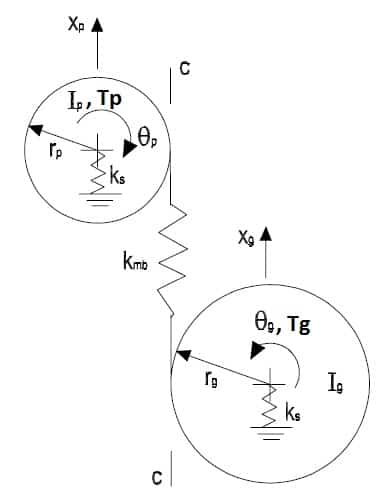
4dofsysgear.jpg


I have derived the equations of motion (EOM) and rearranged into ODEs as seen:
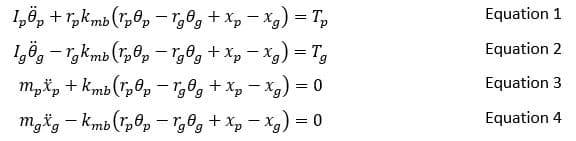
eqs.jpg


Where the force and torque relations are (used in the derivation process):
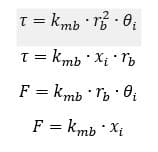
eqs1.jpg

Following this I have made rewritten equations 1-4 into matrix form, creating mass and stiffness matrices.

eqs2.jpg

I have been having trouble achieving steady state of this system in my simulations using Simulink and MATLAB, so I was advised to check the eigenvalues of the dynamic matrix as well as make sure that the mass matrix is diagonal while the stiffness matrix is symmetrical - they both are.

The dynamic matrix is defined as the inverse of the mass matrix multiplied by the stiffness matrix, e.g. Dyn = inv(M)*K.

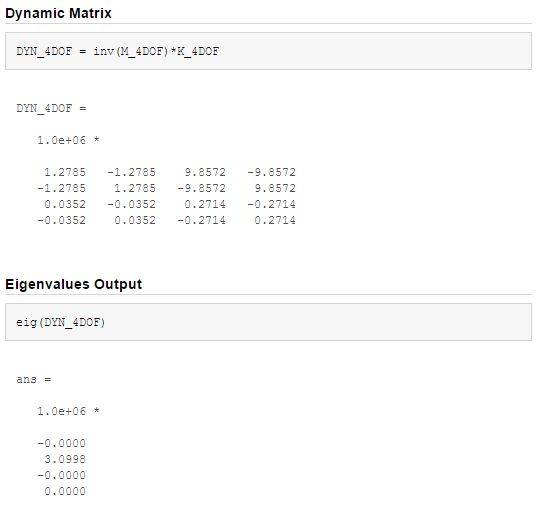
Now, I have input all this into MATLAB with the corresponding values for each of the parameters. However, I can never achieve purely positive eigenvalues for this system, as I'm told is required and may be the issue with my simulation, and where if they're not all positive (including one zero) then the system of equations are incorrect. However, I have reviewed literature on spur gear dynamics and the equations are the same...

This is exhibited below as an output of my MATLAB eigenvalue calculating script:
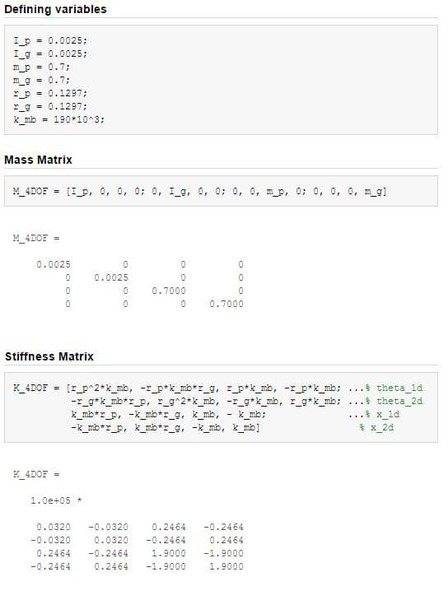
matlab.jpg

matlab1.jpg


Any help would be appreciated greatly, as I am an undergraduate student researching solo. So any advice on my interpretation of either the system dynamics or eigenvalue interpretation would be helpful from you all.

Thanks, Sirsh.
 
Engineering news on Phys.org
I think I can help. Let's start with the eigenvalues, which correspond to (the squares of) your modal frequencies. Since the system you have has exactly one way of moving without causing any forces (when the gears rotate opposite directions according to their gear ratio), you should have exactly one zero-frequency mode. You have three, so yes, something isn't right.

Looking at your stiffness matrix, I noticed there weren't any terms involving the addition of multiple stiffnesses. Whenever motions are coupled by springs, there will be interaction, signaled by stiffness matrix terms containing more than one stiffness.

I believe this all results from your torque and force equations. As written, you are only including the force from the deflection of the stiffness connecting the gears - only kmb appears, not either ks. You need to include the stiffnesses of your bearings; F=kx. Remember that in using F=ma, it's the resultant force applied to the mass, not just one. So each mass in your system should have a combined "bearing force" and "gear tooth" force acting on it.
 
  • Like
Likes   Reactions: John Taco and Sirsh
Randy Beikmann said:
I think I can help. Let's start with the eigenvalues, which correspond to (the squares of) your modal frequencies. Since the system you have has exactly one way of moving without causing any forces (when the gears rotate opposite directions according to their gear ratio), you should have exactly one zero-frequency mode. You have three, so yes, something isn't right.

Looking at your stiffness matrix, I noticed there weren't any terms involving the addition of multiple stiffnesses. Whenever motions are coupled by springs, there will be interaction, signaled by stiffness matrix terms containing more than one stiffness.

I believe this all results from your torque and force equations. As written, you are only including the force from the deflection of the stiffness connecting the gears - only kmb appears, not either ks. You need to include the stiffnesses of your bearings; F=kx. Remember that in using F=ma, it's the resultant force applied to the mass, not just one. So each mass in your system should have a combined "bearing force" and "gear tooth" force acting on it.

Hi Randy, thanks so much for your input!

I have updated my stiffness matrix to include the stiffness of the bearings which is now:
eqs2rev.jpg

And by solving the updated dynamic matrix, has yielded three purely positive eigenvalues with one zero.

So it seems like its responding as it should, now to see the simulation results!
 
By the way, you can also use Matlab to get the eigenvectors, which are the mode shapes corresponding to each modal frequency (the square root of the eigenvalues). And you can state the eigenvalue problem using the mass and stiffness matrices directly:

[V,D]=eig(K,M)

The columns of V are the eigenvectors, and the diagonal of D is the list of eigenvalues.
 
Hi,
thanks so much for sharing your answers and work.
I am analyzing this gear modeling and I have three questions:
1) I think the variables are:
Ѳ_p
Ѳ_g
x_p
x_g
T_p (torque)
T_g (torque)
There are 4 equations and 6 variables. How to solve this?
Do I have to assume values for T_p and T_q? are they equal?

2) could I assume that Ks=Kmb?

3) what are the initial values for the variables and derived variables?John Taco
 

Similar threads

Replies
3
Views
2K
  • · Replies 2 ·
Replies
2
Views
3K
  • · Replies 7 ·
Replies
7
Views
2K
  • · Replies 32 ·
2
Replies
32
Views
4K
  • · Replies 45 ·
2
Replies
45
Views
7K
  • · Replies 0 ·
Replies
0
Views
2K
  • · Replies 4 ·
Replies
4
Views
2K
  • · Replies 4 ·
Replies
4
Views
3K
  • · Replies 1 ·
Replies
1
Views
3K
  • · Replies 7 ·
Replies
7
Views
4K