D'Alembert's Solution – Domain of dependence

Click For Summary
SUMMARY

D'Alembert's solution to the one-dimensional wave equation provides a definitive method for determining the height of a wave, denoted as u, at a specific point (x0, t0) based on initial conditions. The solution incorporates the average height of the wave between two starting positions and the average rate of increase of the height. The concept of the domain of dependence is crucial, as it indicates that the height at (x0, t0) is influenced by initial data within a specific range, particularly affecting the time derivative of the height. This phenomenon is explained through the conservation of transversal momentum in the wave propagation process.

PREREQUISITES
  • Understanding of D'Alembert's formula for wave propagation
  • Familiarity with the concept of domain of dependence in wave equations
  • Knowledge of Green's functions in one-dimensional wave equations
  • Basic principles of wave mechanics and transversal waves
NEXT STEPS
  • Study the derivation and applications of D'Alembert's solution in various contexts
  • Explore the implications of the domain of dependence in higher-dimensional wave equations
  • Investigate the role of Green's functions in solving partial differential equations
  • Examine the conservation of momentum in wave mechanics and its physical interpretations
USEFUL FOR

Mathematicians, physicists, and engineering students focusing on wave mechanics, particularly those interested in the mathematical foundations of wave propagation and its physical implications.

FluidStu
Messages
25
Reaction score
3
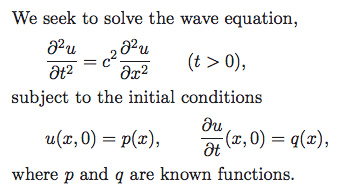
When considering the Wave equation subject to initial conditions as follows…
upload_2017-3-28_20-40-29.png


…then D'Alembert's solution is given by (where c is wave speed):

upload_2017-3-28_20-40-59.png


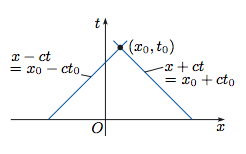
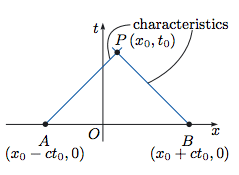
I'd like to understand physically how this formula allows us to know the value of u (where u is the height of the wave, say) at some point (x0,t0). With relation to the diagram below, I understand that the height u is constant along the characteristic lines, and that moving along these characteristic lines in the x-t plane is how the wave crest (at height u) would propagate forwards/backwards in time.
upload_2017-3-28_20-38-58.png
upload_2017-3-28_20-39-13.png


So, referring to D'Alembert's formula above, says that the height of the wave is given by:
  • The average height u of the wave between the two possible starting positions of the wave (the two intersections of x-axis).
  • The average rate of increase of the height of the wave between the two possible starting points.
Could someone please explain physically how D'Alembert's solution allows us to know the height of the wave at some point (x0,t0)? I can't see how the two terms described in bullets above relate to the height of the wave at some point (x0,t0).

The region between the two possible starting points is called the domain of dependence – meaning that the height of the wave at the point (x0,t0) depends only on initial data specified within this range. Why is there a domain of dependence? Why do conditions in the region between these two points influence the height at (x0,t0),? It would seem that the height at (x0,t0) would depend only on the conditions at the two starting points.
 
  • Like
Likes   Reactions: bosque
Physics news on Phys.org
First of all, note that the only dependence on the region in between the points is only in terms of the time derivative of the height, not the height itself. For the height itself, it only depends on the values at the points.

That the dependence is on a region for the time derivative is due to the fact that you are studying the wave equation in one dimension. For the one-dimensional wave equation, the height does not relax back to the original zero level as a wave front passes. You can understand this physically. Let us say that the wave is a transversal wave on an infinite string. If you give the wave some transversal momentum, in a small region - then this transversal momentum is conserved because there is nothing that changes the total transversal momentum. If the string relaxed back to its original state after the wave has passed - then the overall transversal momentum of the string would be zero and so this cannot happen. This can also be seen in the Green's function of the one-dimensional wave equation, which is essentially a step function.

You have a similar behaviour in two dimensions, where the Green's function is never zero in the region that the wave has passed, but instead goes to zero as ##1/\sqrt{t}##. Only in three dimensions does the Green's function become a wave front that leaves the system at zero displacement after passing.
 
  • Like
Likes   Reactions: bosque and dextercioby
Maybe in three dimensions with an impulsively excited sphere there is also a non zero displacement:
see
https://www.researchgate.net/publication/316994209_Making_waves_the_geometric_derivation_of_Huygens%27_Principle_for_wave_propagation_and_the_problem_of_the_wake
 

Similar threads

  • · Replies 18 ·
Replies
18
Views
5K
  • · Replies 1 ·
Replies
1
Views
2K
  • · Replies 10 ·
Replies
10
Views
5K
  • · Replies 3 ·
Replies
3
Views
1K
  • · Replies 8 ·
Replies
8
Views
2K
Replies
4
Views
4K
  • · Replies 19 ·
Replies
19
Views
2K
  • · Replies 1 ·
Replies
1
Views
2K
  • · Replies 10 ·
Replies
10
Views
1K
  • · Replies 3 ·
Replies
3
Views
3K