Just a kinematics problem from a Russian physics olympiad

  • Thread starter Thread starter wrobel
  • Start date Start date
Click For Summary

SUMMARY

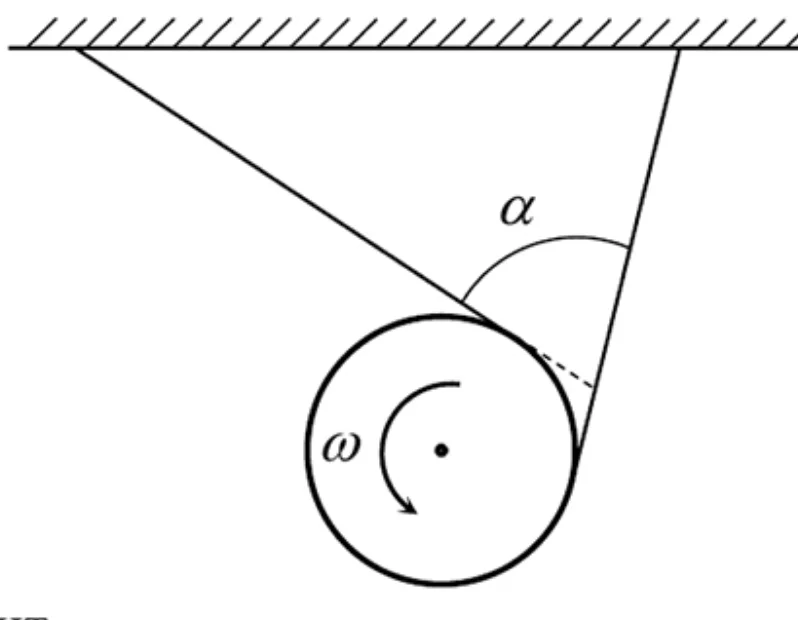
The problem involves a disk of radius R suspended by two inextensible strings attached to the ceiling, forming an angle α between them. At a given instant, the disk has an angular velocity ω, and the task is to determine the linear velocity of the disk's center. The key physics concepts include rotational kinematics, constraints imposed by the taut strings, and the relationship between angular velocity and linear velocity in rigid body motion. This problem is typical of Russian physics olympiad challenges, emphasizing analytical geometry and rotational dynamics.

PREREQUISITES

  • Rotational kinematics and angular velocity concepts
  • Rigid body motion and velocity relations between points on a rotating body
  • Geometric constraints involving angles and string tension in mechanics
  • Basic trigonometry and vector decomposition

NEXT STEPS

  • Analyze velocity constraints using relative motion equations for rigid bodies
  • Apply geometric relations to express string tensions and angles in terms of velocity components
  • Use vector decomposition to relate angular velocity ω to linear velocity of the disk center
  • Explore similar rotational dynamics problems from Russian physics olympiads for advanced practice

USEFUL FOR

Physics educators, olympiad coaches, and students preparing for advanced mechanics competitions will benefit from this discussion. It is also valuable for anyone studying rotational dynamics and constraint-based motion problems in classical mechanics.

wrobel
Science Advisor
Insights Author
Messages
1,287
Reaction score
1,117
Perhaps someone would be interested in offering it to their students.

There is a disk of radius ##R##. The disk is wound with two inextensible strings, the ends of which are attached to the ceiling. At the moment in time shown in the picture, the strings are taut and the angle between them is equal to ##\alpha##. The disk has an angular velocity ##\omega##. Find the velocity of the disk's center.
1.webp
 
  • Like
Likes   Reactions: anuttarasammyak and Lnewqban
Physics news on Phys.org
1777191452862.webp


$$(\mathbf{v}-R\omega\mathbf{e_1})\cdot\mathbf{e}_1=0$$
$$(\mathbf{v}-R\omega\mathbf{e_2})\cdot\mathbf{e}_2=0$$
So
$$\mathbf{v}\cdot\mathbf{e_1}=\mathbf{v}\cdot\mathbf{e_2}=R\omega$$
and
$$\mathbf{e_1}\cdot\mathbf{e_2}=\cos\alpha$$
Thus
$$\mathbf{v}=\frac{R\omega}{\cos\frac{\alpha}{2}} \frac{\mathbf{e_1}+\mathbf{e_2}}{2\cos\frac{\alpha}{2}}$$
where obviously
$$|\frac{\mathbf{e_1}+\mathbf{e_2}}{2\cos\frac{\alpha}{2}}|=1$$
 
Last edited:

Similar threads

  • · Replies 11 ·
Replies
11
Views
2K
  • · Replies 18 ·
Replies
18
Views
4K
  • · Replies 14 ·
Replies
14
Views
2K
  • · Replies 5 ·
Replies
5
Views
2K
  • · Replies 2 ·
Replies
2
Views
2K
  • · Replies 2 ·
Replies
2
Views
1K
Replies
9
Views
3K
  • · Replies 27 ·
Replies
27
Views
6K
  • · Replies 1 ·
Replies
1
Views
2K
  • · Replies 6 ·
Replies
6
Views
2K