Our Beautiful Universe - Photos and Videos

Join the discussion
Registration is free. Ask a follow-up in this thread, or start your own.
2,464 replies · 361K views · last reply
I couldn't see the moon this morning- I don't have a clear sightline to the horizon and the moon is too close to the sun (new moon).

Last night was (supposedly) peak Draconid meteor shower, so I tried imaging (using a non-motorized tripod) with my now trusty Vivitar 28/2.5 lens. I realized that if I stack the images 'normally', all of the stars (and planes and satellites and meteors) will end up being rejected as outliers. So, here is the accumulated image of outliers (lens shot wide open, 30s exposures, 4 hours total imaging time)
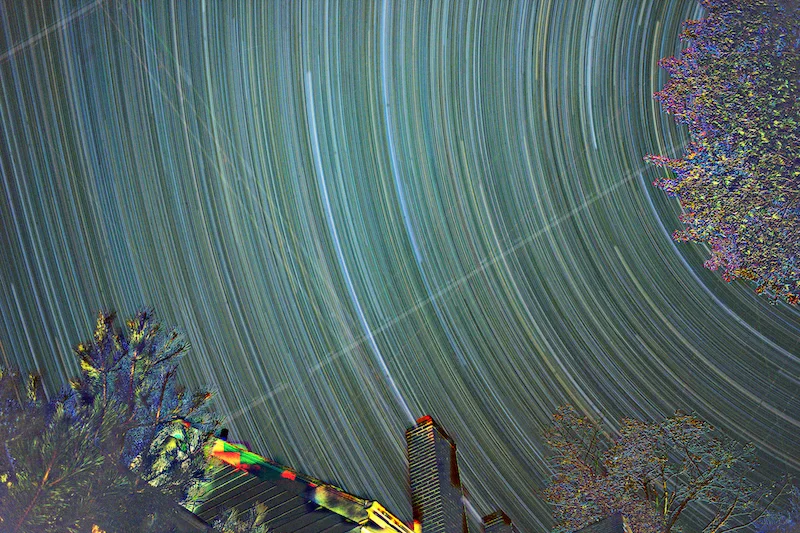
Draconid-rm-St copy.webp


The bright star trail in the middle, passing behind the chimney, is Vega. I didn't see any meteors last night, so I'm not surprised there aren't any in this image- the straight lines are all either airplanes or satellites. The oddly colored trees around the edges are essentially a processing artifact.
 
  • Like
  • Love
Likes   Reactions: collinsmark, Razvan Mihai, davenn and 1 other person
Astronomy news on Phys.org
Catching up with the backlog...

Currently my GM-8 mount is under repair- the quadrennial replacement of the declination gearbox- this is as much time on target (18 hours total) as I could get before the gearbox completely failed:

Stephans_quintet-St-65156s copy.webp


This is the full frame- the prominent galaxy is NGC 7331, there are easily a two or three dozen additional smaller galaxies scattered around; in the center is Stephans's quintet (100% crop):

Untitled.webp


At first I thought the faint smudge near the center was leftover noise, it's actually magnitude 15.6 Active Galaxy Nucleus candidate Z 495-7:

Untitled2.webp


This is my first Z7 astrophotography attempt at 800mm focal length. For whatever reason, imaging this target was thoroughly frustrating. Other than the failing gearbox, the average image quality was poor. One reason is that because the Z7 pixels are smaller than the D810, my system is now much more sensitive to both mis-focus (read: focus drift during falling nighttime temperatures) and bad seeing. For a few weeks, I wasn't sure if the Z7 sensor exceeded the capability of the lens (which is not the case for astrophotography @ 400mm or 105mm). I think I'm just much more seeing-limited than I was before.

FWIW, this is the 4th time I am replacing the gearbox- not complaining- because it's easy to replace and the GM-8 is a fantastic piece of equipment.
 
  • Like
Likes   Reactions: collinsmark, DennisN, Razvan Mihai and 1 other person
M27 Dumbbell Nebula
ZWO Seestar S50 Pro, 10 minute total, 10 sec subs, in Al/Az
In-scope adjustments
Sth of Campbelltown, about an hour south of my inner west Sydney home
 
Attachments
  • M27 Dumbell Nebula ssm.webp
    M27 Dumbell Nebula ssm.webp
    109.7 KB · Views: 1
  • Like
Likes   Reactions: DennisN, Razvan Mihai and collinsmark
Last week was completely cloudless and low humidity- unheard of! Here's a sequence of the moon:

DSC_8374 copy 2.webp


DSC_9736 copy 2.webp


DSC_0740 copy 2.webp


DSC_3606 copy 2.webp


DSC_3947 copy 2.webp


DSC_5683 copy 2.webp


DSC_5684 copy 2.webp


Here's a few close-ups (400%, no interpolation) of (imo) interesting features:

Untitled-1.webp


Alphonsus, in the center, with a low ridge, like a wrinkle.

Untitled 2-1.webp

North pole region


Untitled 3-1.webp

Gassendi

I've made a 6 x 6 image array of the lunar cycle before, back with the Sony a850, this is a good start on the next iteration :).
 
  • Like
  • Love
Likes   Reactions: DennisN, Frimus, Razvan Mihai and 2 others
Tarantula Nebula, also known as NGC 2070 or 30 Doradus, a southern hemisphere object near the Large Magellanic Cloud.
ZWO Seestar S50 Pro, 25 minute total, 10 sec subs, in Al/Az
In-scope and Lightroom adjustments
 
Attachments
  • Tarantula Nebula ssm.webp
    Tarantula Nebula ssm.webp
    214.2 KB · Views: 1
  • Like
Likes   Reactions: DennisN, collinsmark and Razvan Mihai