Discussion Overview
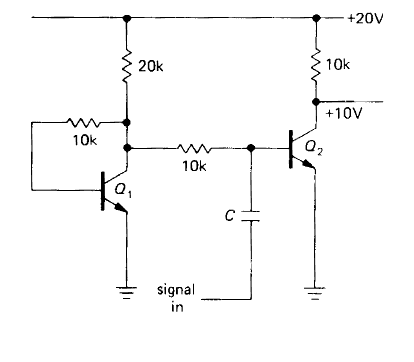
The discussion centers around whether a specific circuit can effectively compensate for temperature-dependent changes in the base-emitter voltage (VBE) of bipolar junction transistors (BJTs). Participants explore theoretical and practical aspects of circuit design, including the implications of temperature variations on transistor behavior.
Discussion Character
- Exploratory
- Technical explanation
- Debate/contested
- Mathematical reasoning
Main Points Raised
- One participant expresses uncertainty about calculating the collector voltage of Q1 and seeks a more rigorous solution than assumptions about base current.
- Another participant suggests using a current mirror configuration and provides a mathematical approach to calculate base current and collector voltage.
- Some participants argue that using a 10k resistor from collector to base is not standard practice and suggest that Q1 should be configured as a diode for better performance.
- Concerns are raised about the reliability of temperature compensation in discrete transistor configurations, emphasizing that matching transistors on the same die is crucial for effective compensation.
- Several participants discuss the temperature coefficient of VBE and how it affects circuit behavior, noting that without proper design, increased temperature can lead to increased current and further VBE drop.
- One participant critiques the educational approach to circuit design, arguing that theoretical exercises may not translate well to practical engineering challenges.
- Another participant highlights the importance of understanding the limitations of transistor parameters, such as beta (β), and how they can introduce errors in circuit performance.
Areas of Agreement / Disagreement
Participants do not reach a consensus on the effectiveness of the circuit for temperature compensation. Multiple competing views are presented regarding the design choices and their implications for performance.
Contextual Notes
Participants note that the assumptions about transistor matching and the impact of temperature on VBE are critical to the discussion. There are unresolved mathematical steps and varying opinions on the appropriateness of certain design practices.
Who May Find This Useful
This discussion may be of interest to students and practitioners in electronics and circuit design, particularly those exploring the effects of temperature on transistor behavior and compensation techniques.