Motion of mass constrained to rail

  • Thread starter Thread starter Fantasist
  • Start date Start date
  • Tags Tags
    Mass Motion
Click For Summary
The discussion revolves around the motion of a mass constrained to a rail, specifically a thin rigid rod moving frictionlessly along a curved path. Participants debate the conservation of energy and the forces acting on the rod as it transitions between straight and curved sections. Key points include the need for continuous curvature to avoid infinite forces and the role of both translational and rotational kinetic energy in determining the rod's speed. The conversation highlights the complexities of modeling such motion realistically, emphasizing that assumptions about the rod's constraints can lead to unrealistic scenarios. Ultimately, the consensus is that the rod's speed decreases in the curve but returns to its initial value upon exiting, adhering to energy conservation principles.
Fantasist
Messages
177
Reaction score
4
I have a classical mechanics problem related to the constrained motion of a mass:

as per the attached graphics, assume a thin rigid rod of length L and mass m moving frictionless constrained to a rail such that is always locally perpendicular to the latter. The rod starts off with speed v=v0 in the straight path of the rail. My question is, what is the speed in the apex of the curved section (half a circle with radius R), and what is the speed after it is in the straight section again? There are no external forces acting.

Thanks.
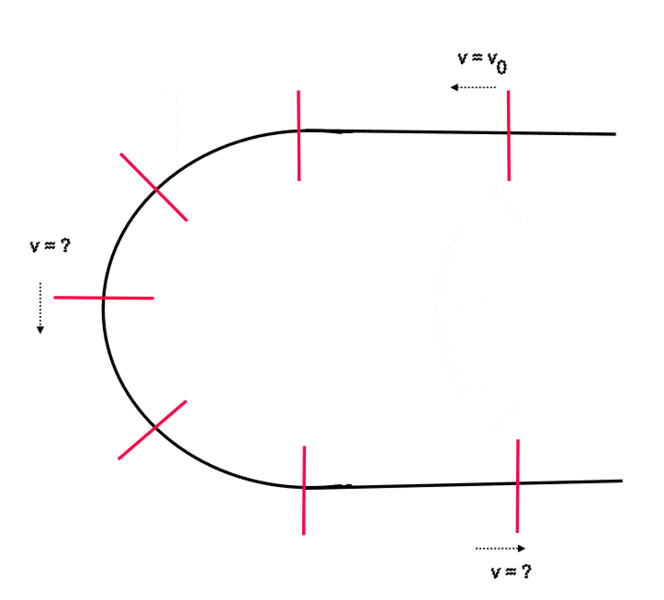
attachment.php?attachmentid=65359&stc=1&d=1388939802.gif
 

Attachments

  • rail.gif
    rail.gif
    9.2 KB · Views: 760
Physics news on Phys.org
If it is frictionless and the rail is immobile then the velocity of the rod center is constant.
 
There must be an external force on the rod. ( A central reaction force from the rail acting inward on the thin rigid rod. )
 
A.T. said:
If it is frictionless and the rail is immobile then the velocity of the rod center is constant.
In the curve, the motion along the rail is not the only contribution to the motion - rotation will need some energy.
The velocity is lower, but goes back to the initial value once the rod leaves the curve - this is a result of energy conservation.

The force between rod and rail is internal.
 
You have ##KE=\frac{1}{2} m v^2 + \frac{1}{2} I \omega^2## during the curve. From that you can do a little algebra to get:
v=\frac{2\sqrt{3}R}{\sqrt{L^2+12 R^2}}v_0
 
Last edited:
mfb said:
In the curve, the motion along the rail is not the only contribution to the motion - rotation will need some energy.
The velocity is lower, but goes back to the initial value once the rod leaves the curve - this is a result of energy conservation.

The force between rod and rail is internal.

But the rod could only be slowed down and accelerated by a force along the rail (after all, the motion is essentially restricted to one degree of freedom). Where does this force come from?

Also, wouldn't the rod have to be slowed down and sped up instantaneously to the appropriate speed when it enters and leaves the curved section?
 
Last edited:
Fantasist said:
Where does this force come from?
It comes from whatever it is that accomplishes this:
Fantasist said:
constrained to a rail such that is always locally perpendicular
 
Fantasist said:
Also, wouldn't the rod have to be slowed down and sped up instantaneously to the appropriate speed when it enters and leaves the curved section?
Yes, in the same way your rail needs "infinite forces" to start the rotation. A more realistic setup would have a curvature that increases gradually, then the forces and accelerations stay finite.
 
DaleSpam said:
You have ##KE=\frac{1}{2} m v^2 + \frac{1}{2} I \omega^2## during the curve. From that you can do a little algebra to get:
v=\frac{2\sqrt{3}R}{\sqrt{L^2+12 R^2}}v_0

Wrong, I think.

##KE=\frac{1}{2} m v^2 ##

or

##KE=\frac{1}{2} I \omega^2##

whatever you choose. You can not apply both formulae to a spinning mass.

It's common sense that the velocity of the rod center is constant.
 
  • #10
alva said:
You can not apply both formulae to a spinning mass.
Wrong, you have to account for both contributions (or choose a frame where the mass is not moving, only rotating - the center of the curve).
 
  • #11
Fantasist said:
But the rod could only be slowed down and accelerated by a force along the rail (after all, the motion is essentially restricted to one degree of freedom). Where does this force come from?

If you want the problem to be physically realistic (no "infinite forces" or "finite impulses applied instantaneously") then the track much have a continuously varying radius of curvature. Also, to apply a moment to the rod, there must be at least two points of contact, at different positions along the length of the track.

With those assumptions, the curvature at the different points of contact will be different, and the resultant forces on the rod can have a component that changes the "linear" speed of the rod along the track, as well as changing its angular velocity.
 
  • #12
mfb said:
Yes, in the same way your rail needs "infinite forces" to start the rotation. A more realistic setup would have a curvature that increases gradually, then the forces and accelerations stay finite.

I don't think that would be necessary because the rod itself, by taking time to enter the curve, would not need an infinite impulse to get it turning. The front section would be deflected a bit, on entering the curve and the deflection would reach a maximum once the rear section was on the curve. (It's a low pass temporal filter, in effect). But, in any case, it's only a step change in acceleration, which doesn't imply an infinite force - just a step change in force.
I don't think the angular rotation is any more relevant than the lateral deflection of the path. With an infinitely rigid rail and infinite mass, no energy can be lost from the rod.
 
  • #13
We can have different interpretations of exactly how to turn this into a physically realistic problem, but the bottom line is, the rod must be able to move along the track without any step changes in velocity (either linear or angular).

With an infinitely rigid rail and infinite mass, no energy can be lost from the rod.
I don't see why do you need "infinite mass" anywhere, unless you really meant "the track is fixed in an inertial coordinate system".
 
  • #14
alva said:
You can not apply both formulae to a spinning mass.
Not only can you apply both, you must apply both. This is common practice:

http://web.mit.edu/8.01t/www/materials/modules/chapter20.pdf eq 20.5.2
http://www2.cose.isu.edu/~hackmart/translation_rotation_work.pdf first two equations
http://physics.ucf.edu/~roldan/classes/phy2048-ch10_sp12.pdf section IX
Etc.
 
Last edited by a moderator:
  • #15
I don't understand why there is so much shock over the concept that, in the problem as stated, the forces and moments at the instantaneous transition between the straight and curved sections have to be infinite. We deal with this all the time in problems involving impact. In this problem, we basically have impact forces and moments applied by the rail at the two transitions. Big deal.

Chet
 
  • #16
Chestermiller said:
I don't understand why there is so much shock over the concept that, in the problem as stated, the forces and moments at the instantaneous transition between the straight and curved sections have to be infinite. We deal with this all the time in problems involving impact. In this problem, we basically have impact forces and moments applied by the rail at the two transitions. Big deal.

I agree with that in principle, but the "big deal" is that the OP's question about the velocity of the rail is not answerable as an impact problem, unless you assume something about the energy loss during the impact.

And you still need to explain away how the the impact can change the rod's angular velocity, without friction forces acting.

But I suppose whoever invented the problem expected the "average student" to realize you could get an answer using conservation of energy and just do the algebra, instead of thinking too hard about whether that method was justifiable.
 
  • #17
AlephZero said:
We can have different interpretations of exactly how to turn this into a physically realistic problem, but the bottom line is, the rod must be able to move along the track without any step changes in velocity (either linear or angular).


I don't see why do you need "infinite mass" anywhere, unless you really meant "the track is fixed in an inertial coordinate system".

I do. I was just putting it in a practical context.
 
  • #18
AlephZero said:
And you still need to explain away how the the impact can change the rod's angular velocity, without friction forces acting.
I think I can see how the impact can change the rod's angular velocity without friction acting. There is a "moment impulse" also. As you yourself indicated, there will be 2 points of contact in the curved section. Going into the curved section, there will first be one point of contact, and the, in rapid succession, a second point of contact. These normal contact forces will be very high at the transition, and produce the impulse moment. What is your opinion? Does this make any kind of sense?

Chet
 
  • #19
Surely, as the rod goes round the curve, its tangential velocity must be less than when along the straight. This allows the total KE (Rotational + Translational) to be unchanged. There will be a compression force on the rod as it enters the curve (slowing it down (gently - as the whole transitions onto the curve; there needs to be no step function in force, I think) and a tension, speeding it up on exit.
We needn't have friction if we don't want it and neither do we need any instant changes of anything.
 
  • #20
Chestermiller said:
I don't understand why there is so much shock over the concept that, in the problem as stated, the forces and moments at the instantaneous transition between the straight and curved sections have to be infinite.
I agree completely. The problem as stated included a bunch of simplifying but unrealistic assumptions (thin, rigid, completely constrained). Those assumptions can be understood as approximations. Under those approximations you get an impulsive torque at either end. That impulsive torque is also unrealistic, but can similarly be understood as an approximation. If you want to get rid of it then you merely have to get rid of the unrealistic approximations that generated it.
 
  • #21
DaleSpam said:
I agree completely. The problem as stated included a bunch of simplifying but unrealistic assumptions (thin, rigid, completely constrained). Those assumptions can be understood as approximations. Under those approximations you get an impulsive torque at either end. That impulsive torque is also unrealistic, but can similarly be understood as an approximation. If you want to get rid of it then you merely have to get rid of the unrealistic approximations that generated it.

Can you help me with this, please? How is the sudden application of the centripetal acceleration on the front of the rod any more problematic than a lossless bounce, which is usually treated as an impulse?
I assumed that this rod is just held on the track at a point at both ends. Is that right?
 
  • #22
Maybe I'm missing something, but I see no impact and not much complexity in identifying the energy loss:

If the rod is held onto the track with pins at front and back, then when it enters the curve, one pin is on the curve and the other is not. The rotational acceleration is finite and the force applied by the curve is not perpendicular.
 
  • #23
russ_watters said:
The force applied by the curve is not perpendicular.
Since the curve is frictionless, the force at any point on the curve is perpendicular to the curve, but not perpendicular to the velocity of the center of mass of the rod.
 
  • #24
rcgldr said:
Since the curve is frictionless, the force at any point on the curve is perpendicular to the curve, but not perpendicular to the velocity of the center of mass of the rod.

So that's ok, isn't it? I couldn't find anything wrong with this simple model and your point about the direction of the force could be what helps to make it all right.
I hate it when there seems to be no problem as far as I'm concerned and then someone with clout says there is a problem. haha
 
  • #25
rcgldr said:
Since the curve is frictionless, the force at any point on the curve is perpendicular to the curve, but not perpendicular to the velocity of the center of mass of the rod.
Yes, that's what I was getting at; not perpendicular to the rod.
 
  • #26
sophiecentaur said:
How is the sudden application of the centripetal acceleration on the front of the rod any more problematic than a lossless bounce, which is usually treated as an impulse?
I don't think that it is any more problematic. In fact, you can think of a lossless bounce of a thin rod which in certain circumstances can convert linear KE to or from rotational KE. Think of a thin rod dropped with high angular velocity, depending on how it hits the ground it can bounce sideways with greatly increased linear KE and reduced rotational KE. It is a very similar concept.
 
  • #27
russ_watters said:
Yes, that's what I was getting at; not perpendicular to the rod.

I wouldn't expect it to be perpendicular to the rod. The rod has to slow down to provide rotational KE. I've lost count about who is holding which side of the argument, (Poor old sod). It all seems to fit together with no paradox nor any infinite forces.
 
  • #28
DaleSpam said:
I don't think that it is any more problematic. In fact, you can think of a lossless bounce of a thin rod which in certain circumstances can convert linear KE to or from rotational KE. Think of a thin rod dropped with high angular velocity, depending on how it hits the ground it can bounce sideways with greatly increased linear KE and reduced rotational KE. It is a very similar concept.

You could possibly replace the curve with two reflectors at 45° to the straight track and get the same effect - with the above argument. But I think you would need to get the spacings right.
 
  • #29
DaleSpam said:
Not only can you apply both, you must apply both. This is common practice:

http://web.mit.edu/8.01t/www/materials/modules/chapter20.pdf eq 20.5.2
http://www2.cose.isu.edu/~hackmart/translation_rotation_work.pdf first two equations
http://physics.ucf.edu/~roldan/classes/phy2048-ch10_sp12.pdf section IX
Etc.
I looked at your 2 first references. They talk about other problem: a spinning body that has also transversal movement. This is not the case.

Perhaps we should do this experiment.
 
Last edited by a moderator:
  • #30
mfb said:
Yes, in the same way your rail needs "infinite forces" to start the rotation. A more realistic setup would have a curvature that increases gradually, then the forces and accelerations stay finite.

But there are no infinite forces here: in the straight section there is no force at all, in the curved section there is a (finite) centripetal force that keeps the rod on the rail. A force that changes from 0 to something finite shouldn't cause any problems, even if it changes instantaneously.
 

Similar threads

  • · Replies 54 ·
2
Replies
54
Views
5K
  • · Replies 21 ·
Replies
21
Views
2K
  • · Replies 6 ·
Replies
6
Views
3K
Replies
9
Views
6K
  • · Replies 3 ·
Replies
3
Views
3K
Replies
10
Views
3K
  • · Replies 11 ·
Replies
11
Views
2K
Replies
38
Views
3K
Replies
4
Views
3K
  • · Replies 1 ·
Replies
1
Views
2K