Wild Goose@pf.com - Have I been Chasing?

  • Thread starter Thread starter OmCheeto
  • Start date Start date
Click For Summary

Discussion Overview

The discussion revolves around the efficiency of vehicles, particularly in relation to an image that purportedly illustrates energy losses in engines and the implications of the second law of thermodynamics. Participants explore concepts of vehicle efficiency, energy extraction from waste heat, and the validity of claims made in the referenced image.

Discussion Character

  • Exploratory
  • Debate/contested
  • Technical explanation
  • Mathematical reasoning

Main Points Raised

  • Some participants believe the image in question has been previously discussed and assert that it accounts for the second law of thermodynamics.
  • One participant expresses a desire to find the most efficient vehicle, excluding bicycles, while another argues that bicycles should be considered.
  • A participant mentions a vehicle in England that achieves 6000 mpg, suggesting that bicycles represent a highly efficient model for vehicles.
  • There is a discussion about the feasibility of extracting the remaining 60-70% of energy from engines, with some arguing it is a waste of time due to the second law's implications.
  • Some participants highlight ongoing research into utilizing waste heat from engines, with references to specific technologies like BMW's "trubosteamer" system.
  • Concerns are raised about the practicality of achieving high efficiency in heat engines, with some suggesting that while lofty goals may inspire innovation, significant improvements are still possible.
  • One participant questions whether the graph should indicate energy that cannot be extracted due to the second law, leading to a discussion about the complexities of energy losses in thermodynamic cycles.
  • There are suggestions that replacing gasoline engines with diesel engines could improve efficiency, particularly when using biodiesel.
  • Some participants note the challenges in comparing diesel and gasoline engines due to differences in energy density and compression ratios.

Areas of Agreement / Disagreement

Participants express a mix of agreement and disagreement regarding the efficiency of vehicles and the potential for extracting energy from waste heat. While some believe that efforts to improve efficiency are worthwhile, others contend that certain goals may be unrealistic. The discussion remains unresolved with multiple competing views on the topic.

Contextual Notes

Participants acknowledge the limitations imposed by the second law of thermodynamics on energy conversion efficiency. There are also discussions about the assumptions underlying the claims made in the referenced image and the complexities involved in calculating energy losses in thermodynamic cycles.

OmCheeto
Gold Member
Messages
2,503
Reaction score
3,487
[SOLVED] Wild geese@pf.com

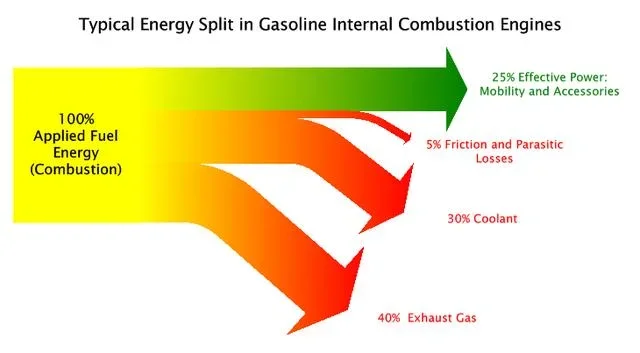
I'm new here and have spent 2 years moping about the following image:
1760903015395.webp


Has this image been discussed at your forum?
Does this image take into account the 2nd law of thermodynamics?
Have I been chasing a wild goose?
 
Last edited by a moderator:
Engineering news on Phys.org
I do believe this image has been used before here (or something very similar to it).

Yes this definitely takes the second law into account.

How can we say you've been on a wild goose chase if you haven't even said what you were looking for?
 
FredGarvin said:
I do believe this image has been used before here (or something very similar to it).

Yes this definitely takes the second law into account.

How can we say you've been on a wild goose chase if you haven't even said what you were looking for?

I'm looking for the most efficient vehicle of course. (bicycles do not count)
 
It sure would be cool if people finally realized that bicycles should count, but I guess that's not relevant here.

- Warren
 
putt.. putt... putt...

chroot said:
It sure would be cool if people finally realized that bicycles should count, but I guess that's not relevant here.

- Warren

Well, not quite totally irrelevant. There's a vehicle in England that get's 6000 mpg. I don't see any difference in pedaling and using a motor running on human generated fuels. (See https://www.physicsforums.com/showthread.php?t=203214&highlight=flatulence")

And bicycles are the best model for hyperefficent vehicles. What other device on the planet has been tweaked to such perfection. Actually, I've never heard of one having regenerative braking. So I'd say they could use some improvement as well.

And I never said my vehicle wouldn't have pedals did I.

FredGarvin said:
Yes this definitely takes the second law into account.
So it's not a waste of time trying to extract the other 60-70% of the energy?
I guess that was the question I was trying to ask.

BMW's been working on it for 10 years and doesn't seem to have progressed very far.
I can't help but think that the graph might have been based on some old Edsel.
 
Last edited by a moderator:
A lot of work has been done, especially in the area of extracting energy from the 40% contained in the exhaust. However, like the second law implies, you will NEVER be able to convert all of that energy into useful work.
 
OmCheeto said:
So it's not a waste of time trying to extract the other 60-70% of the energy?

Yes it is a "waste" of time.
 
FredGarvin said:
A lot of work has been done, especially in the area of extracting energy from the 40% contained in the exhaust. However, like the second law implies, you will NEVER be able to convert all of that energy into useful work.

Yes. I understand that. Shouldn't the graph then have an extra arrow labeled "energy which cannot be extracted due to the 2nd law..."?

I'm just trying to get someone to validate their numbers.
 
  • #10
OmCheeto said:
Yes. I understand that. Shouldn't the graph then have an extra arrow labeled "energy which cannot be extracted due to the 2nd law..."?

I'm just trying to get someone to validate their numbers.
I don't know. Obviously the person's picture was of a more general nature, saying where the energy goes rather than what is actually usable.
 
  • #11
stewartcs said:

Well, as a starting point it did.
I ended up here: http://mb-soft.com/public2/engine.html

The author described in detail why the graph looks the way it does.

He ended the paper with some research he had performed where he was able to take a 3.5hp engine, modify it somehow, and generate ~45 hp, at which point it blew up.

He did in the paper provide one number I was looking for; the temperature of combustion: 4000'F
Which from the http://hyperphysics.phy-astr.gsu.edu/hbase/thermo/carnot.html#c1" provided by your link yields a theoretical efficiency of 88% in a perfect carnot engine.

So I guess I've answered my own question. It is not a waste of time.
Though I suspected this all along as I didn't think those Bavarian's would waste their time on something they hadn't researched first.
 
Last edited by a moderator:
  • #12
This is a terrbile title for a thread- it tells us nothing about what is being asked.

That being said, increasing efficiency of an engine by trying to effectively utilize some of its waste heat is a big deal for a lot of auto manufacturers. I seem to remember reading that Mercedes and BMW are researching next-gen hybrid systems that use a small steam turbine powered from steam boiled from the exhaust gases to help the combustion engine along.

BMW's "trubosteamer" system nets a 15% increase in efficiency essentially for "free" (from energy that would otherwise be lost):

http://www.autoblog.com/2005/12/09/bmw-turbosteamer-gets-hot-and-goes/

How to extract heat energy and turn it into useful mechanical work is the biggest hurdle, especially in the case of energy lost through the radiator because the temperature difference between coolant and ambient is relatively small (~100C).
 
Last edited:
  • #13
stewartcs said:
Yes it is a "waste" of time.

I disagree, there is a lot of work that can be done for new ways to capture the waste heat energy and utilize it somehow...

Now it's probably a waste of time to try and achieve 80% efficiency (although lofty goals may help the invention process); I don't see why current engine technology can't become 20% more efficient through heat capture.
 
  • #14
Mech_Engineer said:
I disagree, there is a lot of work that can be done for new ways to capture the waste heat energy and utilize it somehow...

Now it's probably a waste of time to try and achieve 80% efficiency (although lofty goals may help the invention process); I don't see why current engine technology can't become 20% more efficient through heat capture.

I think it's definitely a waste of time to try and utilize the remaining 60% to 70% lost in the heat engine depicted in the OP's link. That would indicate a heat engine that is 85% to 95% efficient. I don't think that is plausible, which is why I said it was a waste of time.

However, it's not a waste of time to try and increase the efficiency of a heat engine to some degree by utilizing the exhaust gases.
 
  • #15
If you want to increase the efficiency of your gasoline engine then replace it with a diesel. Then, run it with a strong blend of biodiesel.

The Honda Civic Diesel has about a 5 mpg [average] advantage over the Honda Civic Hybrid.
 
Last edited:
  • #16
OmCheeto said:
Yes. I understand that. Shouldn't the graph then have an extra arrow labeled "energy which cannot be extracted due to the 2nd law..."?
There is some of that in each of the listed losses. I don't think exact quantity that can never be extracted is something you can calculate. It depends on how far you are willing to go to extract it (which is the whole reason it is such a complicated issue to deal with).

[edit] Ugh, I really shouldn't have forgotten this by now, but I think all of that energy shown as losses is "unavailable to do work", but only for that particular cycle. If you modify the cycle or add another cycle on to it, you change the entropy.
 
Last edited:
  • #17
Ivan Seeking said:
If you want to increase the efficiency of your gasoline engine then replace it with a diesel. Then, run it with a strong blend of biodiesel.

The Honda Civic Diesel has about a 5 mpg [average] advantage over the Honda Civic Hybrid.

Unfortunately, that's not really an apples to apples comarison... diesel and biodeisel have higher energy densities than gasoline, and as a general rule diesel engines run at much higher compression.
 

Similar threads

  • · Replies 2 ·
Replies
2
Views
3K
  • · Replies 77 ·
3
Replies
77
Views
7K
  • · Replies 3 ·
Replies
3
Views
1K
  • · Replies 12 ·
Replies
12
Views
4K
  • · Replies 12 ·
Replies
12
Views
2K
  • · Replies 1 ·
Replies
1
Views
2K
  • · Replies 3 ·
Replies
3
Views
2K
  • · Replies 15 ·
Replies
15
Views
3K
  • · Replies 73 ·
3
Replies
73
Views
3K
Replies
6
Views
3K