What Are the Four Degrees of Freedom in the Higgs Field?

Click For Summary

Discussion Overview

The discussion centers around the concept of the "four degrees of freedom" in the Higgs field, particularly in the context of the Higgs mechanism and its implications in quantum field theory. Participants explore the nature of these degrees of freedom, their relationship to particle mass, and how they fit into the broader framework of the Standard Model of particle physics.

Discussion Character

  • Exploratory
  • Technical explanation
  • Conceptual clarification
  • Debate/contested

Main Points Raised

  • Some participants explain that the four degrees of freedom in the Higgs field are not directly measurable physical quantities but rather scalar fields related to the Lagrangian of the model.
  • One participant suggests that the Higgs mechanism involves two fields that can be combined into a complex field, leading to the emergence of the Higgs field and the mass of gauge bosons.
  • Another participant describes the relationship between the Higgs field and electroweak symmetry, noting that while there are four degrees of freedom, only one remains after symmetry breaking, which gives rise to massive particles.
  • Several participants discuss the philosophical implications of fields, questioning what "creates" the Higgs field and how it fits into the understanding of fundamental forces and matter in quantum field theory.
  • There are attempts to find analogies to explain the existence of the Higgs field to a high school audience, with some suggesting that fields do not require a cause in the same way that forces do.

Areas of Agreement / Disagreement

Participants express varying degrees of understanding regarding the nature of the Higgs field and its degrees of freedom. While there is some agreement on the relationship between the Higgs field and particle mass, the discussion includes multiple competing views on how to conceptualize and explain these ideas, particularly to those with less background in physics.

Contextual Notes

There are limitations in the discussion regarding the assumptions made about the audience's prior knowledge of quantum field theory and the Lagrangian framework. Some participants express uncertainty about how to convey complex concepts to a less technical audience.

ryanwilk
Messages
55
Reaction score
0
Hi,

I'm doing an essay on the Higgs boson and I'm confused about what the "four degrees of freedom" of the Higgs field are. I know that the W and Z bosons become massive by absorbing 3 of the degrees of freedom and the remaining one becomes the Higgs boson but I don't really understand what this means. Are the degrees of freedom actual physical quantities?

Thanks.
 
Physics news on Phys.org
Not in the sense that you can measure them directly. They're really just scalar fields, variables in a Lagrangian.

How much do you know about quantum field theory? Or Lagrangian mechanics? I wouldn't want to get into a long detailed explanation that would go over your head :wink:
 
It's a L2 undergraduate essay so I don't really know much about either. I've attached what I've wrote so far about the Higgs mechanism. I just need a sentence or two where *** is, saying that the Higgs has 4 degrees of freedom and what this means...
I haven't mentioned the Lagrangian anywhere.
 

Attachments

  • higgs.JPG
    higgs.JPG
    61.7 KB · Views: 476
Last edited:
OK, let me see if I can fill in some details without getting too technical - not that you have to put this in your essay, it's just for your understanding.

In quantum field theory, basically everything is expressed in terms of fields, functions of spatial and temporal position. Kind of like the electric field and magnetic field (but those particular fields aren't the fundamental ones in QFT). The fields basically correspond to particles.

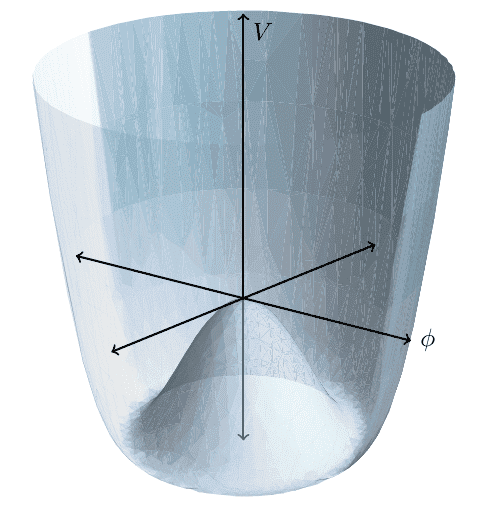
The Higgs mechanism requires a minimum of two of these fields, which could be labeled \phi_1 and \phi_2, or they could be combined into a single complex field \phi = \phi_1 + i\phi_2. Anyway, QFT has some sort of a potential energy that's associated with these fields. It's a function of the values of the fields. If you were to graph the potential V as a function of the complex field \phi, it might look like this:
potential.png

You'll notice that there is a whole ring of minimum-potential points, but the universe/particle/system/whatever you're dealing with can't be at every point on that ring simultaneously. It has to have some particular value of the field \phi - it has to be at one particular point, just as if you dropped a ball into this graph it would come to rest at one particular point on the ring. Basically, the Higgs mechanism consists of making a particular choice of coordinates to put that one particular point at the origin of the graph. You define a new complex field \eta which is a shifted version of \phi. That field \eta is the Higgs field.

Now, when you use \eta instead of \phi in the mathematics of QFT, you find that your gauge fields (the ones corresponding to the W and Z bosons) acquire a mass. For a simple example, think of this (I'm switching to real, not complex, variables now):
[(1 + A)\phi]^2 = \phi^2 + 2A\phi^2 + A^2\phi^2
In QFT, any term that contains a field variable squared times a constant (like m\phi^2) tells us the mass of that field. In the above expression, \phi has a mass of 1, but A has no mass since there's no term of the form m A^2. But when you substitute \phi \to \eta + D (this is how you shift the field), you get
[(1 + A)(\eta + D)]^2 = D^2+2 D^2 A+D^2 A^2+2 D \eta +4 D A \eta +2 D A^2 \eta +\eta ^2+2 A \eta ^2+A^2 \eta ^2
Now you see a term D^2 A^2, which means that now the particle corresponding to the field A has a mass of D^2. That's basically the gist of the Higgs mechanism.

The Higgs mechanism that gives the weak bosons mass is just a more complicated version of that. It involves four scalar fields, that could be labeled \phi_1, \phi_2, \phi_3, and \phi_4. (If you were to read papers on the subject, you'd often see them combined into two complex fields.) That's where the four degrees of freedom come from. There are also the three gauge fields for the W and Z bosons, which correspond to A in my example. I've only just started learning about this myself, so I couldn't really tell you much more than that, but hopefully that'll get you started :wink:
 
Thanks a lot. I think I get it now :smile:
 
Here's a short non-technical explanation if you're still interested:

The physical degrees of freedom associated with the Higgs are the symmetries of the model. Each symmetry of the model (really the Lagrangian of the model) has an associated Higgs field (eg the \phi_1 and \phi_2 that diazona is talking about).

Now, in the case of the Standard Model, the Higgs is associated with the electroweak symmetry -- this has 4 degrees of freedom (a higher dimensional analog of the figure provided by diazona, but conceptually equivalent). Early in the Universe's history, the Higgs field rolled down to one of the minima of the potential. This minimum no longer enjoys the full 4-dimensional symmetry of the theory, as you can see from looking at the lower dimensional analog. In fact, in the Standard Model, this minimum possesses only 1 symmetry, with 3 of the original 4 being "broken". These broken symmetries don't just disappear though -- they are what ultimately give rise to massive particles -- in this case, the three bosons of the electroweak force: Z and 2 W's.
 
Is there a simple way of explaining to a senior high school student what (if anything) creates these scalar fields. At senior high school level: mass 'creates' the familiar Newtonian gravitational field; charge 'creates' a classical electric field...therefore what 'creates' the Higgs field? Is an explanation at this level possible?
 
david2010 said:
Is there a simple way of explaining to a senior high school student what (if anything) creates these scalar fields. At senior high school level: mass 'creates' the familiar Newtonian gravitational field; charge 'creates' a classical electric field...therefore what 'creates' the Higgs field? Is an explanation at this level possible?

it has always been around, it is not a "force field"
 
Thank you. It just 'is'. Unfortunately (some) students (possibly because of the way the force fields are taught at high school level) seem to look for 'something' to be the 'cause' of the field's existence. Is there any useful analogy I can employ?
 
  • #10
david2010 said:
Thank you. It just 'is'. Unfortunately (some) students (possibly because of the way the force fields are taught at high school level) seem to look for 'something' to be the 'cause' of the field's existence. Is there any useful analogy I can employ?

Put it the other way around, masses are due to the field of gravity, and charges due to the field of electromagneism.. The concept of field was actually very debated in philosophical circumstances when it was introduced by guys like faraday etc in the 19th century.

So asking what is the cause of one another is like the chicken and the egg...
 
  • #11
Quantum field theory teaches us that the fundamental entities of particle physics are fields. Of course, we're all familiar with gravitational fields and electromagnetic fields -- these are force fields, which, as has been mentioned in the post, are 'created' by something. But, we don't stop there. On equal footing with these force fields are electron fields, quark fields, and yes, the Higgs field. In quantum field theory (qft), we no longer think of, say, electrons as a fundamental entity, but as excitations of the electron field (just as photons are the excitations of the electromagnetic field). Nothing 'causes' the matter fields.

So, qft gives us a unified picture of both forces and matter -- they are all just fundamental fields, and the particles -- electrons, quarks, Higgs bosons, what have you -- are all just excitations of these fields. Bottom line: everything is a field -- some fields mediate forces, some do not. The confusion is probably a historical accident -- fields were invented to understand the influence of forces.
 
Last edited:
  • #12
ansgar said:
Put it the other way around, masses are due to the field of gravity, and charges due to the field of electromagneism.. The concept of field was actually very debated in philosophical circumstances when it was introduced by guys like faraday etc in the 19th century.

Ansgar, this is not correct. Masses are not due to gravity. Within the standard model, masses are generated through interaction with the Higgs field. Gravity would be perfectly happy in a massless world, since it is energy that gravitates.

I also don't understand why you claim that charges are due to electromagnetism. Can you elaborate on this?
 
  • #13
bapowell said:
Ansgar, this is not correct. Masses are not due to gravity. Within the standard model, masses are generated through interaction with the Higgs field. Gravity would be perfectly happy in a massless world, since it is energy that gravitates.

I also don't understand why you claim that charges are due to electromagnetism. Can you elaborate on this?

not all masses are created with interaction with the higgs field...
 
  • #14
ansgar said:
So asking what is the cause of one another is like the chicken and the egg...
Off topic alert ;):
The egg came first, assuming you believe evolution.
This is pretty obvious if you think about it.
 

Similar threads

  • · Replies 8 ·
Replies
8
Views
3K
  • · Replies 11 ·
Replies
11
Views
3K
  • · Replies 7 ·
Replies
7
Views
3K
  • · Replies 4 ·
Replies
4
Views
2K
  • · Replies 4 ·
Replies
4
Views
2K
  • · Replies 13 ·
Replies
13
Views
4K
  • · Replies 31 ·
2
Replies
31
Views
8K
  • · Replies 2 ·
Replies
2
Views
2K
  • · Replies 38 ·
2
Replies
38
Views
8K
  • · Replies 12 ·
Replies
12
Views
4K