0-1A Bidirectional Current Source

Click For Summary
The discussion focuses on designing a bidirectional current source for measuring very low resistances, specifically addressing issues with achieving a 1A output. Participants discuss the role of 1K resistors and capacitors in the circuit, noting that increasing the resistor values may help improve current drive. Suggestions include using higher gain power transistors, such as Darlington pairs, or cascading an additional transistor output stage with lower resistance values for increased current. The potential use of an AC bridge circuit, like the Kelvin Double Bridge, is mentioned as an alternative for low resistance measurement. Overall, the conversation emphasizes the need for circuit modifications to enhance current sourcing and sinking capabilities.
saad87
Messages
83
Reaction score
0
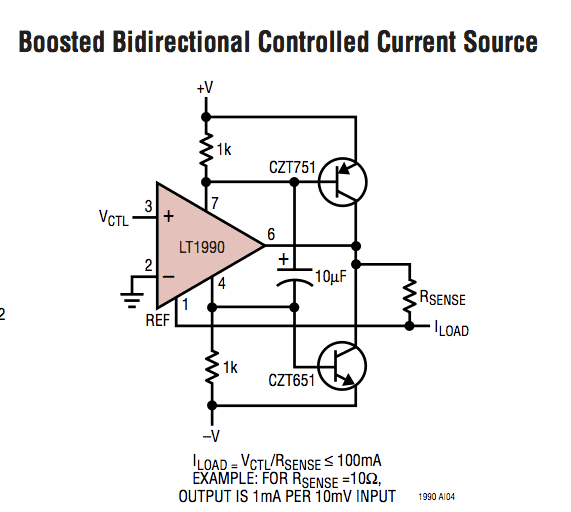
I'm trying to design a bidirectional current source for the purpose of measuring very small (0.0001 Ohm) resistances. I've come across this circuit:
PUp9g.png


I can see that the transistors are there to 'boost' the current but I don't understand the purpose of the 1K resistors and the capacitor. I also don't follow how I can increase the current rating of this pump to 1A.

I've simulated the circuit in LTSpice and it works very well at 100mA but when I try to source or sink 1A I only get 850mA out.

Any suggestions on increasing the current sourcing/sinking ability of the above circuit to 1A or any other suggestions for such a pump?
 
Engineering news on Phys.org
I don't have any opinion about that circuit, I'm afraid but I wonder whether you ever considered using an AC bridge circuit for measuring low resistance values? The Kelvin Double Bridge (Google it) has been used for ages to measure very low values of resistance. Old fashioned engineering is often a good way to go at the fringes of measurement.
 
I've read that circuit sucks (hard to keep stable), but have no experience with it. Maybe increasing the 1K resistors will increase the drive.
 
That's a bit of a weird circuit. It's using the power drawn by the opamp to turn on the transistors. (note the 1 k hom resistors are in the power supply leads.) (And I don't quite see how the feed back works.)

You might try a power opamp. Maybe the TCA0372. Can the load float or does it need to be grounded?
George H.
 
The 1k resistors must be low enough to not turn on the power transistors when the op-amp quiescent current flows. When op-amp output current flows, it turns on the power transistors as it must also flow through the 1k resistors.

To increase output current you could use higher gain power transistors such as Darlington pairs.
An alternative would be to cascade another transistor output stage, but use 100 ohm resistors for the final stage for ten times the current.
 
I am trying to understand how transferring electric from the powerplant to my house is more effective using high voltage. The suggested explanation that the current is equal to the power supply divided by the voltage, and hence higher voltage leads to lower current and as a result to a lower power loss on the conductives is very confusing me. I know that the current is determined by the voltage and the resistance, and not by a power capability - which defines a limit to the allowable...

Similar threads

  • · Replies 44 ·
2
Replies
44
Views
7K
  • · Replies 6 ·
Replies
6
Views
8K
  • · Replies 12 ·
Replies
12
Views
2K
  • · Replies 2 ·
Replies
2
Views
2K
  • · Replies 7 ·
Replies
7
Views
2K
Replies
7
Views
2K
Replies
68
Views
7K
  • · Replies 3 ·
Replies
3
Views
10K
  • · Replies 14 ·
Replies
14
Views
2K
  • · Replies 37 ·
2
Replies
37
Views
5K