Stomachbuzz
- 1
- 0
Moved from a technical forum, no template.
Hi there,
I've got a Heat Transfer problem that I can't seem to get right.
I will list all information in the problem without 'interpreting' it:
Givens: 100 cm long cylinder filled with hot water, and constantly heated to maintain the water at 100°C. Heat is transferred via conduction from inner to outer surface, and convection from there. Ignoring heat losses from top and bottom of cylinder.
InnerR=50cm, OuterR=62cm
Water temp = 100°C
Outer Temp = 80°C
Ambient Temp = 20°C
h = 10W/m^2 * K
k = 20W/m* K
"When operated steadily, the conduction heat transfer from outer surface to ambient air is equal to the conduction through the wall from inside surface to outside surface"
Find:
1) the heat loss from the cylinder to ambient air
2) Find T as a function of r
3) Find inner surface temperature
For 1, I used Qcond, cyl = -kA(dT/dr)
Q/(2πr*L) dr = -k dT
Integrate:
Q = 2πk*L (T1 - T2)/(ln(r2/r1))
I found this method from a University .edu site, and it made sense to me.
Plugging in numbers, I get Q = 2π * (20) * (1m) (20°C/ (ln(62/50)) = 11,684 watts.
This seems a bit high considering the mild ΔT and small volume but...what do I know
so I go onto part 2:
Again, drawing from .edu site, I use (d/dr (r * dT/dr)) = 0
Integrate: r * dT/dr = c1
Algebra: dT= c1 * (dr/r)
Integrate: T = c1 * ln(r/r1) + c2
I understand it that when r=r1 (inner radius), the temperature would be equal to inner surface temp. Which I want to assume is 100°C, but you know where that gets me...
I know when r=r2 T=Touter = 80°C
I'm trying to solve for c1 using a ΔTmax formula I found, and this is where it gets murky.
ΔTmax, cyl = (g⋅L2)/2k
L and k are given, but what's g, right?
Well, I figure I can just borrow Q from part 1, and divide by volume, no? Qdot = gdot * V
11684w / (.622 -.52)(π)(1m) = 27,672 w/m3 =gdot which, again, seems high but
The catch (for me at least) is trying to draw equivalence with the convection equation, Qdot = hA(Ts - T∞)
Using that one, Q= (10 w/m2 *k)(.62m * 2π) (80-20°C)= 10 * 3.896 * 60 = 2,337 watts
Which is much different. 2,337 ≠ 11684
What's goin on here?
Thanks in advance for the help. I've found my way onto this forum for years doing homework through HS and college. I know I'm in for a treat.
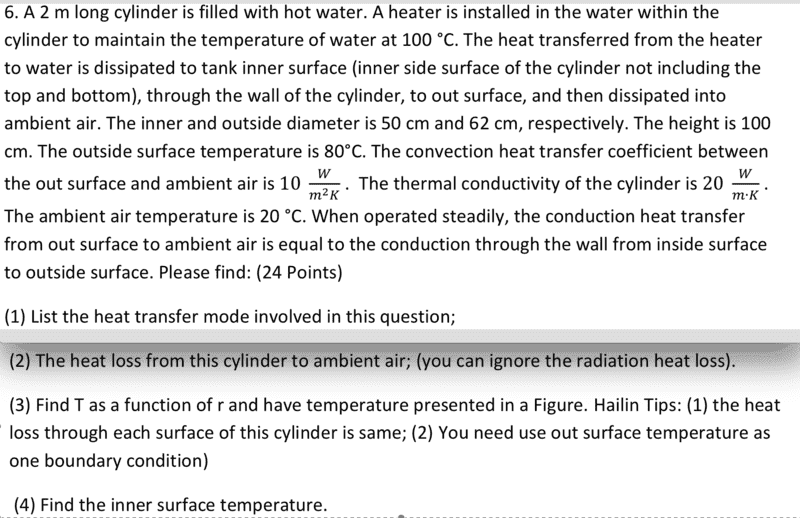
Including screenshot of homework problem here. I do realize it lists both 2m and 100cm as height. I figured it was an error (conflicting) and didn't matter as long as height used is consistent.
I've got a Heat Transfer problem that I can't seem to get right.
I will list all information in the problem without 'interpreting' it:
Givens: 100 cm long cylinder filled with hot water, and constantly heated to maintain the water at 100°C. Heat is transferred via conduction from inner to outer surface, and convection from there. Ignoring heat losses from top and bottom of cylinder.
InnerR=50cm, OuterR=62cm
Water temp = 100°C
Outer Temp = 80°C
Ambient Temp = 20°C
h = 10W/m^2 * K
k = 20W/m* K
"When operated steadily, the conduction heat transfer from outer surface to ambient air is equal to the conduction through the wall from inside surface to outside surface"
Find:
1) the heat loss from the cylinder to ambient air
2) Find T as a function of r
3) Find inner surface temperature
For 1, I used Qcond, cyl = -kA(dT/dr)
Q/(2πr*L) dr = -k dT
Integrate:
Q = 2πk*L (T1 - T2)/(ln(r2/r1))
I found this method from a University .edu site, and it made sense to me.
Plugging in numbers, I get Q = 2π * (20) * (1m) (20°C/ (ln(62/50)) = 11,684 watts.
This seems a bit high considering the mild ΔT and small volume but...what do I know
so I go onto part 2:
Again, drawing from .edu site, I use (d/dr (r * dT/dr)) = 0
Integrate: r * dT/dr = c1
Algebra: dT= c1 * (dr/r)
Integrate: T = c1 * ln(r/r1) + c2
I understand it that when r=r1 (inner radius), the temperature would be equal to inner surface temp. Which I want to assume is 100°C, but you know where that gets me...
I know when r=r2 T=Touter = 80°C
I'm trying to solve for c1 using a ΔTmax formula I found, and this is where it gets murky.
ΔTmax, cyl = (g⋅L2)/2k
L and k are given, but what's g, right?
Well, I figure I can just borrow Q from part 1, and divide by volume, no? Qdot = gdot * V
11684w / (.622 -.52)(π)(1m) = 27,672 w/m3 =gdot which, again, seems high but
The catch (for me at least) is trying to draw equivalence with the convection equation, Qdot = hA(Ts - T∞)
Using that one, Q= (10 w/m2 *k)(.62m * 2π) (80-20°C)= 10 * 3.896 * 60 = 2,337 watts
Which is much different. 2,337 ≠ 11684
What's goin on here?
Thanks in advance for the help. I've found my way onto this forum for years doing homework through HS and college. I know I'm in for a treat.
Including screenshot of homework problem here. I do realize it lists both 2m and 100cm as height. I figured it was an error (conflicting) and didn't matter as long as height used is consistent.
