1018 carbon steel tensile test explanation

Click For Summary

Discussion Overview

The discussion revolves around the tensile testing of 1018 unheat treated carbon steel samples that yielded significantly different results despite being assumed similar. Participants explore potential reasons for the discrepancies in the tensile test outcomes, focusing on experimental setup and measurement accuracy.

Discussion Character

  • Exploratory
  • Technical explanation
  • Debate/contested

Main Points Raised

  • One participant reports testing two samples of 1018 carbon steel with differing tensile test results, raising questions about the reliability of the experimental setup.
  • Another participant challenges the reported tensile test values, suggesting that the yield stress and strain are inconsistent with known properties of steel, indicating potential errors in measurement or calculation.
  • A participant acknowledges a calculation error regarding stress but maintains that the observed differences in test results are not due to this mistake.
  • Concerns are raised about the linearity of elastic modulus in carbon steel and the implications of differing results on the validity of the experimental setup.
  • Participants suggest a thorough review of the testing equipment, calibration, and potential sources of error, particularly in strain measurement and data labeling.

Areas of Agreement / Disagreement

Participants express disagreement regarding the accuracy of the tensile test results and the reliability of the experimental setup. There is no consensus on the cause of the discrepancies, with multiple viewpoints on the validity of the measurements and calculations.

Contextual Notes

Limitations include potential errors in the experimental setup, measurement techniques, and data interpretation. The discussion highlights the need for careful examination of the testing process and equipment.

Jacob Noble
Messages
3
Reaction score
0
TL;DR
Tensile tested 2 samples of 1018 unheat treated carbon steel, assumed to be very similar steel (bought from same place, same order, ect) very different tensile test results.
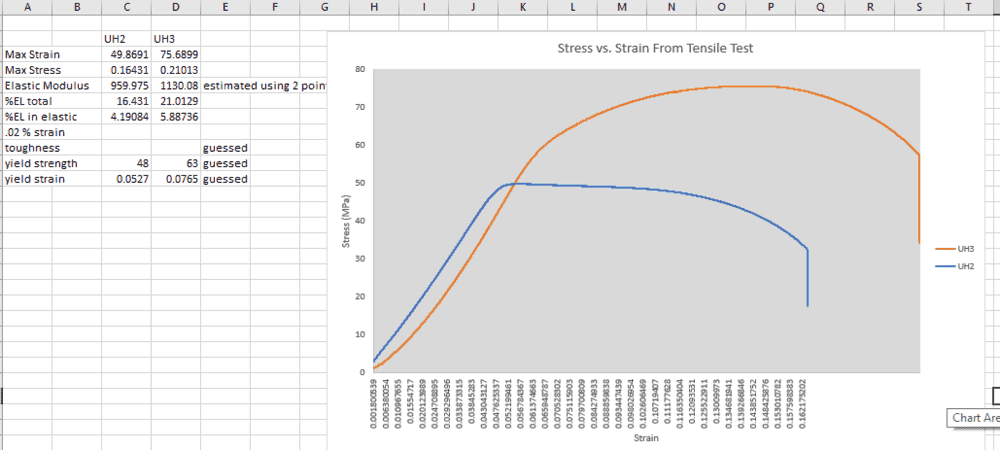
Tensile tested 2 samples of 1018 unheat treated carbon steel, assumed to be very similar steel (bought from same place, same order, ect) but very different tensile test results.
The results of the tensile test can be seen below as well as a few calculated values. I do not know what this would be from as the samples were tested on same machine with changing settings (re balanced), one after the other, measurements taken from same spots.
Screenshot (18).png
 
Engineering news on Phys.org
Raw data for both test
 

Attachments

For starters, your numbers are completely wrong for any type of steel. AISI 1018 steel could have a yield somewhere near 50 KSI if is was cold rolled, but a yield stress of 50 MPa (7.25 KSI) is not steel. A strong plastic, maybe, but not steel. Similarly, a yield strain of 0.04 is way beyond any steel on this planet.

Go back and take a long hard look at the experimental setup. How is the force and strain measured? Has the equipment been calibrated? Recheck every step of your calculations. And add units to the labels in your spreadsheet.
 
  • Like
Likes   Reactions: berkeman
I was off by a factor of 10 for stess in my calculations. So 500 not 50 MPa.
The units are now fixed but still the large problem of difference in the graphs.
The difference was also immediately noticed when testing by the automatic graphing the testing program has, meaning it did not come from error in my calculations.
 
All carbon steel has the same elastic modulus, and that modulus is linear. When two different samples of similar steel show different elastic moduli, and one of those is curved, the experimental setup is suspect. Please reread the rest of my post with that in mind.

When the labels in your spreadsheet are confusing, or flat wrong (stress vs strain), readers can easily get the idea that you rushed the process without thinking about what is being done. The fact that a specimen was loaded into a machine, a button was pushed, and data output, does not mean that the data is correct. Given what you have showed us, I suggest that you spend several hours studying the machine, and asking yourself what could go wrong. That includes studying the owner's manual in detail.

Hint: If the strain was measured with an extensometer, those are subject to a number of errors. Pretend that you have an exam tomorrow on error sources in the entire setup - test machine, data reduction, strain measurement, force measurement, etc.

Another hint: When I said "several hours", I was being conservative, not facetious. Expect to take longer than that if you want to do it right.
 
  • Like
Likes   Reactions: jim mcnamara

Similar threads

  • · Replies 5 ·
Replies
5
Views
8K
  • · Replies 6 ·
Replies
6
Views
2K
  • · Replies 2 ·
Replies
2
Views
3K
  • · Replies 1 ·
Replies
1
Views
2K
  • · Replies 3 ·
Replies
3
Views
3K
  • · Replies 3 ·
Replies
3
Views
6K
  • · Replies 9 ·
Replies
9
Views
21K
Replies
2
Views
2K
  • · Replies 9 ·
Replies
9
Views
3K
Replies
14
Views
3K