1500w 120vac variable power control

Click For Summary

Discussion Overview

The discussion revolves around the use of a light dimmer circuit for variable power control of a load up to 1500W at 120V. Participants explore the implications of using a triac-based dimmer, including concerns about harmonics and safety in high-power applications.

Discussion Character

  • Exploratory
  • Technical explanation
  • Debate/contested

Main Points Raised

  • One participant expresses concern about using a light dimmer for large loads, citing warnings about phase switching and potential issues with direct current in the neutral line and harmonics in the power supply frequency.
  • Another participant argues that light dimmers produce a symmetrical output and do not introduce DC into the neutral line, although they acknowledge the introduction of harmonics and potential radio interference.
  • A suggestion is made to add a resistor from the gate to MT1 of the triac to improve circuit reliability, along with a caution regarding the gate current and triac ratings.
  • A participant shares an anecdote about using triac-based dimmers in theatrical applications, noting that larger setups require significant heat sinks, implying that high power applications can be managed with appropriate hardware.
  • For controlling heaters, one participant recommends using a zero-crossing module instead of a light dimmer, suggesting that it would be more effective and manageable.

Areas of Agreement / Disagreement

Participants express differing views on the safety and effectiveness of using light dimmers for high-power applications. There is no consensus on whether the concerns about harmonics and DC in the neutral line are valid or significant.

Contextual Notes

Participants mention various assumptions about the circuit's design and safety, as well as the specific applications for which the dimmer is intended, but these assumptions remain unresolved.

T Handy
Messages
1
Reaction score
0
Hello,

I've got an extremely limited background in electronics, so I'd like to ask for some advice regarding this circuit:
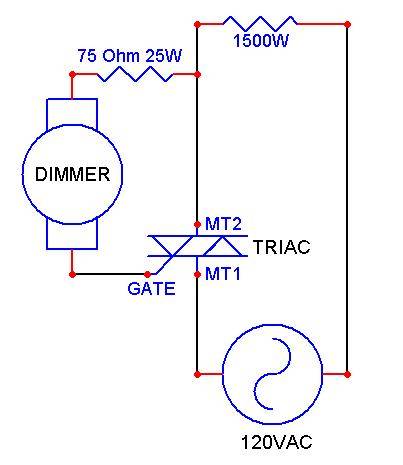
6wWj6.jpg


I found the diagram online, It's supposed to allow variable control of a load up to 1500w at 120v, using an ordinary light dimmer and a 600V / 40A triac.

After doing some research on the subject, I found a few warnings that boiled down to "do not control a large load with a light dimmer because regardless of rating, dimmers use phase switching and introduce direct current into the neutral line and multiple harmonics into the power supply frequency"

A few people have told me this is not a concern, but I'd feel better if someone with some electrical engineering in their background could advise one way or the other.

Thanks!
 
Engineering news on Phys.org
Welcome to PhysicsForums!

Your question is a little general: what is it that you're trying to control, and in what environment? (e.g. a trough heater in a barn vs. a peristaltic pump in a hospital)
 
Light dimmers use triacs and so give a symmetrical output to a lamp. So, they do not produce DC in the neutral line.

It will certainly introduce harmonics, though. Light dimmers are notorious for producing radio interference.
I had a couple and got rid of them for this reason.

That circuit looks like it might work OK. I keep wanting to put a resistor from the gate to MT1.
I guess the worst that could happen is you could blow up a triac and the load would get power all the time.

The gate current is a bit of a worry, though. It would be about an amp. So, you could check for the maximum rating of your triac.

As a safety warning, you probably realize that the voltages in this circuit are very dangerous and you should not even turn it on unless all metal parts are covered.
 
I've seen Triac based dimmers used in theatre work that have a heat sink about as long as my arm. So, there'll always be someone willing to take it to insanety. Then again, when it comes to driving 10,000 watt Xenon lamps, maybe that's the right answer.

If you're looking to control a heater, I'd simply buy a zero-crossing module and pucky it to a heat sink about the size of your hand. With a thermal time constant in the minutes, your controller won't even realize that your PWM rate is only .5Hz...
 

Similar threads

  • · Replies 29 ·
Replies
29
Views
6K
  • · Replies 3 ·
Replies
3
Views
3K
  • · Replies 5 ·
Replies
5
Views
2K
Replies
11
Views
29K
Replies
5
Views
3K
  • · Replies 2 ·
Replies
2
Views
5K
  • · Replies 6 ·
Replies
6
Views
3K
  • · Replies 1 ·
Replies
1
Views
4K
  • · Replies 9 ·
Replies
9
Views
4K