Possible Line Power Conditioner hobby project

Click For Summary

Discussion Overview

The discussion revolves around the feasibility of building a Line Power Conditioner, specifically a single-phase active power line conditioner (APLC). Participants explore various approaches, algorithms, and components necessary for the project, which is aimed at maintaining sinusoidal current for a harmonic load. The conversation includes considerations of technical challenges, available resources, and the participants' varying levels of experience.

Discussion Character

  • Exploratory
  • Technical explanation
  • Debate/contested
  • Mathematical reasoning

Main Points Raised

  • One participant expresses concern about the complexity of controlling variable speed inverters and the availability of necessary algorithms, preferring to use a Raspberry Pi for the project.
  • Another participant suggests starting with a Shunt Active Filter (AF) for maintaining sinusoidal source current, indicating that it may be simpler than the proposed design.
  • Discussion on the Instantaneous Power Theory as a recommended algorithm, with a reference to a specific book for further reading.
  • Participants mention the need for high switching frequencies for effective performance, with suggestions of 20 kHz or higher for hysteresis control.
  • One participant questions the feasibility of achieving the required switching frequency with a Raspberry Pi and references an IEEE article for further insight.
  • There is a query about the type of load to be compensated, with suggestions that space vector modulation may be applicable for three-phase systems.
  • Another participant provides a link to a Simulink file for experimenting with different switching and sampling frequencies.
  • Discussion includes the potential use of an H-bridge for a single-phase system and the applicability of pq-theory for single-phase scenarios.
  • Participants share links to resources and simulation models related to single-phase shunt active power filters and pq-theory.

Areas of Agreement / Disagreement

Participants express varying levels of confidence regarding the project's feasibility and the complexity of the algorithms involved. There is no consensus on the best approach or the specific challenges that may arise, indicating multiple competing views and unresolved questions.

Contextual Notes

Participants acknowledge limitations in their access to certain academic resources, which may affect the depth of their research and understanding of the algorithms and components discussed.

tim9000
Messages
866
Reaction score
17
Hi All,

[This thread has been re-started to accommodate modification of the project for the benefit of anyone that isn't a qualified Professional. Specifically the use of a Low Voltage isolated Source.]

I want to get the opinion of people with more experience than me, regarding a project I was thinking about undertaking.

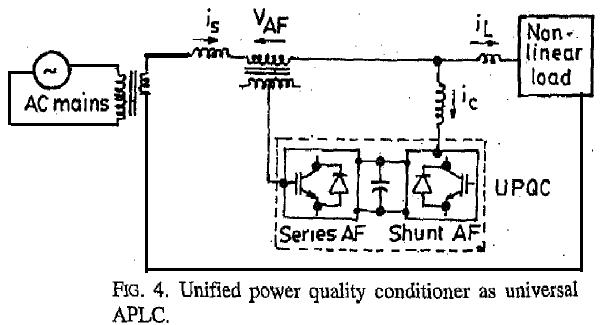
I am wondering if it would be realistically feasible for me to build a Line Power conditioner. Something like this single phase (2 wire) Universal APLC:
upload_2018-1-23_12-8-50.png


However, I'm afraid that controlling the variable speed inverters would be too difficult, I'd like to use something cheap like a raspberry pi if possible. I'm worried that the necessary algorithms wouldn't be publicly available. Or the necessary suitable PT and CT would be too hard to find, or interfacing between control and inverter would be too difficult.

Mostly I'm interested in maintaining sinusoidal current for about a 10 amp somewhat harmonic load.

I'd prefer to find a schematic to roughly go off, because I'm more interested in the experience of building and playing with it, rather than doing base R&D reinventing the wheel writing all this controller code. [Some available literature to go off would be good]

Given the outlined circumstance and the fact that I'd like to spend maybe 20 hours max, working on it (not 100s of hours) would this be a suitable project? Or is this not realistic for something one should build in a DIY manner? I see a lot of possible hurdles which might stop the project from getting off the ground."

Thanks
 

Attachments

  • upload_2018-1-23_12-8-50.png
    upload_2018-1-23_12-8-50.png
    8.9 KB · Views: 680
Engineering news on Phys.org
Windadct said:
Have you researched Active Filters? -- actually a little simpler than your diagram.
I've only done about an hour and a half's research, no. What more simple topologies should I be looking into?

Baarken said:
If you are only interested in maintaining sinusoidal source current, as far as I know, you would only need the Shunt AF. The Series AF is there to compensate for any voltage harmonics, voltage unbalance etc. from the utility.
I would certainly start with only the Shunt AF. Then if successful, move onto incorporating the Series AF.

Baarken said:
There are several algorithms available, the one that seem to be the most popular is the Instantaneous Power Theory. This book: Instantaneous Power Theory and Applications to Power Conditioning by H. Akagi et al. is a good reference in my opinion.
Thank you for the recommendation, if the project goes ahead, this will be an invaluable help.

Baarken said:
Yes, if you want good performance (and depending on which switching algorithm you use) you need a very high switching frequency to obtain good results.

Based on this page:
https://raspberrypi.stackexchange.com/questions/28319/rpi-use-in-inverter
I assume 20kHz is possible on an Rpi. Would this be high enough for a decent hysteresis control switching frequency?

Baarken said:
The simplest PWM algorithm, in my opinion, would be the Hysteresis Current Control but requires high switching frequency. A more advanced algorithm would be space vector modulation (SVM)

I saw some simulations (I can't remember where), where they used the instantaneous power theory togheter with hysteresis current control. The switching frequency was in the range 30-70 kHz, if this is possible in real life with limited budget I do not know.
I remember learning the theory of SVM, I assume this would be very difficult (for me) to code for.Does anyone know of any off-the-shelf equipment (like inverters etc.) which they would recommend for a project like this?

Thanks!
 
tim9000 said:
I assume 20kHz is possible on an Rpi. Would this be high enough for a decent hysteresis control switching frequency?
Sorry, but I can't say, I would think the performance might suffer, but worth a try if its a fun DIY-project. If you have access to the ieee xplore library (I dont), this article might provide us the answer: http://ieeexplore.ieee.org/document/7042030/

What type of load do you want to compensate for? Single phase, three phase (without neutral) or three phase (with neutral)? If it is three phase (without neutral) I think it should be doable to implement space vector modulation as there are a lot of available references out there. Maybe there is some finished software available aswell.

Do you have MATLAB/Simulink by the way? I found this Simulink file: https://www.mathworks.com/matlabcentral/fileexchange/42753-shunt-active-power-filter
You could play around with different switching and sampling frequencies and see how it effect the results?
 
Baarken said:
Sorry, but I can't say, I would think the performance might suffer, but worth a try if its a fun DIY-project. If you have access to the ieee xplore library (I dont), this article might provide us the answer: http://ieeexplore.ieee.org/document/7042030/

What type of load do you want to compensate for? Single phase, three phase (without neutral) or three phase (with neutral)? If it is three phase (without neutral) I think it should be doable to implement space vector modulation as there are a lot of available references out there. Maybe there is some finished software available aswell.

Do you have MATLAB/Simulink by the way? I found this Simulink file: https://www.mathworks.com/matlabcentral/fileexchange/42753-shunt-active-power-filter
You could play around with different switching and sampling frequencies and see how it effect the results?
Thanks for your reply.
I don't have access to IEEE at the moment, but I'll see.

It would be for a single phase system, although I'm not sure how much more simple that would make it. Although, does that mean I can get away with just using a H-bridge rather than an inverter?

I do have access to Matlab, thanks for the file, I'll take a look. Do you know of a single phase equivalent strategy (I assume pq theory is just for 3-phase)?
 
Last edited:
tim9000 said:
Do you know of a single phase equivalent strategy (I assume pq theory is just for 3-phase)?
I found this: https://www.mathworks.com/matlabcen...e-power-filter-based-on-three-phase-pq-theory
It is a single phase shunt AF that uses the pq-theory.

I am not familiar with using the pq-theory for singel phase, but looking inside the simulation model the author generate "artificial" voltages and currents for phase b and c and by doing that he is able to calculate the required compensating current.
 
Baarken said:
I found this: https://www.mathworks.com/matlabcen...e-power-filter-based-on-three-phase-pq-theory
It is a single phase shunt AF that uses the pq-theory.

I am not familiar with using the pq-theory for singel phase, but looking inside the simulation model the author generate "artificial" voltages and currents for phase b and c and by doing that he is able to calculate the required compensating current.

Interesting, looks like I've got a lot of research to do on pq-theory.

Thanks
 

Similar threads

Replies
6
Views
4K
Replies
21
Views
3K
Replies
9
Views
2K
  • · Replies 5 ·
Replies
5
Views
3K
  • · Replies 18 ·
Replies
18
Views
3K
Replies
20
Views
3K
  • · Replies 2 ·
Replies
2
Views
2K
  • · Replies 8 ·
Replies
8
Views
2K
  • · Replies 8 ·
Replies
8
Views
3K
Replies
2
Views
2K