3 objects connected by ropes (tension)

  • Thread starter Thread starter metalmagik
  • Start date Start date
  • Tags Tags
    Tension
Click For Summary

Homework Help Overview

The problem involves three objects connected by ropes over massless and frictionless pulleys, with given masses and a coefficient of kinetic friction. The participants are tasked with finding the acceleration of the objects and the tension in the strings.

Discussion Character

  • Mixed

Approaches and Questions Raised

  • Participants discuss free body diagrams (FBDs) for each block and question how to determine the acceleration of all three objects based on the acceleration of the middle block.
  • Some participants express confusion about calculating acceleration without knowing the tension forces and question the necessity of these forces for determining net force.
  • There are discussions about setting up equations based on Newton's second law for each mass and how to relate the tensions and forces acting on them.
  • One participant suggests that if they find the mass of one block, they may have found the mass at which all blocks accelerate, prompting further exploration of this idea.

Discussion Status

The discussion is ongoing, with participants sharing their equations and reasoning. Some guidance has been offered regarding the setup of equations for each mass, and there is an acknowledgment of the need to express tensions in terms of acceleration. However, there is no explicit consensus on the correctness of the calculations or the final values.

Contextual Notes

Participants are working within the constraints of a homework assignment, which may impose specific rules or expectations regarding the methods used to arrive at solutions. There is also a sense of urgency expressed by some participants regarding the accuracy of their calculations.

metalmagik
Messages
130
Reaction score
0
The drawing shows three objects, with m1 = 11.5 kg and m2 = 23.5. They are connected by strings that pass over massless and frictionless pulleys. The objects move, and the coefficient of kinetic friction between the middle object and the surface of the table is 0.100.
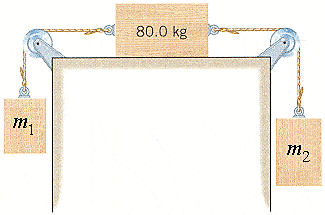
p4-109alt.gif


(a) What is the acceleration of the three objects?

(b) Find the tension in each of the two strings.

I made FBDs for these three blocks...and what I got ended up being the acceleration for the middle block, which came out to be [itex]1.7 m/s^2[/itex]. How do I find the acceleration of ALL three objects?? Any help is greatly appreciated, this is for a webassign and I would really like to get this correct.
 
Physics news on Phys.org
metalmagik said:
I made FBDs for these three blocks...and what I got ended up being the acceleration for the middle block, which came out to be [itex]1.7 m/s^2[/itex]. How do I find the acceleration of ALL three objects?? Any help is greatly appreciated, this is for a webassign and I would really like to get this correct.
HINT: All three block accelerate at the same rate.
 
so if I find the mass of ONE block, I've found the mass at which all three blocks accelerate? or must I add them up?
 
I do not understand how to achieve the acceleration when you don't have the tension forces. You need those to achieve Fnet do you not?
 
metalmagik said:
I do not understand how to achieve the acceleration when you don't have the tension forces. You need those to achieve Fnet do you not?

All you have to do is slow down. Take the mass m2 and draw a FBD for it. As Hootenanny said, all masses accelerate at the same rate. Apply Newton's second law to mass m2. Then do the same thing for the mass in the middle. And then for the left one. Look at the equations you got and try to solve for a.
 
Fnet = ma...so...for the right one what is the Fnet? I still don't understand how one does this without the Force of tension. I'm very confused.
 
metalmagik said:
Fnet = ma...so...for the right one what is the Fnet? I still don't understand how one does this without the Force of tension. I'm very confused.

OK, let's take the right mass, m2. The forces acting on it are the gravitational force G = m2*g and the tension in the right rope, let's call it T2. So, tkat makes Fnet = T2 - G = T2 - m2*g. When you use Newton's second law, you have Fnet = m2*a, i.e. T2 - m2*g = m2*a. Now do the same thing for the other masses.
 
Ok so for the center one I have [itex]T1-F+T2 = Mc*a[/itex]

and for the left one I have [itex]T1 - m1g=m1a[/itex]

is this correct?
 
metalmagik said:
Ok so for the center one I have [itex]T1-F+T2 = Mc*a[/itex]

and for the left one I have [itex]T1 - m1g=m1a[/itex]

is this correct?

Correct, but you made a mistake for the central mass. T1 and T2 are pointing in opposite directions. So, it should be -T1 - F + T2 = Mc*a.
 
  • #10
oh I see. How can I now calculate acceleration from this?
 
  • #11
metalmagik said:
oh I see. How can I now calculate acceleration from this?

You have three equations now, right? Well, use the equations for the right and left mass, and express them in a form T2 = ... and T1 = ... Then plug T1 and T2 into the equation for the central mass and you'll be able to calculate the acceleration a out of this equation directly.
 
  • #12
I have -(m1g+m1a)-Ff+(m2g+m2a) = ma

Is it possible for me to set the accelerations equal to 1 making them insignificant in the equation?
 
  • #13
metalmagik said:
I have -(m1g+m1a)-Ff+(m2g+m2a) = ma

Is it possible for me to set the accelerations equal to 1 making them insignificant in the equation?

I don't understand what you're trying to ask. You now know everything in the equation, just solve for a.
 
  • #14
Oh I see, I got .871 [itex]m/s^2[/itex]

Is this correct? I am going CRAZY with all of this haha
 
  • #15
metalmagik said:
Oh I see, I got .871 [itex]m/s^2[/itex]

Is this correct? I am going CRAZY with all of this haha

If you followed the equation, and if you didn't do any 'calculator typos', it should be correct.
 
  • #16
wow okay I got it wrong...I guess it must've been my fault.
 

Similar threads

  • · Replies 3 ·
Replies
3
Views
2K
  • · Replies 47 ·
2
Replies
47
Views
3K
  • · Replies 12 ·
Replies
12
Views
2K
Replies
21
Views
2K
  • · Replies 38 ·
2
Replies
38
Views
5K
  • · Replies 3 ·
Replies
3
Views
2K
  • · Replies 7 ·
Replies
7
Views
4K
  • · Replies 33 ·
2
Replies
33
Views
3K
  • · Replies 22 ·
Replies
22
Views
2K
  • · Replies 1 ·
Replies
1
Views
2K