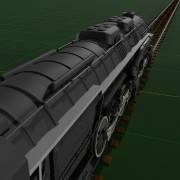
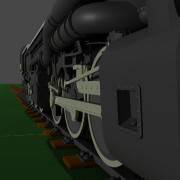
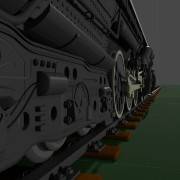
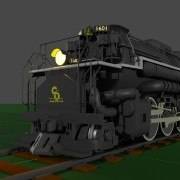
3D model I created of the largest steam locomotive ever built

Click For Summary
SUMMARY

The discussion centers on a 3D model created using Blender 2.8 of the Chesapeake and Ohio Allegheny 1601, the largest steam locomotive ever built. Participants discuss enhancing visibility through improved lighting and the use of HDRI for realistic effects. Techniques for texturing the ground with grass using Quick Fur are shared, along with insights into the complexity of 3D printing the model. The conversation also touches on the historical context of various steam locomotives, including specifications and manufacturers.

PREREQUISITES
  • Familiarity with Blender 2.8 for 3D modeling
  • Understanding of HDRI lighting techniques
  • Knowledge of texturing methods in 3D environments
  • Basic concepts of 3D printing and model assembly
NEXT STEPS
  • Research advanced lighting techniques in Blender 2.8
  • Explore texturing options for natural materials in 3D models
  • Learn about 3D printing processes and best practices for complex models
  • Investigate the history and specifications of notable steam locomotives
USEFUL FOR

3D artists, modelers, historians, and enthusiasts interested in steam locomotives and advanced 3D modeling techniques.

ElliotSmith
Messages
167
Reaction score
104
Here is a 3D model (blender 2.8) I created of the Chesapeake And Ohio Allegheny 1601 steam locomotive, which remains today the largest locomotive ever built.
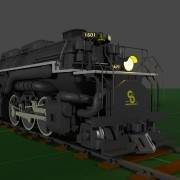
1.jpg
2.jpg
3.jpg
4.jpg
5.jpg
6.jpg
 
  • Like
Likes   Reactions: DennisN
Science news on Phys.org
Can you change the lighting so that the images are more visible?
 
phinds said:
Can you change the lighting so that the images are more visible?

I thought that was smoke. 😉
 
  • Haha
Likes   Reactions: berkeman
phinds said:
Can you change the lighting so that the images are more visible?

Yeah, I'm just looking for a good HDRI, and I also need to texture the floor to make it look like grass or some other natural ground material.
 
ElliotSmith said:
Yeah, I'm just looking for a good HDRI, and I also need to texture the floor to make it look like grass or some other natural ground material.

You can use quick fur to create a pretty good grass. This is what I was able to get fairly easily by tweaking the properties a bit.
grass.png


Here's what settings I used to get it:
settings.png
 
  • Like
Likes   Reactions: ElliotSmith
ElliotSmith said:
Here is a 3D model (blender 2.8) I created of the Chesapeake And Ohio Allegheny 1601 steam locomotive, which remains today the largest locomotive ever built.
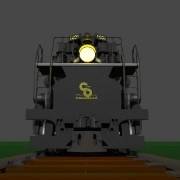
Impressive!

I like building (assembling) small (real) models myself, and I have always been impressed by those who have talent and patience to do models from scratch, both real, and as in this case, virtual.

How long did it take to do the model, I wonder?

And can it be printed on a 3D printer, or is it too complicated? I guess one would have to print the individual parts and then assemble it, perhaps?
 
Thanks!

It took me about a month to complete.

And it's probably far too complex for a 3D print.
 
  • Like
Likes   Reactions: DennisN
Can i get that model in obj format cause i want to to make a paper model out of that
 
A bit of steam locomotive history

UP Big Boy (4-8-8-4) - 4884-2: 772,250 lb (386 tons), total weight with tender 4884-2: 1,208,750 lb
C&O Allegheny (2-6-6-6) - 772,250 lb (386 tons), or about the same as UP's Big Boy
PRR Q2 (4-4-6-4) -

Nominal or design horsepower -
UP Big Boy ~ 7000 hp, typ operation 5,500–6,290 hp (4,100–4,690 kW)
C&O Allegheny ~ 7500 hp, between 6,700 to 6,900 hp (5.0 to 5.1 MW) at about 45 mph (72 km/h) based on a dynamometer car test.
PRR Q2 ~ 8000 hp, 7,987 cylinder horsepower (5,956 kW) on the PRR's static test plant.

Ref: https://en.wikipedia.org/wiki/Union_Pacific_Big_Boy
https://en.wikipedia.org/wiki/2-6-6-6
https://en.wikipedia.org/wiki/Pennsylvania_Railroad_class_Q2

Those Wikipedia articles don't do those locomotives justice.

Big Boys were built by American Locomotive Company (ALCO)
C&Os Alleghenys were built by Lima Locomotive Works (Lima)
PRRs Q2 were built PPR's Altoona Works, Altoona, PA

Perhaps the heaviest steam locomotive was the Jawn Henry (6-6-6-6), steam turbine locomotive operated briefly by Norfolk & Western (N&W). It weighed 818,000 lb (371,000 kg) (409 t), but was rated at 4500 hp. The locomotive was built by Baldwin Locomotive Works (BLW). Baldwin and Lima-Hamilton eventually merged in 1950. Diesels began replacing steam locomotives in the 1930s/1940s, and most steam locomotives were out of service by 1960.

https://en.wikipedia.org/wiki/Norfolk_and_Western_2300
https://en.wikipedia.org/wiki/Baldwin_Locomotive_Works
https://en.wikipedia.org/wiki/American_Locomotive_Company
https://en.wikipedia.org/wiki/Lima_Locomotive_Works
 
  • Like
Likes   Reactions: berkeman

Similar threads

  • · Replies 1 ·
Replies
1
Views
2K
Replies
8
Views
2K
Replies
7
Views
3K
Replies
1
Views
2K
  • · Replies 1 ·
Replies
1
Views
2K
  • · Replies 12 ·
Replies
12
Views
5K
  • · Replies 19 ·
Replies
19
Views
1K
Replies
5
Views
3K
  • · Replies 2 ·
Replies
2
Views
3K
  • · Replies 14 ·
Replies
14
Views
2K