5th and 7th Harmonic mitigation (D-yd transformer)

Click For Summary

Discussion Overview

The discussion revolves around the mitigation of 5th and 7th harmonics in electrical systems, particularly focusing on the effectiveness of a wye-delta transformer connection. Participants explore theoretical and practical aspects of harmonic cancellation, including phase shifts and impedance adjustments.

Discussion Character

  • Debate/contested
  • Technical explanation
  • Mathematical reasoning

Main Points Raised

  • Some participants question the claim that a 30-degree phase shift can completely remove the 5th and 7th harmonics, suggesting that the required phase shifts for complete cancellation are 36 degrees and 25.71 degrees, respectively.
  • Others argue that while complete cancellation may not be possible, a 30-degree shift can significantly reduce the harmonics, leading to confusion over terminology used in literature.
  • A participant proposes that harmonic mitigation requires filtering through impedance adjustments rather than solely relying on phase shifts.
  • One participant presents calculations showing the reduction of harmonic currents with a 30-degree phase shift, suggesting that the reduction is significant.
  • Another participant asserts that full cancellation is theoretically possible if the loads are equal and provides a mathematical breakdown of the harmonic currents in delta and wye configurations.
  • There are requests for verification of calculations presented, indicating a desire for clarity and correctness in the discussion.
  • Some participants express uncertainty regarding the necessity of a square root of three correction in their calculations, leading to further debate on the topic.

Areas of Agreement / Disagreement

Participants do not reach a consensus on the effectiveness of the 30-degree phase shift for harmonic cancellation, with multiple competing views on the theoretical and practical implications of harmonic mitigation strategies.

Contextual Notes

Limitations include assumptions about load equality and the dependency of results on specific configurations and definitions of impedance. The discussion reflects varying interpretations of harmonic behavior in electrical systems.

BjornFanden
Messages
8
Reaction score
0
Hi,
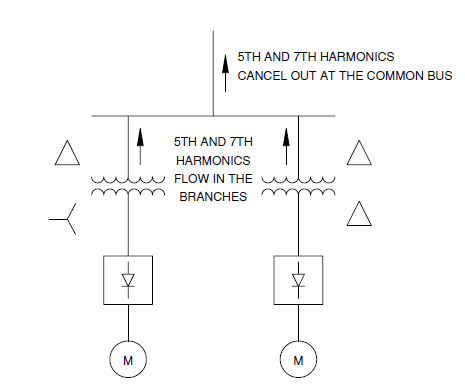
I do not see how this method (illustrated in the figure below), can completely remove the 5th and 7th harmonic?

I know that in a wye-delta connection a 30 degree phase shift is introduced. But to fully remove the 5th harmonic we need a phase shift of 180/5 = 36, and for the 7th harmonic we need 180/7 = 25.71.

Since 36 and 25.71 degree is Close to 30 degree I assume they get greatly reduced. So parhaps they should not write "cancel out at the common bus" to avoid any confusion?
Skjermbilde.PNG
 
Last edited:
Engineering news on Phys.org
In my opinion, it is difficult to mitigate the harmonics by changing phase since the wave will remain unchanged. In order to mitigate a harmonic one has to filter the harmonic by increase the series impedance and to reduce the shunt impedance in order to purge the harmonic.

The impedance depends on harmonic frequency-the resistance less due to skin effect and proximity-effect, but the reactance is direct proportional with frequency. A suitable capacitance parallel will form inductance together a harmonic barrier and in a series a shunt.

Cap=1/(2*pi()*f)/XL f=[5 or 7]*[50 or 60] XL=inductive reactance [ohm]
See[for instance]:
http://www.apqpower.com/assets/files/AReviewOfHarmMitigTech.pdf
upload_2016-10-5_22-19-26.png
 
Sorry. Wrong position of the shunt.
upload_2016-10-5_22-25-32.png
 
Thank you for replying.

But I am just curious when the Author of the book (Power Quality by C. Sankaran) says that by shifting one load 30 degree with respect to the other, we can cancel out the 5th and 7th harmonic, assuming the loads are equal etc.

But we can not cancel them completely?

Lets say we have to 5th harmonic loads connected in parallel, and they are shifted 180/5=36 degrees, if they are shifted 36 degrees with respect to each other they would completely cancel if they were identical, correct?

However, if we only shift 30 degrees, we can not completely cancel them out, even if they are identical. But 30 degrees is kind of Close to 36 degrees, so we can some cancellation, and that is what the Author means when he says that 5th and 7th harmonic cancel at common bus, correct?
 
I found the "Power Quality of Mr. C.Sankaran" and indeed on the ch.4.10 HARMONIC CURRENT MITIGATION I read this sentence:

"As the result of this, the source does not see any significant amount of the 5th and 7th harmonics."

I split the 5 and 7 harmonic current wave in 10 equal parts duration and I use this formula[if the currents are equal]:

Sum[ two currents at time t]= SIN(h*w*t)+SIN(h*(w*t-fi)) where:

w=2*pi()*f[50 or 60]; h=5 or 7;t=n/f/h/10 n=number of time part [0 to 10].

fi=angle difference between currents.

In this way calculated for fi=0 [both current on the same phase-respectively-] Sum [rms]=1.818

If the currents are 30deg apart then Sum decrease to 0.1445 [7.9% from the initial]. It is not significant, may be.

By-the-way at 25.7 deg. for h=7 and 35 deg.for h=5 the Sum is 0 indeed.
 
  • Like
Likes   Reactions: BjornFanden
Thank you for your time :)
 
Sorry. I forgot to extract the root. Then that has to be:

In this way calculated for fi=0 [both current on the same phase-respectively-] Sum [rms]=1.4142

If the currents are 30deg apart then Sum decrease to 0.3987 [28.19% from the initial]. It is significant, in my opinion.
 
Hi, I think that full cancellation is theoretical possible if the loads are equal, here's why:
In the delta-delta the currents are the same at primary and secondary.
a1 = x1 = sin(5 \omega t)\\b1 = y1 = sin(5 \omega t - 120^{\circ})\\c1 = z1 = sin(5 \omega t + 120^{\circ})
for the delta-wye we have on the secondary side:
x2 = sin(5 \omega t+30^{\circ}\times 5) = sin(5 \omega t+150^{\circ})\\<br /> y2 = sin(5 \omega t - 120^{\circ}\times 5 +30^{\circ}\times 5) = sin(5 \omega t -90^{\circ})\\<br /> z2= sin(5 \omega t + 120^{\circ}\times 5 +30^{\circ}\times 5) = sin(5 \omega t +30^{\circ})

Going from secondary to primary we have to include the \sqrt3:1 ratio
A2= (i_{a}-i_{b})/\sqrt3 = (sin(5\omega t+150^{\circ})-sin(5\omega t +30^{\circ}))/\sqrt3 = -sin(5 \omega t)

Similar can be shown for b2 and c2 that they are equal to b1 and c1, respectively (for 5th harmonic).

Can someone verify my calculations, so we do not cause any problems for other wondering about the same.

20swf.JPG
 
Bump, could any kind soul check if my last post (#8) is correct so we can settle for an answer.
 
  • #10
Bump, ref. post #8.
 
  • #11
In my opinion, since the apparent power on low-voltage side is equal to apparent power at high-voltage side and the line-to-line voltage is the same the line current has to be the same. So no correction of sqrt(3) is required.
However, the winding turns ratio has to be w1/w2=sqrt(3).
For other explanations see your new post of Dec.2
 

Similar threads

  • · Replies 2 ·
Replies
2
Views
4K
  • · Replies 16 ·
Replies
16
Views
4K
  • · Replies 6 ·
Replies
6
Views
4K
Replies
17
Views
6K
  • · Replies 2 ·
Replies
2
Views
8K
  • · Replies 7 ·
Replies
7
Views
3K
  • · Replies 2 ·
Replies
2
Views
4K
  • · Replies 5 ·
Replies
5
Views
4K
Replies
24
Views
8K
  • · Replies 94 ·
4
Replies
94
Views
14K