A.C. Circuits: Graphs & Voltage/Current Curves

  • Context: Undergrad 
  • Thread starter Thread starter uzair_ha91
  • Start date Start date
  • Tags Tags
    Circuits Graphs
Click For Summary

Discussion Overview

The discussion revolves around the representation of current and voltage curves in alternating current (A.C.) circuits, specifically addressing the differences in graphs found in various sources and the implications of these differences on understanding circuit behavior. The conversation includes technical explanations related to capacitors and inductors, as well as the mathematical relationships governing these components.

Discussion Character

  • Technical explanation
  • Debate/contested

Main Points Raised

  • Some participants note that the relative positioning of current and voltage curves in graphs can vary, suggesting that it may be arbitrary.
  • Others argue that scaling the y-axis of the graphs does not affect the underlying relationships, implying that the height of the curves is not significant.
  • One participant presents mathematical relationships for capacitors and inductors, indicating that the ratio of voltage to current is frequency-dependent.
  • A later reply attempts to clarify the phase shift between current and voltage in capacitors, explaining the mathematical derivation of current based on voltage and frequency.
  • There is a request for clarification regarding the explanation of the voltage-current relationship, indicating some confusion among participants.

Areas of Agreement / Disagreement

Participants express differing views on the significance of the graphical representation of current and voltage, with some asserting it is arbitrary while others provide mathematical context. The discussion remains unresolved regarding the implications of these graphical differences on understanding A.C. circuits.

Contextual Notes

Participants have not reached a consensus on the importance of the graphical representation of current and voltage curves, and there are unresolved questions about the clarity of the mathematical explanations provided.

uzair_ha91
Messages
92
Reaction score
0
A.C. Circuits -- Graphs

http://img136.imageshack.us/img136/5782/image64.jpg
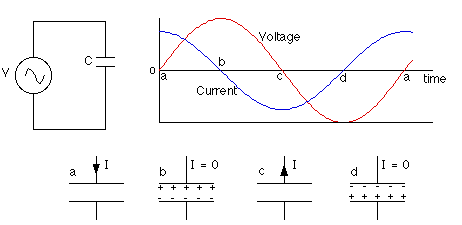
In this graph, the curve of current is larger than that of voltage...but in some books the voltage curve is above the current curve (like the one below)...Which one's correct?
ACcap.GIF
 
Last edited by a moderator:
Physics news on Phys.org


It's arbitrary. You are shown a graph with two curves of different units.


So basically it doesn't matter if you drew both curves of same height, right?


uzair_ha91 said:
So basically it doesn't matter if you drew both curves of same height, right?

It doesn't matter, you can scale the y-axis to any size.


For capacitors, The ratio of voltage to current at a frequency f (where f = w/(2 pi) where w is the frequency in radians per second), is

V/I = -j/wC (where the j indicates a 90 degree phase shift). For an inductance:

V/I = +jwL

So for any given C or L, the ratio V/I depends on frequency.


Bob S said:
For capacitors, The ratio of voltage to current at a frequency f (where f = w/(2 pi) where w is the frequency in radians per second), is

V/I = -j/wC (where the j indicates a 90 degree phase shift). For an inductance:

V/I = +jwL

So for any given C or L, the ratio V/I depends on frequency.


I'm sorry I don't understand what you are trying to explain..


Hi Usair-

Suppose I have a capacitor C and I put a voltage V on it at frequency f.

The current in it is given by I = (2 pi f) C V. But the phase of the current is shifted by 90 degrees. So we use the short-hand notoation j, so that

I = j (2 pi f C) V

This is because of the equation for charge on a capacitor is

Q = C V

Now suppose V = V0 sin(wt) where w = 2 pi f

Then I = dQ/dt = C dV/dt = w C V0 cos(wt)

So there is a 90 degree phase shift (between the sine and cosine), and the amplitude of I depends on frequency f, as well as on C and V0.

I hope this helps

Bob S
 

Similar threads

  • · Replies 3 ·
Replies
3
Views
1K
  • · Replies 8 ·
Replies
8
Views
2K
  • · Replies 1 ·
Replies
1
Views
2K
  • · Replies 7 ·
Replies
7
Views
3K
  • · Replies 3 ·
Replies
3
Views
2K
  • · Replies 16 ·
Replies
16
Views
4K
  • · Replies 6 ·
Replies
6
Views
5K
  • · Replies 25 ·
Replies
25
Views
11K
  • · Replies 10 ·
Replies
10
Views
2K
  • · Replies 7 ·
Replies
7
Views
2K