A little solar activity this week

  • Context: High School 
  • Thread starter Thread starter davenn
  • Start date Start date
  • Tags Tags
    Activity Solar
Click For Summary
SUMMARY

This discussion centers on recent solar activity, particularly highlighting the sunspot group AR2403, which is one of the largest observed during the current solar maximum. Despite its size, AR2403 has produced only six M-class flares, with the most significant being an M 5.6. Participants also share their experiences capturing solar images and recommend various resources for monitoring solar activity, including SOHO and SDO satellites.

PREREQUISITES
  • Understanding of solar activity and classifications of solar flares (e.g., M-class flares)
  • Familiarity with solar imaging techniques and equipment (e.g., 800mm lens, solar filters)
  • Knowledge of solar observation satellites (e.g., SOHO, SDO)
  • Basic skills in image processing and analysis of solar data
NEXT STEPS
  • Research the capabilities of the Solar Dynamics Observatory (SDO) for real-time solar imaging
  • Explore advanced solar imaging techniques using different filters and equipment
  • Learn about the significance of sunspot groups and their impact on solar activity
  • Investigate the historical data available from SOHO and its implications for solar research
USEFUL FOR

Astronomy enthusiasts, solar researchers, astrophotographers, and anyone interested in monitoring solar activity and understanding its effects on space weather.

davenn
Science Advisor
Gold Member
Messages
9,715
Reaction score
11,711
Overall this Solar Max has been pretty disappointing. But occasionally the Sun as shown brief bursts of good activity
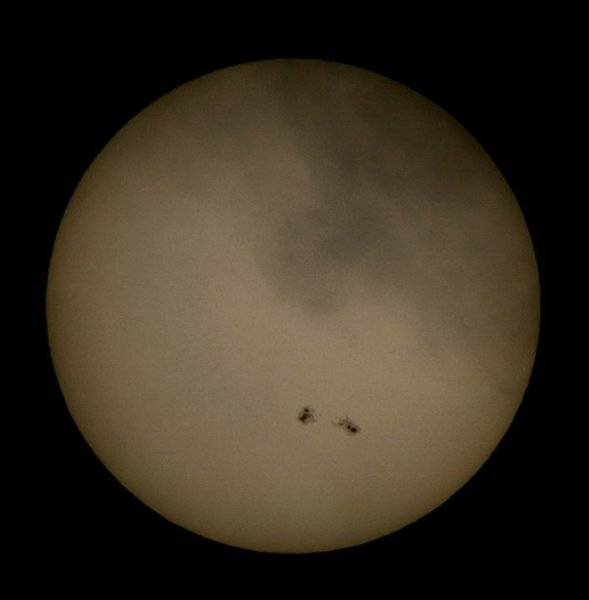
over the last week, and for a few more days, there has been a large sunspot group traversing the solar face.
AR2403 is a massive spot group and one of the largest this solar max. But it hasn't been overly active in the flare production department. So far 6 x M class flares, the largest being a M 5.6

Here's a pic I took yesterday 25 Aug 2015
800mm ( 400mm and 2x teleconverter), f11, ISO 250, 1/250th sec exp and a full aperture solar filter
was a bit of an act to get the shot as the sun came and went behind the thick rain clouds
2015_08_25_4157vsm.jpg
cheers
Dave
 
  • Like
Likes   Reactions: Stavros Kiri, Andy Resnick, Drakkith and 3 others
Astronomy news on Phys.org
jedishrfu said:
Nice photo.

Have you checked on any of the solar satellites to see if they've seen something?

http://sohowww.nascom.nasa.gov/data/realtime-images.html
hi you :smile:

I used to use that site, but their image quality sucks these days
I use this one instead ...
http://umbra.gsfc.nasa.gov/images/latest.html

so much better quality !

I download the Fe 171, He 304, magnetic, intensity and x-ray images daily ( each morning before going to work)

Have a database of images spanning back to the mid 1990's when SOHO first came online
and now more recently superseded by SDO ( Solar Dynamics Observatory) space craftDave
 
Last edited:
  • Like
Likes   Reactions: jedishrfu

Similar threads

  • · Replies 444 ·
15
Replies
444
Views
57K
  • · Replies 3 ·
Replies
3
Views
2K
  • · Replies 16 ·
Replies
16
Views
8K
  • · Replies 2 ·
Replies
2
Views
1K
  • · Replies 21 ·
Replies
21
Views
5K
  • · Replies 9 ·
Replies
9
Views
5K
  • · Replies 1 ·
Replies
1
Views
3K
  • · Replies 1 ·
Replies
1
Views
4K