A Periodic Function Looks Like This Formula?

Click For Summary
SUMMARY

The discussion clarifies the concept of periodic functions, specifically addressing the formula f(t) = f(t + nT), where T represents the period of one cycle. It contrasts this with the sinusoidal function sin(wt + phi), highlighting that phi is not necessary when the waveform starts at zero phase. The equation f(t) = sin(wt + phi) aligns with the periodic function definition, demonstrating that f(t) remains consistent across cycles, reinforcing the fundamental nature of periodicity in waveforms.

PREREQUISITES
  • Understanding of periodic functions and their properties
  • Familiarity with sinusoidal functions and their equations
  • Basic knowledge of waveforms and cycles
  • Concept of frequency and its relation to time
NEXT STEPS
  • Study the properties of square waves and their mathematical representations
  • Learn about the Fourier series and its application in analyzing periodic functions
  • Explore the concept of phase shift in waveforms and its implications
  • Investigate the relationship between frequency, period, and angular frequency (omega)
USEFUL FOR

Students and professionals in mathematics, physics, and engineering who are studying waveforms, periodic functions, and their applications in various fields.
yosimba2000
Messages
206
Reaction score
9
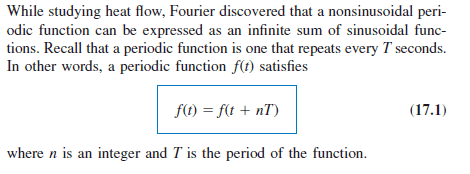
My book says this:

upload_2016-3-7_19-17-13.png


I don't understand how this works. I learned that the usual sunisoidal function looks like
sin(wt+phi), where w is frequency, t is time, and phi is some offset.

EQ 17.1 doesn't match the bolded formula above. How does this work?
 
Engineering news on Phys.org
They are talking about periodic functions that are not necessarily sinusoidal. A square wave for example,
 
f(t) = f(t + nT)

Where 0 <= T < infinity the period of one cycle
0 <= t < T the time interval between samples within a cycle
n=0 1 2 3... which cycle you are evaluating

Looking at the RHS, the part f(t) would be one cycle of a waveform
and the full RHS, f(t + nT) is the waveform of the n th cycle.

All that is saying is that f(t) stays the same regardless of which cycle you look at, which is the definition of a periodic function.

phi isn't used here because the waveform is assumed to start at zero phase, and (t) can be any function of t , such as wt .
 
yosimba2000 said:
My book says this:

View attachment 97012

I don't understand how this works. I learned that the usual sunisoidal function looks like
sin(wt+phi), where w is frequency, t is time, and phi is some offset.

EQ 17.1 doesn't match the bolded formula above. How does this work?
Yes, it does match.

Let ##f(t) = sin(wt + \phi)##

Then ##f(t) = f(t + nT)##, where ##T = 2\pi / \omega##
 

Similar threads

  • · Replies 15 ·
Replies
15
Views
3K
  • · Replies 8 ·
Replies
8
Views
5K
  • · Replies 4 ·
Replies
4
Views
1K
  • · Replies 3 ·
Replies
3
Views
1K
  • · Replies 7 ·
Replies
7
Views
2K
Replies
4
Views
2K
  • · Replies 2 ·
Replies
2
Views
2K
  • · Replies 2 ·
Replies
2
Views
2K
Replies
3
Views
2K
  • · Replies 33 ·
2
Replies
33
Views
3K