A problem in Coupling Transformers

Click For Summary
The discussion centers on a problem involving coupling transformers and the calculation of output voltage. The user calculated V(out) as 624 volts based on the turns ratio and expressed concerns about diode orientation affecting current flow. Responses highlighted that the diode's PIV rating is insufficient for the calculated voltage, risking damage, and noted the importance of considering the diode's forward voltage drop. Additionally, it was clarified that reversing the diode would still allow current to flow during opposite half-cycles, resulting in an output voltage of the same magnitude but with an opposite polarity. Overall, the calculations and understanding of diode behavior were validated, with a cautionary note on component ratings.
bibo_dvd
Messages
37
Reaction score
0
Hello Guys !

While Studing coupling transformers i found this problem
i tried to solve it
but i don't know if my solving is right or no !
so tell me :)

The problem :
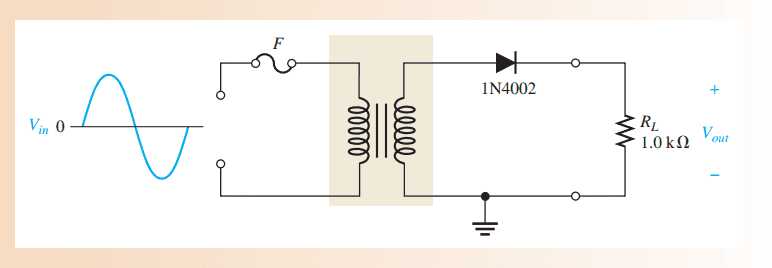
27phVRt.png

eJPQdSJ.png


My solve is :
V(out)=nV(in)
V(out)= 2 * 312 = 624 v
PIV = V(out) = 624 v
and if the diode is turned around it will be reversed biased so no current will pass across RL and
Output voltage will equal to zero ..

am i right guys or what ??

Thank you !
 
Physics news on Phys.org
bibo_dvd said:
My solve is :
V(out)=nV(in)
V(out)= 2 * 312 = 624 v
PIV = V(out) = 624 v
Looks okay. Although whoever set the problem doesn't know his components very well. A 1N4002 diode as a PIV rating of about 100 V if I recall correctly. Expect the magic smoke to escape from the diode very shortly after switching on!

Also, you have ignored the ~0.7 V forward drop across the diode. Probably okay considering what a small percentage this is of the total voltage.

and if the diode is turned around it will be reversed biased so no current will pass across RL and
Output voltage will equal to zero ..
Nope. The secondary will present a full AC voltage signal, so if you turn the diode around it will simply conduct when the diode is forward biased on the opposite half-cycles (opposite that is to the half-cycles when it conducted in the original diode orientation). What does that tell you about the resulting potential across the load resistor?
 
gneill said:
What does that tell you about the resulting potential across the load resistor?

I think the potential across the load resistor will be the same but with an opposite sign
i mean that the voltage will take this shape ..am i right ??

SlNR6jY.png
 
bibo_dvd said:
I think the potential across the load resistor will be the same but with an opposite sign
i mean that the voltage will take this shape ..am i right ??

SlNR6jY.png

Looks good!
 
  • Like
Likes 1 person

Similar threads

Replies
7
Views
2K
Replies
15
Views
2K
  • · Replies 20 ·
Replies
20
Views
5K
  • · Replies 12 ·
Replies
12
Views
2K
  • · Replies 2 ·
Replies
2
Views
3K
Replies
6
Views
2K
  • · Replies 1 ·
Replies
1
Views
2K
  • · Replies 2 ·
Replies
2
Views
2K
  • · Replies 2 ·
Replies
2
Views
2K
  • · Replies 7 ·
Replies
7
Views
2K
