A question about conditions for Weightlessness

Join the discussion
Ask a follow-up here, or get your own question answered by working scientists, mathematicians and engineers — people, not an autocomplete.
Real named experts · corrections over time · the nuance an AI answer skips
5 replies · 5K views
nadavg54
Messages
9
Reaction score
0
I read that if you are in a spaceship orbiting Earth in a circular motion, the astronout feels weightless (meaning the normal force to the astronout is equal to zero). But according to Newton laws equations you get:
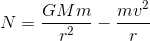
gif.latex?N%20=%20\frac{GMm}{r^2}%20-%20\frac{mv^2}{r}.gif

and then if we assume N=0 (which is really what's happening according to my understanding), we get:
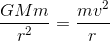
gif.latex?\frac{GMm}{r^2}%20=%20\frac{mv^2}{r}.gif

And I don't understand why is that true, if you can explain, or if there is any mistake in what I've said above,

Thanks
 
Last edited by a moderator:
Physics news on Phys.org
The only force acting on the ship is gravity, which is just enough to keep it in orbit. No additional force is required to support something in orbit, so the apparent weight is zero.
 
so my equations are not correct?
 
nadavg54 said:
so my equations are not correct?

They are correct. N=0 for an astronaut in freefall, because there's nothing that
can push against the astronaut. Your equation is just F =ma , where the
force is [itex]\frac {GmM}{r^2}[/itex] and the acceleration is [itex] \frac {v^2}{r}[/itex]
 
Yes, your equations are correct. We actually don't "feel" gravity, we feel the ground pushing on our feet on response to the gravity pulling us against the ground. In free fall, there is no ground pushing back, so we feel don't feel it. But there is still gravity pulling on us. That is why we accelerate downwards. Try jumping off a high bridge into a river with your eyes closed. While in the air, you will feel weightless, but gravity is still at work, because you fall.