A Question About Weight and Pressure

  • Thread starter Thread starter MBrain
  • Start date Start date
  • Tags Tags
    Pressure Weight
Click For Summary

Homework Help Overview

The discussion revolves around the concepts of weight and pressure in the context of different shapes filled with liquid, specifically water. Participants are exploring how weight and pressure relate to each other in various scenarios presented in samples A, B, and C.

Discussion Character

  • Conceptual clarification, Assumption checking

Approaches and Questions Raised

  • Participants are questioning the relationship between weight and pressure, particularly in how they differ and interact in the context of the samples. There is a focus on understanding where additional pressure comes from in sample B and the apparent loss of weight in sample C.

Discussion Status

Some participants have provided insights into the forces exerted by the walls of the shapes and the nature of pressure acting in all directions. However, there seems to be a lack of consensus on a comprehensive explanation, with one participant indicating that their teacher is seeking a more advanced understanding.

Contextual Notes

There is mention of a need for a more sophisticated explanation that addresses the nuances of weight and pressure, suggesting that the original poster's current understanding may not fully align with the expectations of their teacher.

MBrain
Messages
3
Reaction score
0
Hello there :) First I'm sorry for my English it might be kinda bad !

I Have a little question about Weight and Pressure, Hope this is the right place.
1qh501.jpg


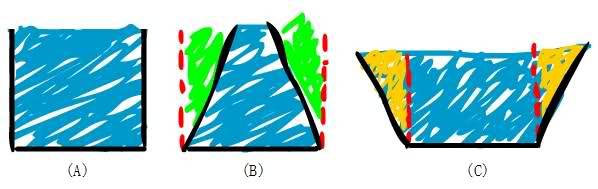
Here in this image we have 3 samples, A, B and C.

They are 3 different types of shapes fulled with a liquid (let's say water)

Talking about the physical pressure on the bottom of every shape :-

In Sample (A) we can see that Weight = Pressure.
In Sample (B) we can see that Weight < Pressure.
In Sample (C) we can see that Weight > Pressure.

Where did we get the extra pressure in the sample (B) ? It's like we create that green area from nowhere!
And where did the extra weight go in the sample (C) ? It's like we lost that orange area and it's nothing!

Hope I can fine the answer, Thank you :) !
 
Physics news on Phys.org
MBrain said:
In Sample (A) we can see that Weight = Pressure.
In Sample (B) we can see that Weight < Pressure.
In Sample (C) we can see that Weight > Pressure.
Where you say "weight", I assume you mean "weight/area". (Which would give you a pressure term.)
Where did we get the extra pressure in the sample (B) ? It's like we create that green area from nowhere.
The slanted walls exert a downward force.
And where did the extra weight go in the sample (C) ? It's like we lost that orange area, or it is nothing!
Here the slanted walls exert an upward force.
 
Weight and pressure are very different things. For starters, weight is a force and has units of Newtons. Pressure is a force per unit area and has units of N/m². Weight only acts downward toward the center of the Earth. Pressure acts in all directions simultaneously.

Pressure is not like light intensity (energy/m²), either. If you increase the area on the bottom, the pressure at the bottom is spread over a larger area but it is not thereby diminished as light intensity would be if spread over a larger area. Consider a balloon. If you blow it up to a pressure of 1.1 atmospheres, then pump it up to 1.2 the balloon gets larger and the pressure is 1.2 on every bit of the larger surface area.
 
Doc Al said:
Where you say "weight", I assume you mean "weight/area". (Which would give you a pressure term.)

The slanted walls exert a downward force.

Here the slanted walls exert an upward force.

And where that forces come from ?!
 
MBrain said:
And where that forces come from ?!
The pressure of the water against the containing walls. Which, as pointed out by Delphi51, acts the same in all directions.
 
Doc Al and Delphi51 Thank you for your helping.
but when I explained it that way to my teacher he said that its not exactly the right answer.
I think he is looking for a really advance answer that explains it all.
 

Similar threads

Replies
2
Views
1K
  • · Replies 4 ·
Replies
4
Views
2K
  • · Replies 13 ·
Replies
13
Views
4K
  • · Replies 6 ·
Replies
6
Views
2K
  • · Replies 13 ·
Replies
13
Views
2K
  • · Replies 4 ·
Replies
4
Views
3K
Replies
8
Views
2K
  • · Replies 2 ·
Replies
2
Views
5K
  • · Replies 10 ·
Replies
10
Views
2K
  • · Replies 24 ·
Replies
24
Views
2K