A simple question about non-inertial Frames of Reference

Click For Summary
The discussion centers on the difficulty of answering question D due to the implications of condition #4 regarding non-inertial frames of reference. It is noted that either frame S or S' could be accelerating, which affects the outcome for D. Clarification on condition #2 suggests that the particle velocity in S' is constant, leading to the conclusion that only S is accelerating. The realization that both frames were initially considered to have constant velocities complicates the problem, as it implies that if both could be accelerating, questions D and C would remain unanswerable. Ultimately, the understanding of the conditions is crucial for resolving the questions posed.
Singalo
Messages
2
Reaction score
0
Hello
Is it even possible to have an answer for D given condition #4 ?
i need help in just for question D, and not everything else . Thanks :]

The Attempt at a Solution


Because Either S or S' Could be accelerating, and depending on which one and how much is accelerating, there will be different answers for D. Everything else is working out for me up until condition 4 which is giving me trouble answering D.
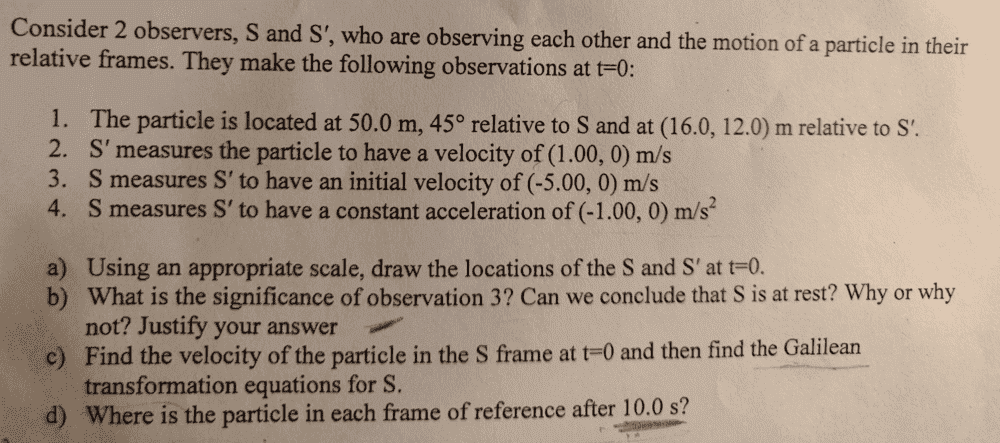
phys2.png
 

Attachments

  • phys2.png
    phys2.png
    98.5 KB · Views: 629
Last edited:
Physics news on Phys.org
2 seems to suggest that this is always the particle velocity in S’, since 3 mentions ”initially”.
 
Orodruin said:
2 seems to suggest that this is always the particle velocity in S’, since 3 mentions ”initially”.
ahh! i did not notice that. if that's the case then S would definitely be the only one accelerating. Its answerable now. I assumed both of them were initial velocities since these conditions were observed at t=0. Would have helped if condition #2 specifically said that the velocity would not change relative to S'..

If somehow it weren't the case, D cannot be answered right? (just tried out, C would also be unanswerable since yet again, either frame could be accelerating)
 
Last edited:
The book claims the answer is that all the magnitudes are the same because "the gravitational force on the penguin is the same". I'm having trouble understanding this. I thought the buoyant force was equal to the weight of the fluid displaced. Weight depends on mass which depends on density. Therefore, due to the differing densities the buoyant force will be different in each case? Is this incorrect?

Similar threads

  • · Replies 3 ·
Replies
3
Views
2K
  • · Replies 2 ·
Replies
2
Views
2K
  • · Replies 38 ·
2
Replies
38
Views
4K
  • · Replies 3 ·
Replies
3
Views
2K
  • · Replies 3 ·
Replies
3
Views
2K
Replies
34
Views
2K
Replies
24
Views
2K
Replies
13
Views
3K
  • · Replies 3 ·
Replies
3
Views
2K
  • · Replies 22 ·
Replies
22
Views
1K