About determine zero force member

Click For Summary
SUMMARY

The discussion centers on the determination of zero-force members in structural analysis, specifically addressing confusion regarding the application of rules for identifying these members. Key rules established include: if only two members meet at an unloaded joint, both are zero-force members; if three members meet at an unloaded joint where two are collinear, the third is a zero-force member; and in a loaded joint, if the load's line of action coincides with one member, the other is a zero-force member. The conclusion emphasizes that zero-force members do not experience internal forces and can exist even at loaded joints.

PREREQUISITES
  • Understanding of structural analysis principles
  • Familiarity with the concept of force equilibrium
  • Knowledge of joint types in truss structures
  • Basic proficiency in interpreting structural diagrams
NEXT STEPS
  • Study the principles of static equilibrium in trusses
  • Learn about the application of the method of joints in structural analysis
  • Explore advanced topics in structural mechanics, such as internal force analysis
  • Review case studies involving zero-force members in real-world structures
USEFUL FOR

Structural engineers, civil engineering students, and anyone involved in the analysis and design of truss structures will benefit from this discussion.

mchei
Messages
7
Reaction score
0
i am confused on the determination of zero force member
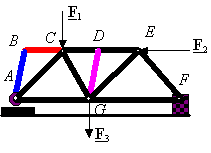
image014.gif

from the above pic, the coloured beam is zero member, i know that when u view from joint B, 2 beams are zero member, but when u view from A, beam_AB is not zero, are there any contradiction?

also, i don't know why when F_AB is zero, then F_BC is also zero? becoz the beam BC don't have any supporting foce on it, am i correct?

finally, i have found 2 rule on wiki but i am confused on it.
do zero force member must not exist when u view the joint that is applied a load or it is a supporting point?

furthermore, is zero force member have zero force acting on it?

2. Homework Equations

1. If only two members meet in an unloaded joint, both are zero-force members.
2. If three members meet in an unloaded joint of which two are in a direct line with one another, then the third (perpendicular) member is a zero-force member.
3. If two members meet in a loaded joint and the line of action of the load coincides with one of the members, the other member is a zero-force member.

3. The Attempt at a Solution

coloured beam is zero force member
 
Last edited:
Physics news on Phys.org
mchei said:
i am confused on the determination of zero force member
image014.gif

from the above pic, the coloured beam is zero member, i know that when u view from joint B, 2 beams are zero member, but when u view from A, beam_AB is not zero, are there any contradiction?
There is no contradiction, because AB force is still zero when looking at joint A. The support reaction force from A goes into member AC as a vertical component of the force in AC, and the horizontal component of the force in AC goes into AG.
also, i don't know why when F_AB is zero, then F_BC is also zero? becoz the beam BC don't have any supporting foce on it, am i correct?
Since F_AB is 0, then, yes, there is no force applied to BC. There can't be any force in AB , because if there were, there would be no place to balance its vertical component.
finally, i have found 2 rule on wiki but i am confused on it.
Rule 2 is wrong...remove the word 'perpendicular'. DG is a zero force member, it does not have to be perpendicular.
do zero force member must not exist when u view the joint that is applied a load or it is a supporting point?
No, untrue. See rule 3, only one of the members may have zero force, or none of the members, but not all the members.
furthermore, is zero force member have zero force acting on it?
yes, no internal force acts in a zero force member, and hence, it can have no force acting on it.
2. Homework Equations

1. If only two members meet in an unloaded joint, both are zero-force members.
2. If three members meet in an unloaded joint of which two are in a direct line with one another, then the third (perpendicular) member is a zero-force member.
3. If two members meet in a loaded joint and the line of action of the load coincides with one of the members, the other member is a zero-force member.

3. The Attempt at a Solution

coloured beam is zero force member
 

Attachments

  • image014.gif
    image014.gif
    1.4 KB · Views: 487
Last edited:

Similar threads

  • · Replies 8 ·
Replies
8
Views
2K
  • · Replies 3 ·
Replies
3
Views
2K
  • · Replies 4 ·
Replies
4
Views
4K
  • · Replies 3 ·
Replies
3
Views
2K
  • · Replies 13 ·
Replies
13
Views
3K
  • · Replies 1 ·
Replies
1
Views
2K
  • · Replies 1 ·
Replies
1
Views
3K
  • · Replies 9 ·
Replies
9
Views
26K
Replies
3
Views
5K
  • · Replies 3 ·
Replies
3
Views
3K