About Maxwell's equations and the attempt to insert a magnetic monopole

Click For Summary
SUMMARY

The discussion centers on the theoretical implications of magnetic monopoles on Maxwell's equations. It asserts that the existence of magnetic monopoles would necessitate modifications to these equations, fundamentally altering our understanding of electromagnetism. The conversation references J. Schwinger's work in "Classical Electrodynamics" (1998) as a significant resource for exploring these changes. The consistency of Maxwell's equations and their relationship with relativity are highlighted as crucial points of consideration.

PREREQUISITES
  • Understanding of Maxwell's equations
  • Familiarity with electromagnetic theory
  • Knowledge of Hamiltonian mechanics
  • Basic concepts of magnetic monopoles
NEXT STEPS
  • Research the modifications to Maxwell's equations with the introduction of magnetic monopoles
  • Study J. Schwinger's "Classical Electrodynamics" for in-depth theoretical insights
  • Explore the implications of magnetic monopoles in modern physics
  • Investigate the relationship between electromagnetism and relativity in the context of monopoles
USEFUL FOR

This discussion is beneficial for physicists, students of electromagnetism, and researchers interested in theoretical physics and the implications of magnetic monopoles on established equations.

LCSphysicist
Messages
644
Reaction score
163
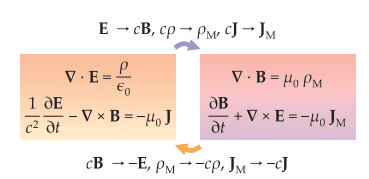
I was reading somethings about magnetic monopoles, and how, if it were discovered its existence, it would changes the Maxwell equations, in summarizing, is not the first time i see this:
1602395525344.png

It is the consequences of the existence of a magnetic monopole? That is, IF it exist, SO the imagem is true. Or is just a possible, and not exactly truth, way to imagine how the Maxwell Equations would suffer under such changes?
 
Physics news on Phys.org
I think, it's pretty unique considering the consistency of the equations and relativity. It can also be derived from the Hamilton principle for the em. field. A good discussion can be found in

J. Schwinger, Classical Electrodynamics, Perseus Books (1998)
 
  • Informative
Likes   Reactions: LCSphysicist

Similar threads

  • · Replies 2 ·
Replies
2
Views
2K
  • · Replies 1 ·
Replies
1
Views
5K
  • · Replies 13 ·
Replies
13
Views
2K
  • · Replies 7 ·
Replies
7
Views
2K
  • · Replies 21 ·
Replies
21
Views
7K
  • · Replies 2 ·
Replies
2
Views
2K
  • · Replies 27 ·
Replies
27
Views
4K
  • · Replies 2 ·
Replies
2
Views
2K
  • · Replies 3 ·
Replies
3
Views
2K
  • · Replies 1 ·
Replies
1
Views
2K