[AC Circuit] How do we convert from the time domain to the phasor domain?

Join the discussion
Registration is free. Start your own thread to ask a follow-up.
5 replies · 3K views
Special One
Messages
32
Reaction score
1
Homework Statement
Converting
Relevant Equations
AC Circuits
In this example, We need to covert e2 & e5 to a form with imaginary number .
we will obtain e2=j10 & e5=20
Can anyone explain how we got this?
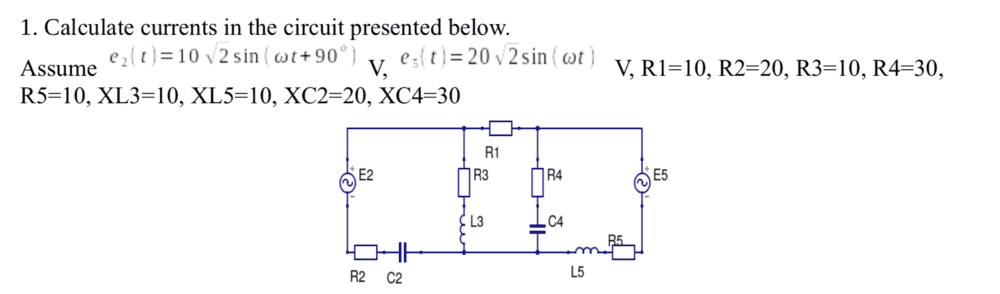
Screenshot 2020-05-15 at 22.55.53.png
 
Physics news on Phys.org
Special One said:
Homework Statement:: Converting
Relevant Equations:: AC Circuits

In this example, We need to covert e2 & e5 to a form with imaginary number .
we will obtain e2=j10 & e5=20
Can anyone explain how we got this?
View attachment 262833
It looks like you can write them down by inspection of the problem statement. your are given ##e_2(t)## and ##e_5(t)## right after the "Assume" in your problem statement. Can you say what the "j" means in ##e_2 = j10##?
 
berkeman said:
It looks like you can write them down by inspection of the problem statement. your are given ##e_2(t)## and ##e_5(t)## right after the "Assume" in your problem statement. Can you say what the "j" means in ##e_2 = j10##?
it means i. Imaginary part
 
Special One said:
it means i. Imaginary part
LOL, yes of course. Um, let me re-phrase...

Are you familiar with the phasor representation of a sinusoidal signal?

https://www.electronics-tutorials.ws/accircuits/phasors.html

1589585090600.png
 
  • Like
Likes   Reactions: scottdave and DaveE
BTW, it's hard to separate the "calculate the currents" part of the question from the "Assume" part and the part that you posted about "e2=j10 & e5=20 ".

To calculate the branch currents, I would use KCL equations to find the node voltages, but you can also use KVL equations if you prefer. But also, why would you say "e2=j10 & e5=20" when there also ##\sqrt{2}## terms in the time domain definitions?