Acceleration, Displacement, Graph Interpretation

Click For Summary
The discussion revolves around interpreting a velocity vs. time graph to find acceleration, normal force, displacement, and tension in an elevator scenario. It is clarified that acceleration can be constant or negative, with examples provided for negative acceleration. The user correctly applies the formula F=ma to calculate the normal force for a 65 kg person using the derived acceleration. For displacement, the user calculates the area of triangles under the graph, arriving at a total of 12 meters for the first four seconds. Lastly, tension in the elevator is linked to the weight and acceleration, emphasizing the relationship between mass and force.
lthcn99
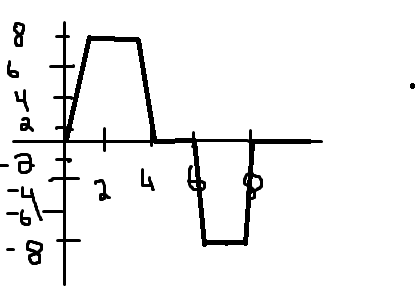
Hello, I was working on a worksheet. It gave a graph that was velocity vs. time. I was asked to find the acceleration rate for the given (specific) time in seconds. My first question is if the line on the graph for example is from 1-3 seconds, in that 1-3 second range, is acceleration constant? And is it possible to have a negative acceleration? After finding the acceleration, I was asked to find the Normal Force using those acceleration and a person who weights 65 kg. Do I just use F=ma? Then I was asked to find I guess the displacement from 0-8 seconds. Do I make triangles, find area, and add them all up? Then lastly it asked if a elevator was 500 kg, what would be the tension pulling it. I'm hoping someone can help. Thank you.
upload_2017-10-6_23-34-10.png
 
Physics news on Phys.org
lthcn99 said:
Hello, I was working on a worksheet. It gave a graph that was velocity vs. time. I was asked to find the acceleration rate for the given (specific) time in seconds. My first question is if the line on the graph for example is from 1-3 seconds, in that 1-3 second range, is acceleration constant? And is it possible to have a negative acceleration? After finding the acceleration, I was asked to find the Normal Force using those acceleration and a person who weights 65 kg. Do I just use F=ma? Then I was asked to find I guess the displacement from 0-8 seconds. Do I make triangles, find area, and add them all up? Then lastly it asked if a elevator was 500 kg, what would be the tension pulling it. I'm hoping someone can help. Thank you.
View attachment 212471

PF rules require that YOU do some work first (and show what you have done) before asking for help here.
 
It ask me what would be the acceleration rate for 1 seconds. So I did A=vf-vi/t and got 4 m/s2 because y=8 and x=2 secs. But then it asks for the acceleration rate for 1.5 seconds, so will it still be 4 m/s2 cause it is constant? Then it ask for the acceleration rate for 6.5 seconds. I wasn't sure what to do so I did -8/6 and got -1.33 m/s2.
Part B ask what would be the normal force with a person of 65 kg. I'm confuse whether to use f=ma or N=f-mg. Like am I using the acceleration from above to solve this? I used f=ma, 65 x 4 = 260 N. 65 x -1.33 = -86.45 N.
For finding displacement, I went to find the areas of triangles from the graph. From 0-2 seconds is one triangle, so 1/2(b)(h), 1/2(2)(8)=8m. Then 3-4 seconds, I got 4 m. So I'm assuming from 0-4 secs, the displacement is 12m.
 
Do you know what acceleration represents? What happens to velocity during time periods when acceleration is zero? What would the velocity graph look like during those time periods? You asked if negative acceleration is possible. The answer is yes. Try to think of examples of when acceleration is negative. Think about when you are driving or riding in a car. What horizontal accelerations act on you. When are the positive? When negative? When is acceleration zero?
 
lthcn99 said:
Then lastly it asked if a elevator was 500 kg, what would be the tension pulling it.

Hint: Tension is a Force. Find out what is 500kg and how would it be related in finding the tension pulling it upwards.
 
The book claims the answer is that all the magnitudes are the same because "the gravitational force on the penguin is the same". I'm having trouble understanding this. I thought the buoyant force was equal to the weight of the fluid displaced. Weight depends on mass which depends on density. Therefore, due to the differing densities the buoyant force will be different in each case? Is this incorrect?

Similar threads

  • · Replies 6 ·
Replies
6
Views
2K
  • · Replies 11 ·
Replies
11
Views
3K
  • · Replies 30 ·
2
Replies
30
Views
4K
  • · Replies 15 ·
Replies
15
Views
3K
  • · Replies 14 ·
Replies
14
Views
5K
  • · Replies 1 ·
Replies
1
Views
2K
  • · Replies 1 ·
Replies
1
Views
3K
Replies
7
Views
2K
  • · Replies 1 ·
Replies
1
Views
1K
  • · Replies 49 ·
2
Replies
49
Views
4K