Acceleration and Displacement from a Velocity vs. Time Graph

Click For Summary

Homework Help Overview

The discussion revolves around analyzing a velocity vs. time graph to determine acceleration and displacement. The original poster presents a multi-part question involving the calculation of gradients and areas under specific regions of the graph, particularly focusing on a circular segment.

Discussion Character

  • Exploratory, Assumption checking, Problem interpretation

Approaches and Questions Raised

  • Participants discuss the necessity of deriving the equation of a circle to solve parts of the problem, particularly for calculating areas. There is a debate about whether integration is the only method to find the area under the curve, with some suggesting geometric approaches as alternatives.

Discussion Status

The conversation is active, with various participants sharing their calculations and interpretations. Some have confirmed the original poster's calculations, while others have raised questions about the correctness of the book's answers. There is no explicit consensus on the methods or results, but several productive lines of reasoning are being explored.

Contextual Notes

Participants note potential discrepancies in the book's answers and discuss the implications of using different methods for area calculation. The original poster expresses uncertainty about the correctness of their own calculations and seeks verification from others.

gnits
Messages
137
Reaction score
46
Homework Statement
Find the acceleration and displacement of a particle from its velocity versus time graph
Relevant Equations
a=dv/dt
Please could I ask for help with the following question:
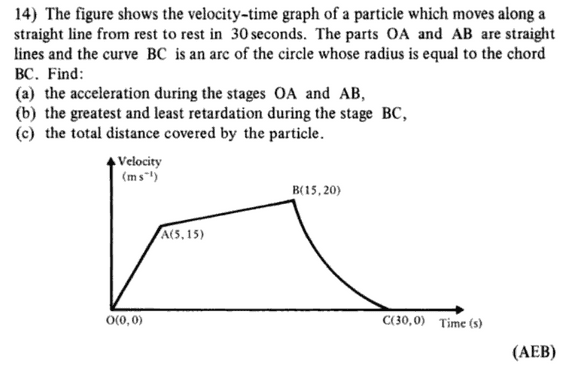
graph.png


Part (a) is no problem. Acceleration is the gradient of the graph in regions OA and AB which gives 3 and 0.5

Part (b), I believe, requires me to calculate the greatest and least value of the gradient of the curve in region BC

Part (c), I believe, requires me to calculate the area under the whole graph.

My question is, can I solve parts (b) and (c) without working out the equation of the circle? Unless I have miscalculated, the equation of the circle is not particularly simple, the centre is not nicely located on integral values of x and y.

My working was that the length of the chord is sqrt(15^2+20^2) = 25 and so to get the centre of the circle in order to find it's equation I should have to solve the following system:

(x-15)^2+(y-20)^2 = 625
(x-30)^2+y^2=625

Once I had the equation of the circle I would differentiate it to find max min gradients and integrate it to find area under it.
is this the way to go?


The answers the book gives are:

(b) (1/3)*(24 + 13*sqrt(3)) and (1/3)*(24 - 13*sqrt(3))

(c) 258

Thanks,
Mitch.
 
  • Like
Likes   Reactions: Delta2
Physics news on Phys.org
I think for (c) you definitely need the equation of the circle. I don't see any other way cause you have to integrate to find the area under the curve BC.
But for (b) I got no clue what your book means by retardation. If it means deceleration then it wants you to find the maximum and minimum of v'(t), so i think you ll have to look for solutions to the equation v''(t)=0.
 
Delta2 said:
I think for (c) you definitely need the equation of the circle. I don't see any other way cause you have to integrate to find the area under the curve BC.
If you are looking to find the area under a curve, integration is not the only approach. Geometry works too.
 
jbriggs444 said:
If you are looking to find the area under a curve, integration is not the only approach. Geometry works too.
Ok I can't disagree with that but I still think he needs to find the center of the circle in order to do it with the geometric approach.
 
Delta2 said:
Ok I can't disagree with that but I still think he needs to find the center of the circle in order to do it with the geometric approach.
The area of an equilateral triangle and the area of a 60 degree sector of a circle can both be determined without bothering about the location of the center.
 
jbriggs444 said:
The area of an equilateral triangle and the area of a 60 degree sector of a circle can both be determined without bothering about the location of the center.
Ok I think I see your approach, quite clever I should say. It involves the area of an isosceles triangle as well right?
 
Delta2 said:
Ok I think I see your approach, quite clever I should say. It involves the area of an isosceles triangle as well right?
We are given that the chord is equal to the radius. To me, that says "equilateral". But yes, I think you have grasped the scheme.
 
  • Like
Likes   Reactions: Ibix
jbriggs444 said:
We are given that the chord is equal to the radius. To me, that says "equilateral". But yes, I think you have grasped the scheme.
Besides the area of the equilateral triangle and the area of respective circular sector we also need the area of the triangle BCD into the calculations, where D the point on x-axis below B, don't we?
 
Delta2 said:
Besides the area of the equilateral triangle and the area of respective circular sector we also need the area of the triangle BCD into the calculations, where D the point on x-axis below B, don't we?
Oh, that. It is a right triangle (15, 20, 25 it looks like) not isosceles. I was just considering that as part of computing the area of a trapezoid quadrilateral -- too easy to worry about.
 
  • #10
Thanks for all the replies. Looking at part (c) I want to calculate the area under the whole graph. Can anyone see an error in this calculation? Area of 60 degree sector = (1/2)*25^2*PI/3 = 327.25. Area of equilateral triangle = (1/2)*25^2*sin(60) = 625*sqrt(3)/4 = 270.63. So area of segment 327.25 - 270.63 = 56.62. So area under circular part of graph = Area of (15,20,25) triangle - 56.62 = (1/2)*15*20 - 56.62 = 93.38 and so area under whole graph = (1/2)*5*15+150+(1/2)*10*5+93.98 = 305.88 NOT 258 :( Thanks for any help, Mitch.
 
  • #11
gnits said:
Thanks for all the replies. Looking at part (c) I want to calculate the area under the whole graph. Can anyone see an error in this calculation? Area of 60 degree sector = (1/2)*25^2*PI/3 = 327.25. Area of equilateral triangle = (1/2)*25^2*sin(60) = 625*sqrt(3)/4 = 270.63. So area of segment 327.25 - 270.63 = 56.62. So area under circular part of graph = Area of (15,20,25) triangle - 56.62 = (1/2)*15*20 - 56.62 = 93.38 and so area under whole graph = (1/2)*5*15+150+(1/2)*10*5+93.98 = 305.88 NOT 258 :( Thanks for any help, Mitch.
I can't spot any mistake in the above calculation...
 
  • #12
Thanks for checking. It's really uncharacteristic for the book I am working from to have wrong answers. When it does it's usually just an obvious sign missing or something similar. I did part (b). Can anyone confirm whether my working looks correct. Firstly I derived the equation of the circle as (x - (45/2 + 10*sqrt(3)) )^2 + (y - ( 10+15*sqrt(3)/2) )^2 = 625. It can be easily seen that the points (15,20) and (30,0) are on this circle so I am confident that this is the correct equation. Now I differentiate this to get dy/dx = (-x-(45/2)+10*sqrt(3)) / (y -10-15*sqrt(3)/2) and then I put in x = 15 and y = 20 to get the maximum gradient. This gives dy/dx = -8.3 so my answer would be 8.3 but book says (1/3)*(24 + 13*sqrt(3)) which is 15.5. Thanks for any verification or otherwise. Mitch.
 
  • #13
I ran the same numbers without looking at your calculations and got the same answer.

My notes:

Let us start with the area of a quadrilateral bounded below by the x-axis and above by:

Line segment from (0,0) to (5,15). This triangle is 5 units wide by 15 units high. Area = 5*15/2 = 37.5
Line segment from (5,15) to (15,20). The average height is (15+20)/2. Multiply by width 10. Area = 35*10/2 = 175
Line segment from (15,20) to (30,0). This triangle is 15 units wide by 20 units high. Area = 15*20/2 = 150

Add them up and we get 325+37.5 = 362.5

But we have to subtract out that crescent-shaped segment where the circular arc eats into the quadrilateral.

I get ##\frac{1}{6}\pi r^2## = 327.25 for the area of the circular sector and ##\frac{r^2\cos 30}{2}## = 270.63 for the area of the equilateral triangle. (r=25 of course). The delta is 56.62 for the crescent.

Subtract 56.62 from 362.5 and get 305.88
 
  • Like
Likes   Reactions: Delta2
  • #14
gnits said:
Thanks for checking. It's really uncharacteristic for the book I am working from to have wrong answers. When it does it's usually just an obvious sign missing or something similar. I did part (b). Can anyone confirm whether my working looks correct. Firstly I derived the equation of the circle as (x - (45/2 + 10*sqrt(3)) )^2 + (y - ( 10+15*sqrt(3)/2) )^2 = 625. It can be easily seen that the points (15,20) and (30,0) are on this circle so I am confident that this is the correct equation. Now I differentiate this to get dy/dx = (-x-(45/2)+10*sqrt(3)) / (y -10-15*sqrt(3)/2) and then I put in x = 15 and y = 20 to get the maximum gradient. This gives dy/dx = -8.3 so my answer would be 8.3 but book says (1/3)*(24 + 13*sqrt(3)) which is 15.5. Thanks for any verification or otherwise. Mitch.
Also getting 8.3 as maximum gradient by finding the centre D (22.5 + 10√3 ; 10 + 7.5√3) and hence gradients of DB and DC. Maximum gradient will be that of tangent line perpendicular to DB and minimum gradient that of tangent line perpendicular to DC.
 
  • #15
Great job you are doing. Keep it up. I really like it
 
  • #16
Thanks averybody for all of your help. I'm going with our answers and in this case assuming that the book is incorrect. Thanks again, Mitch.
 
Last edited:

Similar threads

  • · Replies 9 ·
Replies
9
Views
1K
  • · Replies 2 ·
Replies
2
Views
5K
Replies
25
Views
3K
  • · Replies 30 ·
2
Replies
30
Views
4K
  • · Replies 3 ·
Replies
3
Views
1K
Replies
1
Views
3K
  • · Replies 6 ·
Replies
6
Views
1K
  • · Replies 1 ·
Replies
1
Views
9K
Replies
6
Views
2K
Replies
7
Views
2K