Understanding a Velocity-Time Graph

  • Thread starter Thread starter PleaseAnswerOnegai
  • Start date Start date
  • Tags Tags
    Area Graph Triangle
Click For Summary

Homework Help Overview

The discussion revolves around understanding a velocity-time graph and its implications for calculating displacement. Participants explore how to interpret the areas under the graph, particularly focusing on the signs of the values when calculating areas of triangles and rectangles. The context is rooted in introductory physics concepts related to motion and displacement.

Discussion Character

  • Exploratory, Conceptual clarification, Mathematical reasoning, Assumption checking

Approaches and Questions Raised

  • Participants discuss the calculation of displacement using the areas of geometric shapes derived from the velocity-time graph. Questions arise regarding the use of negative values for height in triangles when the graph indicates negative velocity. There are inquiries about the relationship between velocity and displacement, and how to sketch a displacement vs. time graph based on the velocity-time graph.

Discussion Status

The discussion is active, with participants sharing their interpretations and seeking clarification on key concepts. Some guidance has been offered regarding the treatment of areas under the graph, and there is an ongoing exploration of how to accurately calculate displacement at specific time intervals. Multiple interpretations of the problem are being examined, particularly concerning the signs of the calculated areas.

Contextual Notes

Participants are working within the constraints of a homework assignment, which may limit the information available for discussion. There are references to potential misunderstandings regarding the definitions of displacement and velocity, as well as the implications of negative values in calculations.

PleaseAnswerOnegai
Messages
13
Reaction score
1
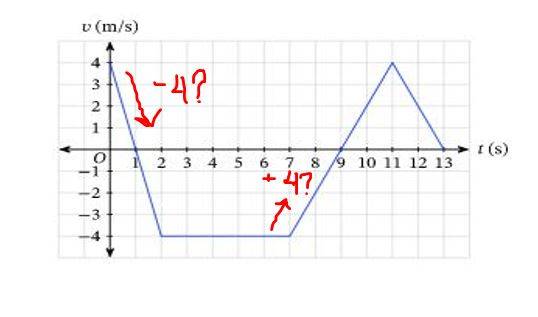
Summary:: I think we are still in the earlier parts of Physics and I am confused at how "values" work for a velocity-time graph. We are using the formulas to solve an area of a triangle and rectangle to find the total displacement. If a diagonal line begins from above and continue to go down, that denotes a negative velocity but in solving for the height of a triangle, will it also be negative?
4.JPG

For the area of triangle, we use " 1/2(b)(h) ". For the first triangle will its height be a -4 in solving, as the line is going down therefore it is decelerating, or should I use a positive 4? How about the two other triangles in the trapezoid? How about the rectangle, will its height be -4?
We were asked to solve the displacement within the time frame of (0,9) so the triangle beyond that is not a concern for me at the moment.
 
Physics news on Phys.org
What is displacement?

What is the relationship between velocity and displacement?

Can you sketch a displacement vs time graph from the velocity vs time graph?
 
PeroK said:
What is displacement?

What is the relationship between velocity and displacement?

Can you sketch a displacement vs time graph from the velocity vs time graph?
Based on my understanding:

Displacement is a scalar measurement that quantifies how far we have gone from an original point/place/position relative to direction as opposed to Distance which simply measures, well, total "distance."

Similarly, velocity takes into account direction. And its relationship with displacement tells us how fast you have gone in any specified direction relative to where you began.

That is why we can have negative velocity and displacement as that would mean you went the "opposite direction"; backward instead of forward.

I think yes, once you've found the displacement.

I may be wrong but please correct me, thank you very much.
 
PleaseAnswerOnegai said:
Based on my understanding:

Displacement is a scalar measurement that quantifies how far we have gone from an original point/place/position relative to direction as opposed to Distance which simply measures, well, total "distance."

Similarly, velocity takes into account direction. And its relationship with displacement tells us how fast you have gone in any specified direction relative to where you began.

That is why we can have negative velocity and displacement as that would mean you went the "opposite direction"; backward instead of forward.

I think yes, once you've found the displacement.

I may be wrong but please correct me, thank you very much.
Displacement is a vector quantity. Distance is a scalar.

Velocity is the rate of change of displacement.

For your example, calculate:

The displacement at ##1s, 2s, 3s##.
 
Pardon me, I mixed them up.
 
In solving of the triangle, should my solution be 1/2(1)(-4)?
 
PleaseAnswerOnegai said:
In solving of the triangle, should my solution be 1/2(1)(-4)?
PeroK said:
For your example, calculate:

The displacement at ##1s, 2s, 3s##.

Why don't you calculate the displacement at ##1s, 2s, 3s##?

If in doubt calculate!
 
PeroK said:
Why don't you calculate the displacement at ##1s, 2s, 3s##?

If in doubt calculate!
Would the displacement at 1s be 2 cm?
 
PleaseAnswerOnegai said:
Would the displacement at 1s be 2 cm?
Why ##cm##?
 
  • #10
PeroK said:
Why ##cm##?
I'm really sorry, I meant 2m. Would that be correct?
 
  • #11
PleaseAnswerOnegai said:
I'm really sorry, I meant 2m. Would that be correct?
Yes.
 
  • #12
And at 2s, the displacement would be 0m because of 2m + (-2m)?
 
  • Like
Likes   Reactions: PeroK
  • #13
PleaseAnswerOnegai said:
And at 2s, the displacement would be 0m because of 2m + (-2m)?
Yes. In summary:

When the velocity is positive, the graph is above the ##t## axis and area represents a positive displacement. Regardless of the sign of the acceleration.

When the velocity is negative, the graph is below the ##t## axis and area represents a negative displacement.

Note: if you have studied calculus, the integral takes care of this for you. If you integrate a velocity vs time function, then the integral automatically calculates anything below the ##t## axis as negative.

If you calculate the areas by hand, you have to put in the negative signs for anything below the ##t## axis.

Note that that signs on your original diagram were the wrong way round. As you now know.
 
  • #14
PeroK said:
Yes. In summary:

When the velocity is positive, the graph is above the ##t## axis and area represents a positive displacement. Regardless of the sign of the acceleration.

When the velocity is negative, the graph is below the ##t## axis and area represents a negative displacement.

Note: if you have studied calculus, the integral takes care of this for you. If you integrate a velocity vs time function, then the integral automatically calculates anything below the ##t## axis as negative.

If you calculate the areas by hand, you have to put in the negative signs for anything below the ##t## axis.

Note that that signs on your original diagram were the wrong way round. As you now know.
Thank you very much! This helps me greatly. And I have taken Calculus, that would make sense. Thank you again and have a nice day :)

Oh, and I wouldn't want to get complacent hahaha, upon calculating: the total displacement in 9s would be -24m, correct?
 
  • #15
PleaseAnswerOnegai said:
Oh, and I wouldn't want to get complacent hahaha, upon calculating: the total displacement in 9s would be -24m, correct?
Correct.

If you make separate triangles for times where the velocity is positive and regions where it is negative then it's easier to keep track of the signs.

In some cases symmetry arguments work as well. Between t=0 and t=2 for example: As you see both triangles cancel each other to get 0 displacement. Knowing the area of the triangles isn't important as long as you know the areas are the same (but on opposite sides of the x axis).
 

Similar threads

  • · Replies 11 ·
Replies
11
Views
3K
Replies
12
Views
5K
Replies
5
Views
3K
  • · Replies 4 ·
Replies
4
Views
4K
  • · Replies 7 ·
Replies
7
Views
2K
  • · Replies 23 ·
Replies
23
Views
3K
  • · Replies 4 ·
Replies
4
Views
2K
Replies
40
Views
3K
  • · Replies 10 ·
Replies
10
Views
18K
Replies
6
Views
2K