Acceleration of objects connected by pulley on rough inclined plane

Click For Summary

Homework Help Overview

The discussion revolves around the acceleration of two masses connected by a pulley on a rough inclined plane. The original poster is attempting to determine the acceleration of the system while considering the effects of friction and the direction of motion.

Discussion Character

  • Exploratory, Assumption checking, Problem interpretation

Approaches and Questions Raised

  • The original poster presents equations based on different assumptions about the direction of motion and seeks clarification on the relationship between the two scenarios. Participants question the validity of combining different sign conventions and the implications of negative acceleration.

Discussion Status

Participants are actively exploring the implications of their assumptions regarding direction and friction. Some guidance has been offered regarding the treatment of acceleration and the need to reconsider assumptions when negative values arise. There is no explicit consensus on the correct approach yet.

Contextual Notes

Participants note the complexity introduced by frictional forces and the potential for static equilibrium, which complicates the determination of direction and magnitude of acceleration. The discussion reflects a learning environment where assumptions and interpretations are being critically examined.

songoku
Messages
2,512
Reaction score
394
Summary:: Please see the picture below
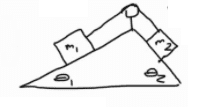
1613207689275.png

Let say:
##W_1## is weight of ##m_1##
##W_2## is weight of ##m_2##
##f_1## is friction on ##m_1##
##f_2## is friction on ##m_2##

I want to find the acceleration of the system. Since I don't know in which direction they will move, I just assume ##m_1## will move downward, so

$$a=\frac{W_1 \sin \theta_1-W_2 \sin \theta_2 -f_1-f_2}{m_1+m_2}...(1)$$

If the value of ##a## is negative, this means that actually ##m_1## moves upward.

My teacher said the value of the acceleration will be the same, just the direction will be opposite. But when I tried doing it, I didn't reach that conclusion.

If ##m_1## moves upward:
$$a=\frac{W_2 \sin \theta_2-W_1 \sin \theta_1 -f_1-f_2}{m_1+m_2}...(2)$$

Equation (2) is not negative of equation (1)

Where is my mistake? Thanks
 
Physics news on Phys.org
songoku said:
My teacher said the value of the acceleration will be the same,
It has to be, if the string doesn't stretch.

songoku said:
Where is my mistake? Thanks
You only need one equation because there is only one acceleration. Combining Equations (1) and (2) makes no sense, because they use different sign conventions. Use (1) or (2).
 
  • Like
Likes   Reactions: songoku
I just tried with random number. Let say:
##m_1## = 10 kg
##m_2## = 5 kg
##\theta_1=30^0##
##\theta_2 = 45^0##
##\mu_k=0.1## for both objects

1) I assume ##m_1## moves upwards
Equation for ##m_1##:
$$\Sigma F=m.a$$
$$T-m_1.g \sin \theta_1 - \mu_k . m_1.g \cos \theta_1 = m_1.a$$
$$T=10a+57.546$$

Equation for ##m_2##:
$$\Sigma F=m.a$$
$$m_2.g \sin \theta_2 - T - \mu_k.m_2.g \cos \theta_2 = m_2.a$$
$$34.6836-10a-57.546-31.215=5a$$
$$a=-3.61 ms^{-2}$$

Since the acceleration is negative, ##m_1## actually moves downwards and I redo the working, changing the direction of friction and expecting to get ##a=3.61 ms^{-2}##

2) ##m_1## actually moves downwards
Equation for ##m_1##:
$$\Sigma F = m.a$$
$$m_1 .g \sin \theta_1 - T - \mu_k .m_1 .g \cos \theta_1=m_1.a$$
$$T=40.554 - 10a...(1)$$

Equation for ##m_2##:
$$\Sigma F=m_2.a$$
$$T - m_2.g \sin \theta_2 - \mu_k . m_2.g \cos \theta_2=m_2.a$$
$$40.554 -10a-34.6836-3.4684=5a$$
$$a=0.16~ms^{-2}$$

I do not get 3.61 ms-2, like what I expect when getting the negative acceleration. That's why I think if I get negative value for acceleration, I need to redo all my working, not simply use the same magnitude of acceleration.

Something wrong with my working? Thanks
 
songoku said:
Where is my mistake?
Your mistake is in undue trust in your teacher's remarks.

When there's a frictional force that could act either way involved, you cannot just suppose the acceleration to be in one direction then, on getting a negative answer, just assume that is the right magnitude but the acceleration has opposite direction from what you supposed.

E.g. consider the case in which the two W sin terms nearly balance and the max frictional forces are enough to hold matters static. Whichever way you suppose it slips you will get a negative answer.
 
Last edited:
  • Like
Likes   Reactions: songoku and Lnewqban
songoku said:
...
If the value of ##a## is negative, this means that actually ##m_1## moves upward.
You could assume that with a velocity, but not with a rate of change, which is what an acceleration is.
Negative rate always means that the value is decreasing.
A negative acceleration always means that the mass is slowing down.

I like to simplify this type of problems as two masses sliding on a horizontal surface, while attached to each other by a string.

F11AC309-868E-4591-AB7A-8BCD7FB1FC51.jpeg
 
  • Like
Likes   Reactions: songoku
Thank you very much A.T. , haruspex, Lnewqban
 
  • Like
Likes   Reactions: Lnewqban

Similar threads

  • · Replies 18 ·
Replies
18
Views
2K
  • · Replies 22 ·
Replies
22
Views
2K
  • · Replies 4 ·
Replies
4
Views
1K
  • · Replies 30 ·
2
Replies
30
Views
4K
Replies
25
Views
3K
  • · Replies 29 ·
Replies
29
Views
4K
  • · Replies 10 ·
Replies
10
Views
2K
  • · Replies 68 ·
3
Replies
68
Views
14K
  • · Replies 6 ·
Replies
6
Views
1K
Replies
1
Views
1K