Acceleration with inclined ramp (Frictionless)

Click For Summary
SUMMARY

The acceleration of a skateboard down a frictionless ramp inclined at 19.5 degrees is calculated using the equation a = g sin(θ), resulting in an acceleration of 3.271 m/s². The confusion arises from the misconception that the formula should be g divided by sin(θ), which would yield an incorrect value exceeding the gravitational constant of 9.81 m/s². The correct interpretation involves understanding that g sin(θ) represents the gravitational component acting along the incline. Visual aids, such as vector diagrams, can clarify this concept effectively.

PREREQUISITES
  • Understanding of basic physics concepts, particularly Newton's laws of motion.
  • Familiarity with trigonometric functions, specifically sine.
  • Knowledge of gravitational acceleration (g = 9.81 m/s²).
  • Ability to interpret vector diagrams in physics.
NEXT STEPS
  • Study the derivation of inclined plane motion equations in classical mechanics.
  • Learn about the role of friction in inclined plane problems.
  • Explore advanced topics in dynamics, such as forces on inclined planes.
  • Review vector decomposition techniques in physics for better understanding of forces.
USEFUL FOR

Students of physics, educators teaching mechanics, and anyone interested in understanding motion on inclined planes without friction.

Sinusoidal
Messages
7
Reaction score
0
1. What is the acceleration of a skateboard down a ramp inclined at 19.5 degrees to the horizontal?

3.271 is the answer.


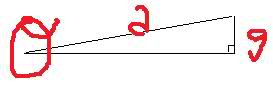
2. I know g Sin\vartheta is the equation to get it, but I don't get why it isn't g divided by Sin\vartheta


3. In my head I thought the picture was like this:
2wew8bq.jpg


I know this should be something super easy, so please explain. haha
 
Physics news on Phys.org
g sin theta gives you the component of the acceleration of gravity along the incline.
g/sin theta would give you a number larger than 9.81m/s^2 which would make absolutely no sense.
 
hp-p00nst3r said:
g sin theta gives you the component of the acceleration of gravity along the incline.
g/sin theta would give you a number larger than 9.81m/s^2 which would make absolutely no sense.

Right, but the first statement still confuses me. Is there a picture you could go by for this?
 
This should help you

http://img145.imageshack.us/img145/6905/accelerationvectorgh9.jpg
 
Last edited by a moderator:
Okay, that totally makes sense now. Thanks! :)
 

Similar threads

  • · Replies 7 ·
Replies
7
Views
1K
Replies
15
Views
2K
  • · Replies 6 ·
Replies
6
Views
2K
  • · Replies 18 ·
Replies
18
Views
6K
Replies
11
Views
1K
  • · Replies 2 ·
Replies
2
Views
3K
  • · Replies 10 ·
Replies
10
Views
3K
  • · Replies 5 ·
Replies
5
Views
2K
  • · Replies 16 ·
Replies
16
Views
5K
  • · Replies 2 ·
Replies
2
Views
1K