Accelerometer vs. Gyroscope - measuring torque

Click For Summary

Homework Help Overview

The discussion centers around the comparison of accelerometers and gyroscopes in the context of measuring torque. Participants explore the principles behind each sensor type and their respective advantages and disadvantages in this application.

Discussion Character

  • Exploratory, Conceptual clarification, Assumption checking

Approaches and Questions Raised

  • Participants discuss the correctness of using accelerometers and gyroscopes to measure torque, raising questions about the pros and cons of each method. There is also exploration of the effects of drift in measurements and how it relates to torque measurement.

Discussion Status

The discussion is ongoing, with participants sharing insights about the characteristics of accelerometers and gyroscopes. Some have provided background information relevant to homework, while others are seeking further clarification and assistance on combining the two sensor types for improved accuracy.

Contextual Notes

Participants note that the discussion is related to homework, which may impose certain constraints on the depth of exploration. There is an emphasis on understanding the trade-offs between the two sensor types and their application in measuring torque.

HarryLime
Messages
3
Reaction score
0
Summary:: accelerometer Vs gyroscope - measuring torque

Torque can be measured with an accelerometer (tangential-acceleration):
t = F*r and F=m*a, so we get a from the accelerometer, giving:
t = m*a*r Nm

Torque can be measured with an gyroscope (angular-acceleration):
t = F*r
The relationship between tangential (a) to angular (omega) acceleration:
[OK gyroscope gives angular-velocity, so differentiate this once and you get angular-acceleration]
a = omega*r m / s^2
Giving:
t = m*(omega*r)*r = m*r^2 * omega
or if we include the moment of inertia:
t = I*omega

Questions:
[1] Is the assessment correct, Torque can be measured with an accelerometer OR with a gyroscope?
[2] what are the pros and cons of either method?

This seems to sum it up nicely:
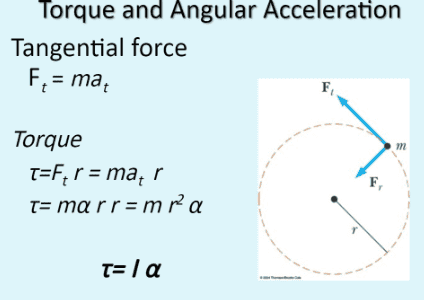
Capture.PNG
 
Physics news on Phys.org
Welcome to PhysicsForums. :smile:
HarryLime said:
Summary:: accelerometer Vs gyroscope - measuring torque

Questions:
[2] what are the pros and cons of either method?
What are your thoughts? I can think of several tradeoffs, but we want to hear your thoughts first.

Is this a schoolwork question?
 
berkeman said:
Welcome to PhysicsForums. :smile:

What are your thoughts? I can think of several tradeoffs, but we want to hear your thoughts first.

Is this a schoolwork question?

Thanks berkeman, Yes this is background for homework! statements, pros & cons -
1. Accelerometer give signal based on linear acceleration or tangential if at the edge of a spinning obj (like the drawing above) - So accelerometers react to linear/tangential forces, which also include Gravity. They suffer from drift (good in the short term but very noisy in the long term due to additive error), noise (any acceleration effects the sensors).

2. Gysroscope give a signal based on angular velocity, like the spinning obj above - So gyroscopes react to rotational motion. They seem to suffer from drift & lag, though I'm unclear as to why. They are also more prone to temperature dependencies (?)

3. Both gyro & acc are often fused to to offset the other's noise and drift errors, providing more accuracy. So they are complementary.

This could do with more - assistance welcomed. how would I tie/combine these sensors together?
 
HarryLime said:
So accelerometers react to linear/tangential forces, which also include Gravity. They suffer from drift (good in the short term but very noisy in the long term due to additive error),
...
So gyroscopes react to rotational motion. They seem to suffer from drift
How is drift relevant, if you are trying to measure torque?
 
A.T. said:
How is drift relevant, if you are trying to measure torque?
yes
 
HarryLime said:
yes
That wasn't a yes/no question.
 
A linear accelerometer is not a good way to measure rotational motion because position relative to axis is a direct requirement. The rotational sensors have no such requirement and simply report any change in angular velocity regardless of linear velocity or acceleration. The MEMS sensors are quite remarkable.
What do you mean by a gyroscope?? Does anyone use them any more?
 
hutchphd said:
Does anyone use them any more?
They're a reasonably decent way of keeping smaller aircraft from landing ahead of schedule.
 

Similar threads

  • · Replies 33 ·
2
Replies
33
Views
3K
  • · Replies 17 ·
Replies
17
Views
1K
Replies
335
Views
17K
Replies
2
Views
886
  • · Replies 6 ·
Replies
6
Views
2K
  • · Replies 12 ·
Replies
12
Views
2K
  • · Replies 13 ·
Replies
13
Views
1K
Replies
15
Views
2K
  • · Replies 32 ·
2
Replies
32
Views
3K
  • · Replies 11 ·
Replies
11
Views
2K