tophernuts
- 3
- 0
1. If the problem statement, all variables and given/known data
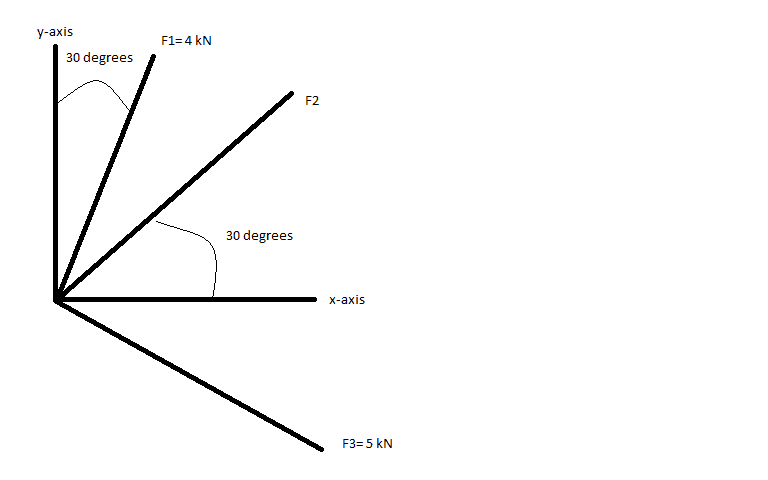
The resultant force acting is directed along the positive x-axis, determine the magnitudes of F2 and the resultant force
And that F3x=4 and that F3y=3 (its a right angle 3-4-5 triangle)
F1=F1x +F1Y
F2=F2x +F2Y
F3=F3x +F3Y
F1y= 4cos(30) = 3.464
F3y=3
And since the resultant force is along the x-axis, the resultant y force (Fry) would therefore have to equal 0.
But when you run the numbers:
Fry=F1Y+F2Y+F3Y
Fry=(+3.464)N + (-3)N + F2y
F2y= -0.464
xsin30=-0.464
x=-0.464/sin30
x=-0.928
But that is impossible because F2 is above the x-axis and therefore couldn't have a negative y value.
This is where I am currently stuck, if it would work out i could figure out the resultant of F2y and F2x which would be F2, and the find out the resultant of all three from there on.Thank you in advance,
Chris
The resultant force acting is directed along the positive x-axis, determine the magnitudes of F2 and the resultant force
And that F3x=4 and that F3y=3 (its a right angle 3-4-5 triangle)
Homework Equations
F1=F1x +F1Y
F2=F2x +F2Y
F3=F3x +F3Y
The Attempt at a Solution
F1y= 4cos(30) = 3.464
F3y=3
And since the resultant force is along the x-axis, the resultant y force (Fry) would therefore have to equal 0.
But when you run the numbers:
Fry=F1Y+F2Y+F3Y
Fry=(+3.464)N + (-3)N + F2y
F2y= -0.464
xsin30=-0.464
x=-0.464/sin30
x=-0.928
But that is impossible because F2 is above the x-axis and therefore couldn't have a negative y value.
This is where I am currently stuck, if it would work out i could figure out the resultant of F2y and F2x which would be F2, and the find out the resultant of all three from there on.Thank you in advance,
Chris
