Discovering Train Friction: Measuring Aerodynamics on Rails

Click For Summary
SUMMARY

This discussion focuses on measuring the friction of a train with its rails and the air, emphasizing empirical methods for calculation. Key methods include observing the train's deceleration after cutting off power to measure friction and air drag, and analyzing the power required to maintain a constant cruising speed. Important factors include rolling resistance, primarily from axle bearing friction, and the impact of speed on drag force and power requirements. The discussion also highlights the need for specific train parameters to achieve accurate calculations.

PREREQUISITES
  • Understanding of basic physics principles related to friction and drag
  • Familiarity with empirical measurement techniques
  • Knowledge of power calculations in mechanical systems
  • Basic understanding of Reynolds number and its significance in fluid dynamics
NEXT STEPS
  • Research the equations for calculating drag force and power requirements in moving vehicles
  • Study the effects of temperature on grease viscosity and bearing friction
  • Explore the concept of Reynolds number and its application in aerodynamics
  • Investigate the differences in rolling resistance for various types of trains, such as passenger and freight
USEFUL FOR

Engineers, physics students, and professionals in the transportation industry seeking to understand the dynamics of train friction and aerodynamics.

konbakas
Messages
2
Reaction score
0
Summary:: How can I measure the friction of a train with its rails and the air.

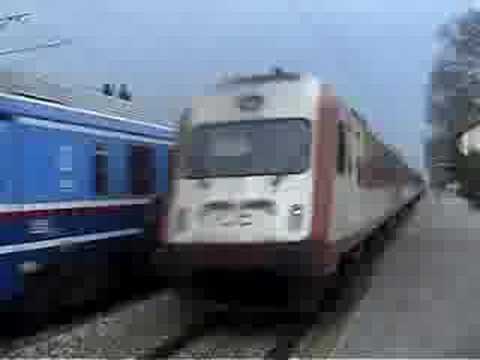
How can I measure the friction of a train with its rails and the air. You can assume that the face of the train is like the picture below.
If you need any specifications just let me know
hqdefault.jpg
 
Physics news on Phys.org
Welcome to Physics Forums. :welcome:

Your question sounds much like homework, so I moved it to this homework forum.

Before our homework helpers help, tell us how you would solve this problem. Clearly, your teacher thinks that you should be able to do it.
 
Does this post help?

Though, I'm not sure if this empirical method is meant to work with trains.
 
anorlunda said:
Welcome to Physics Forums. :welcome:

Your question sounds much like homework, so I moved it to this homework forum.

Before our homework helpers help, tell us how you would solve this problem. Clearly, your teacher thinks that you should be able to do it.
Thank, but that's not an assigned homework, its more like me trying to figure out a thought experiment. But I have nearly no experience in air-friction calculations, so I was hoping someone could enlight me in the mathematic formulas on this field or the thought process behind solving this kind of problem.
 
OK. One way to do it experimentally is to start with the train traveling at a known speed on level track. Then cut off the driving power, and observe how rapidly it slows down. The only thing that slows it down is friction and air drag (drag can be considered friction also).
 
  • Like
Likes   Reactions: berkeman
Another way is to find out how much power it takes to keep moving the train at a constant cruising speed. That energy input is what it takes to overcome rolling resistance and air resistance. Look into what the supplied voltage is for the electric train, and what the typical current consumption is at different speeds.

BTW, there is very little rolling resistance for steel wheels on steel rails. Instead, the primary "rolling resistance" will likely be from bearing friction in the axles and wheels, and any other friction losses in the drive train.
 
  • Like
Likes   Reactions: Lnewqban
You can get a really really ball park answer by using some basic formula.
https://www.engineeringtoolbox.com/drag-coefficient-d_627.html
https://www.engineeringtoolbox.com/rolling-friction-resistance-d_1303.html

Of course, all the the tabulated drag coefficients and rolling resistance coefficients are general.
For the train, they do do not mention what type of train - passenger, freight, loaded, high sped, The Bullet, length, velocity.. so any answer you get is most likely very general in scope if you use the numbers given.
At least you could work through an example just to play around.

Note that while the drag force equation has a v squared term, the power the train needs has a v cubed term ( force times velocity gives the power )

You can look up skin friction, and some of these other terms -Reynolds number - to explore further if you choose.

For the axle bearings, of the journal type, where the axle slides on a layer of grease, you can perhaps investigate that area also. And perhaps find something on how temperature affects the viscosity of the grease and subsequently the bearing friction. You may have noticed your car, if you drive, uses more fuel in the winter, and one reason is that colder oil/grease is more viscous at colder temperatures, and the bearings take longer to warm up in winter.

Engineering wise you won't get anywhere near an exact answer as you do not have all the pertinent information about your train.
 
konbakas said:
Thank, but that's not an assigned homework, its more like me trying to figure out a thought experiment. But I have nearly no experience in air-friction calculations, so I was hoping someone could enlight me in the mathematic formulas on this field or the thought process behind solving this kind of problem.
Welcome, konbakas!
Please, see:

https://www.mech.kth.se/courses/5C1211/Orellano_2010.pdf

:cool:
 
  • Informative
Likes   Reactions: berkeman

Similar threads

Replies
8
Views
3K
  • · Replies 36 ·
2
Replies
36
Views
3K
  • · Replies 1 ·
Replies
1
Views
3K
Replies
18
Views
3K
Replies
1
Views
2K
  • · Replies 6 ·
Replies
6
Views
3K
  • · Replies 4 ·
Replies
4
Views
1K
Replies
4
Views
2K
  • · Replies 40 ·
2
Replies
40
Views
4K
  • · Replies 19 ·
Replies
19
Views
3K
